
Oil shock lifts EV interest as weak spending caps sales growth
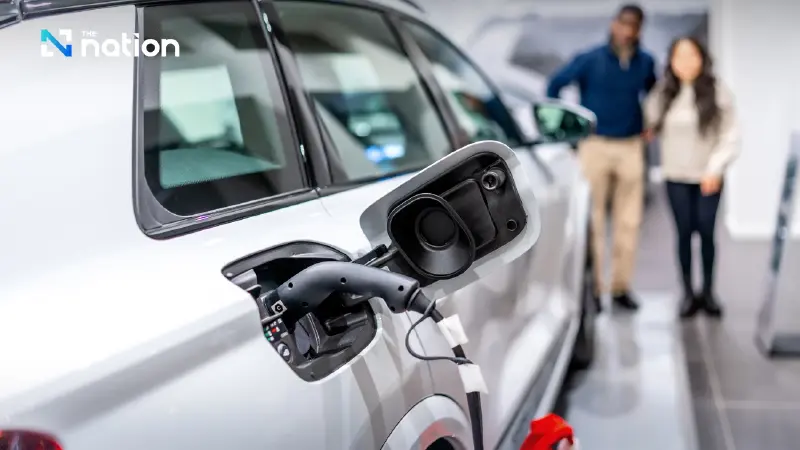


Executives say rising oil prices may support EV momentum in the near term, but weak purchasing power and credit curbs continue to restrain the market.
- Rising oil prices, driven by geopolitical tensions in the Middle East, are expected to increase consumer interest and bookings for electric vehicles (EVs).
- Despite this potential interest, overall vehicle sales are being suppressed by weak domestic purchasing power, stricter lending policies, and consumers delaying purchase decisions.
- Domestic EV sales have actually declined by 18.56%, partly due to the end of government support measures, showing that increased interest has not translated into sales growth.
- Industry leaders believe any boost in EV demand from the oil shock will be limited and potentially short-lived, with the broader economic impact of the conflict being a greater concern.
Thailand’s automotive industry has started to show signs of recovery in production and exports, but it remains under pressure from weak domestic purchasing power and uncertainty stemming from geopolitical factors, particularly tensions in the Middle East.
Compared with Thai vehicle production over the past 10 years, the industry has yet to recover to previous levels.
In 2018, Thailand produced 2.17 million vehicles, the highest level in the past decade.
Most recently, however, output in 2025 stood at only 1.45 million units, marking a continued decline since 2023 after financial institutions tightened lending, even though 90% of vehicle purchases in Thailand are made on credit.
Surapong Paisitpatanapong, adviser to the chairman and spokesperson for the Automotive Industry Club of the Federation of Thai Industries (FTI), said Thailand’s automotive industry in February 2026 had started to recover on the production and export fronts, but continued to face pressure from domestic purchasing power and geopolitical risks, particularly tensions in the Middle East.

The Middle East is Thailand’s third-largest car export market, accounting for 21.17% of the total.
Although exports to the Middle East in February 2026 remained in positive territory, problems have begun to emerge, with vehicles bound for the region reaching the Strait of Hormuz but not daring to pass through, instead stopping in India and Singapore.
Vehicle exports in February totalled 81,195 units, down slightly by 0.05%, effectively flat.
In 2025, Thailand exported 200,001 vehicles to the Middle East, up 0.61% from 2024, with a value of more than THB120 billion.
Pickup trucks accounted for the largest share at 114,644 units, followed by passenger cars at 61,958 units and PPVs at 23,359 units.
Tensions involving the United States, Israel and Iran remain a key factor to watch, as they affect energy prices, freight costs and confidence in global markets.
Watching for a shift towards EVs amid the oil crisis
Vehicle production in February stood at 117,952 units, up 3.43% from a year earlier, although slightly down from the previous month.
The main support came from a 22.83% increase in passenger car production for export and a 55.98% jump in pickup truck production for domestic sale.
As a result, total production in the first two months of 2026 reached 236,338 units, up 6.87%.
Meanwhile, electric vehicle production recorded standout growth. Battery electric passenger car output reached 3,846 units, up 71.54%, while electric pickup truck output totalled 460 units, up 100%, although both still accounted for a small share compared with internal combustion engine and hybrid vehicles.
“Fighting involving Iran has pushed up oil prices, and if filling stations run short of fuel, EV bookings from now on, or at the motor show currently being held in Thailand, could increase, so this needs close monitoring.”
Consumers delay purchase decisions
The domestic market remains sluggish, with vehicle sales at 48,242 units, down 2.17% from a year earlier.
The main factors were low economic growth, stricter lending by financial institutions, consumers delaying purchase decisions, and unclear government policy, compounded by inflationary pressure arising from higher energy prices.
Although EV production expanded strongly, domestic sales declined.
Battery electric vehicle sales stood at 6,168 units, down 18.56%, mainly due to the end of EV 3.0 support measures.
Hybrid electric vehicles continued to grow, while plug-in hybrid electric vehicles contracted sharply, reflecting consumers’ preference for more flexible technology during the transition.
Auto parts stockpile enough for 3 months
Surapong said manufacturers currently had enough parts in stock for three months of production and had not yet raised vehicle prices.
However, if the situation drags on and logistics and raw material costs rise, prices may have to be adjusted in future, particularly as freight rates on some routes have already tripled.
There is also a risk of chip shortages if supply chains are affected by the conflict.
In the short term, the industry has not revised its production and export target of 1.5 million units, and will reassess the situation again at mid-year once market direction becomes clearer.
The overall picture reflects an “uneven recovery” for Thailand’s automotive industry in 2026.
While production and exports are beginning to recover, the domestic market remains weak, and the shift towards EVs continues to face constraints from policy measures and purchasing power, amid economic and geopolitical uncertainty that may prove decisive for the industry’s direction in the period ahead.
Oil may lift the EV market only slightly, but war is not expected to drag on
Pongsak Lertruedeewattanavong, Vice President of MG Sales (Thailand) Company Limited, said war and higher oil prices could lift demand for electric vehicles to some extent, but not by much.
He expected the overall market this year to remain close to 2025 levels at around 120,000 units, partly because the EV 3.0 measure has ended.
Any boost from higher oil prices was likely to be short-lived, he said, while the wider impact would be felt across the market and in costs for all industries, as many believe the war is unlikely to drag on because it is affecting the whole world, and efforts will have to be made to bring it to an end.
Only if the fighting lasts beyond three months would a fresh assessment be needed.
Wallop Chalermvongsavej, Managing Director of Hyundai Mobility (Thailand) Co., Ltd., said the conflict would certainly affect the business sector, including transport, while higher oil prices would raise production and transport costs and could also lead to shortages of raw materials or parts because of shipping disruptions.
As for the broader impact of rising energy prices, he said that in the long term, the effects would not be limited to internal combustion engine vehicles, as EVs would also be affected by future increases in electricity prices.
However, in his personal view, what was more worrying at present than the rise in oil prices was public anxiety, which had begun to affect purchases of both cars and other goods.
If this continued, it would worsen the situation and bring forward the severity of the impact.
He said that if everyone continued living as normally as possible, it would help reduce the severity of the impact.
Even so, he believed the war and the conflict were unlikely to drag on.
Noriaki Yamashita, President of Toyota Motor Thailand Co., Ltd., said the war would certainly affect the car market, but it was still difficult to assess because it had only just begun, and it was not yet known whether it would end quickly or drag on.
One impact already being felt was on transport, as the Middle East is one of Thailand’s largest car export markets and also a major market for Toyota.
In 2025, Toyota exported 100,000 vehicles to the Middle East.
At the same time, the region is a source of key imported raw materials such as resin used to make parts.
However, Toyota, with its global network, would move quickly to solve the problem, and he believed it could handle the situation in a similar way to the microchip shortage in the past.
