
Anutin to unveil Thailand's economic strategy as energy turmoil grows
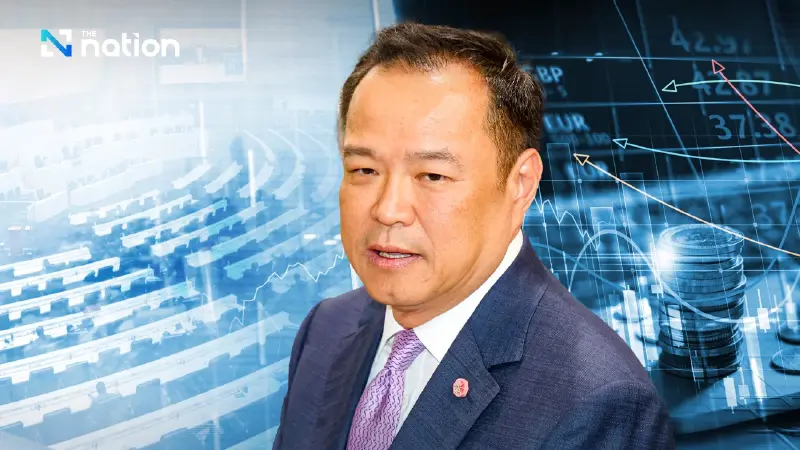


Anutin Charnvirakul will brief Parliament on April 9-10 on the government’s economic direction, with energy, trade, farming, SMEs, AI and tourism in focus.
- Prime Minister Anutin Charnvirakul will unveil a five-pronged economic strategy to address growing energy turmoil and lift Thailand out of the middle-income trap.
- The plan is a response to rising global energy prices caused by conflict in the Middle East, with immediate government actions focused on managing fuel supplies, promoting biofuels, and controlling costs for key production inputs like fertilizer.
- The five core strategies focus on: inclusive growth, restructuring the economy through innovation and technology, proactive international trade, precision agriculture, and high-value tourism.
- Long-term goals underpinning the strategy include securing membership in the Organisation for Economic Co-operation and Development (OECD) and achieving Net Zero greenhouse gas emissions by 2050.
Prime Minister Anutin Charnvirakul is scheduled to deliver the government’s policy statement to Parliament before assuming full authority to administer the country in accordance with constitutional procedures, on April 9-10, 2026.
The key economic policy directions are as follows:
In recent months, the government has administered the country amid uncertainty on multiple fronts, including the economy, society, politics, international relations and global geopolitics.
It has pushed forward several urgent Quick Big Win policies, notably economic stimulus through the Let's Go Halves Plus, measures to ease the public’s cost burden, efforts to resolve the Thailand-Cambodia dispute and protect national sovereignty, an intensified crackdown on scammers and drugs, stronger safety measures and proactive communication to restore confidence among tourists, and the removal of bottlenecks to stimulate private investment from both domestic and foreign investors.

The government has also accelerated trade negotiations and the push into new high-potential markets, added value to agricultural products, and removed the de minimis threshold while collecting duties on imported goods in order to create fairness for products made in Thailand.
It is also pushing for Thailand to become a member of the Organisation for Economic Co-operation and Development (OECD) to attract foreign trade and investment.
It has also declared that Thailand will achieve Net Zero greenhouse gas emissions by 2050 to respond more quickly to international trade requirements and climate change.
In recent months, the government has been able to restore public confidence and drive the Thai economy, which had been stuck in a rut, back to a stronger-than-expected expansion in the fourth quarter of 2025, in line to deliver the short-term stimulus, long-term results and broad-based distribution.
Middle East situation drives energy prices higher
However, the world is now in a period of heightened uncertainty as a result of the severe conflict in the Middle East, which has disrupted the production and transport of the world’s crude oil and natural gas.
The volume of crude oil and natural gas in the global market has fallen against demand, causing fuel and energy prices to fluctuate, with prices showing a tendency to rise sharply and rapidly.
This is affecting economic systems, international trade and energy procurement in countries around the world, including Thailand, and it cannot be predicted when the situation will end or in what direction it will move.
In the period so far, the government has made efforts to manage the situation and ease the impact on the Thai people through the state mechanisms available within the powers and duties of a caretaker administration, such as upgrading consular services to protect and assist Thais overseas and ensuring sufficient fuel supplies to meet domestic demand.
Watching the impact on agricultural production inputs
The government is also managing key production inputs in both the industrial and agricultural sectors that have been affected by the conflict, particularly raw materials and production inputs whose costs are tied to energy prices, such as chemical fertiliser, industrial chemicals and petrochemical feedstock, so that businesses and farmers do not have to shoulder rising costs to the point that it affects the country’s production capacity and competitiveness.
Energy-saving measures must be pursued
The government is managing fuel and energy prices alongside efforts to increase the share of biofuels in order to reduce oil imports from abroad. At the same time, this will help increase demand for agricultural products and agricultural waste materials, which in turn will generate income for Thai farmers.
It is also implementing energy-saving measures in state agencies.
Five strategies to lift Thailand out of the middle-income trap
To lay the foundations for the Thai economy amid global geopolitical volatility, the government has proposed five core strategies to drive Thailand beyond the middle-income trap and create sustainable growth, as follows:
1. Creating opportunities and equitable growth (Inclusive Growth)
The government will focus on helping ordinary people, especially SMEs and low-income earners, by resolving debt problems in a comprehensive and holistic way, with debtors placed at the centre and linked databases across all sectors used to help people return to the formal credit system.
It will also reduce living costs, such as the cost of clean drinking water and energy.
In addition, it will build on the Let's Go Halves Plus scheme alongside the development of digital and AI skills, give Thai SMEs under the Made in Thailand policy an advantage in state procurement, and push for a “Hometown Tax” law to decentralise fiscal power to local areas.
2. Restructuring the economy through innovation and future technologies
The government will create new economic engines by focusing on digital industries, AI, robotics, semiconductors and clean energy.
It will upgrade universities into innovation hubs to develop deep tech and reduce dependence on foreign technology, while establishing a Matching Fund to nurture Thai start-ups onto the global stage and making the money and capital markets more transparent so that they can serve as funding sources for businesses of all sizes.
3. Proactive trade: linking Thailand to the global economy
The government will build trade partnerships through Team Thailand to open new markets and advance free trade agreements (FTAs).
It will tighten checks on rules of origin to prevent low-quality imports and deal seriously with the nominee problem in order to protect Thai entrepreneurs.
It will also promote trade in services in the fields of education, health and the creative economy so that Thailand has greater resilience against global economic volatility.
4. Precision agriculture
The government will shift from traditional farming to precision agriculture by using AI and Big Data in production planning and weather forecasting.
It will support farmers through an interest co-payment scheme for the purchase of high-quality production inputs, while pushing Thailand to become a global food security hub, cracking down on illicit agricultural goods and promoting domestic fertiliser production in order to stabilise costs.
5. High-value tourism and a world-class destination
The government will restructure the sector through cultural diplomacy by linking the tourism mission with cultural work in order to strengthen the country’s image.
It will push Thailand to become a 365-day destination under Destination Thailand, with a focus on wellness tourism and support for digital nomads who can work from anywhere, while also upgrading safety through strict law enforcement and a mandatory insurance and health coverage system for tourists.
All of these policies build on the urgent Quick Big Win measures already undertaken to secure OECD membership and achieve Net Zero in 2050 so that Thailand can grow steadily on the global stage.
