
True advances three-pillar AI strategy to drive growth and efficiency
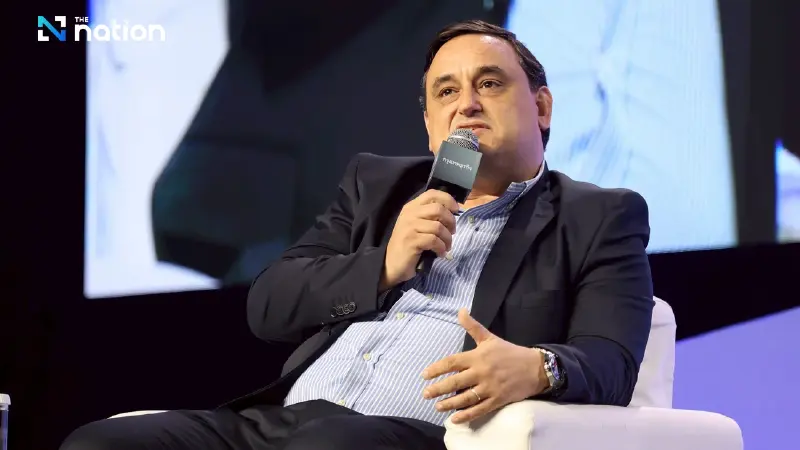


True has built a three-pillar AI strategy spanning people, operations and new revenue, arguing that human capital is its strongest competitive edge in the AI era.
Artificial intelligence (AI) may not yet be the main engine of the entire economy, but its role is becoming increasingly visible, particularly in the private sector, where large corporations are helping to accelerate technological transformation and raise national productivity.
Speaking at the AI Revolution Shift 2026: Shaking the Global Economy seminar organised by Bangkokbiznews on Tuesday (March 31), Joao Pedro Azevedo Oliviera, Chief Data and AI Officer of True Corporation, said the company sees its role as going beyond business growth. It also aims to help drive Thailand’s digital transition into the AI era in a serious and sustained way.
True believes AI can help lift productivity, create new sources of income and strengthen Thailand’s competitiveness on the global stage, he explained. In the company’s view, this transition began around four to five years ago and is now accelerating rapidly.
Oliviera described AI as moving beyond the status of an emerging technology to become an economic “superpower” that will help drive future growth, adding that True is now working to steer the organisation towards that goal.

To become an AI-native organisation, True has built its strategy around three main pillars: “AI for All”, “AI Powered Operations” and “AI Growth Engine”.
The first pillar, “AI for All”, focuses on preparing people inside the organisation for the AI era. True sees productivity as a core issue, with AI serving as an important tool to improve the efficiency of the business.
Employees therefore need training, the right tools and the right support systems. At the same time, AI for All also means widening access to AI for customers and the public, while ensuring they understand how to use it safely and reliably.

The second pillar, “AI Powered Operations”, centres on using AI to transform the way the company works, especially in telecommunications network operations. In the past, network problems were difficult to predict in advance. Today, AI can analyse network conditions, anticipate disruptions and help manage operations more effectively.
A key example is True’s AI-powered network system called “Genie”, which has evolved from an AI agent into Agentic AI capable of taking action in real time. It can, for instance, reroute traffic automatically when problems arise. It also has self-healing capabilities, allowing the system to recover on its own.
According to True, this has helped improve network stability while significantly reducing operating costs.
The third pillar, “AI Growth Engine”, is about using AI to generate new growth and new revenue. True has continued to invest in hyper-personalisation so it can better understand customers, identify what message should be delivered, to whom, and at what moment it will be most effective.
Oliviera said the company had previously used machine learning to analyse customer data, but the arrival of generative AI has allowed it to expand further into automated services. One example is “Mali”, True’s GenAI assistant, which supports customers through both chat and voice.
The system can answer questions, solve problems and handle customer requests directly, reducing the need for people to wait for a call centre response or visit a branch as they did in the past. As a result, customer satisfaction has improved while the company has also been able to cut operating costs.
In terms of new revenue creation, he said AI is having a major impact on software engineering and coding, where it can dramatically improve productivity and help create a new type of economy.
At the same time, AI is also playing a growing role in marketing and digital marketing by producing creative work at scale, analysing target groups and improving customer acquisition.
Even so, Oliviera acknowledged that AI adoption is still uneven across industries. The world is currently in a transitional phase in which AI is on its way to becoming a main economic driver, but it has not fully reached that point yet.

Oliviera went on to say that the pace of change is far faster than previous economic revolutions, which took decades to unfold. By contrast, AI has needed only a few years to reshape the technology landscape, from chips and models to future business structures.
Over the next five years, he said, the world could change so dramatically that people may look back on the present moment as only the beginning of a much larger transformation.
For True, the advantage that competitors cannot easily replicate is its people. He said the real difference does not lie in technology alone, but in the human capital and teams the company has built over time.
True has invested continuously in data analytics and machine learning for many years before moving more fully into AI, giving it a team that now serves as a critical backbone of the organisation, he said.

Oliviera concluded that in the AI era, the one thing that must not stop is learning. Everyone, he said, must stay open to new ways of thinking and working, as the world shifts from an economy driven by human intelligence to one increasingly powered by machine intelligence.
Those who learn fastest will hold the advantage in the AI economy that is arriving at speed, he concluded.
