
Middle East war hits Thai food exports, with market at risk of 50% slump
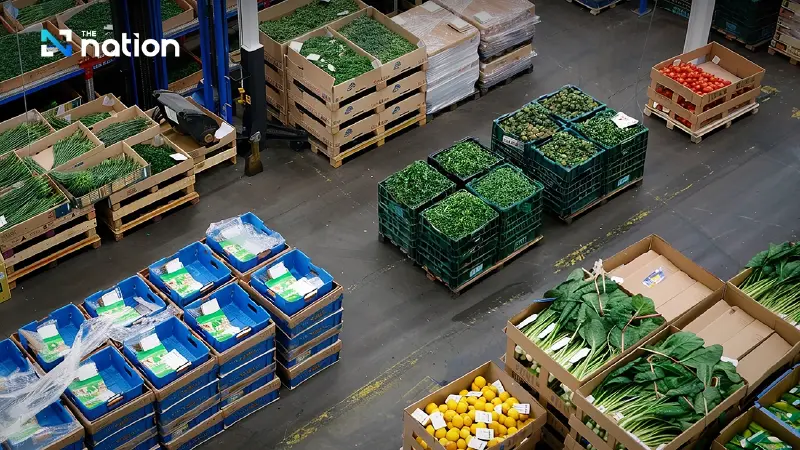


Rising freight costs, route disruption and the Hormuz closure are threatening Thai food exports, with shipments to the Middle East forecast to plunge by 50.7%.
The war in the Middle East, now in its second month, is hitting global trade as shipping costs climb in line with higher oil prices, while freight rates have also risen sharply.
The UN Food and Agriculture Organisation (FAO) said on April 3, 2026 that the global food price index rose in March, driven mainly by higher energy prices and increased transport costs linked to the war in the Middle East.
The FAO Food Price Index averaged 128.5 points in March 2026, up 3 points from February, or 2.4%, as the impact of the Iran war spread into the global food security chain.
Although war conditions could lift food demand, the situation is not positive for Thai exports, particularly food shipments to the Middle East, which are now facing growing risk.
That view is in line with the assessment of food export monitoring bodies, including the National Food Institute, the Thai Chamber of Commerce and the Federation of Thai Industries (FTI), which project that Thai food exports in 2026 will be worth 1.4 trillion baht, down 7.3% from 2025.
Among the markets expected to post the sharpest contractions are the United States, Asean, Africa and the Middle East. The Middle East market in particular is forecast to fall to 29.468 billion baht, down 50.7%, due largely to shipping route constraints.
Wisit Limleucha, vice-chairman of the Thai Chamber of Commerce and chairman of the Processed Food and Future Food Committee, said Thai food exports to the Middle East in 2026 were expected to contract by as much as 50.7%, marking a severe decline.
He said the slump was not due to demand-side factors alone, but also to geopolitical conflict and war. The main pressure comes from tensions in the Middle East, which have undermined the stability of shipping routes and disrupted logistics systems, while a slowing global economy and weaker purchasing power have added to the strain.
As uncertainty rises, importers are delaying orders, cutting stock levels and, in some cases, switching suppliers, as the war has made major ports inoperable.
The closure of the Strait of Hormuz has compounded the problem, hitting both the destination markets and the trade routes at the same time. On the destination side, shipments to key regional hubs such as Dubai, Qatar, Bahrain and Kuwait can no longer proceed normally, preventing Thai goods from reaching the main distribution centres of the Gulf Cooperation Council.
On the shipping side, exporters have been forced to divert cargo to alternative ports such as Khor Fakkan and Fujairah in the United Arab Emirates, and Sohar and Salalah in Oman. However, these ports face limitations in size and cargo-handling equipment, resulting in congestion, longer delivery times and significantly higher costs.
At the same time, the Red Sea route to Jeddah Islamic Port and King Abdullah Port in Saudi Arabia, while still an important alternative, is also beginning to face congestion and delays.
The result has been a sharp rise in logistics costs. Freight rates, including war-risk surcharges, have climbed to US$6,000-8,000 per container on the Gulf side, and US$4,000-6,000 per container on the Red Sea side, while overland transport costs have risen by a further 8,000-10,000 baht per container.
“Latest data show that the impact has already begun. In January-February 2026, Thai food exports to the Middle East were worth 8.618 billion baht, down 22.5% from the same period last year. This is a leading signal suggesting that the contraction forecast for 2026 is likely to materialise,” Wisit said.
He added that Thailand’s main food exports to the Middle East include rice, canned tuna, chicken, canned pineapple and instant noodles. These products play an important role in Thailand’s export structure, and when disruption occurs in the region, they are directly affected both in terms of order volumes and freight costs.
Trade is now a contest of delivery capability
The current situation clearly shows that global trade is no longer competing on quality or price alone. The ability to deliver and the speed of decision-making have become decisive factors.
Exporters therefore need to follow developments closely and assess risk day by day in order to identify the right moment and opportunity to resume shipments to the Middle East as soon as ports or trade routes begin reopening.
At the same time, relationships with trading partners in the region have become even more important. Communication and information-sharing must continue so that decisions can be made quickly and accurately when the time comes to re-enter the market.
In the end, those who can effectively combine logistics management with trade relationship management will be the ones best placed to preserve their competitiveness and remain in the global market over the long term.
Thailand urged to cut reliance on high-risk markets
Wisit said that, in the short term, exporters must manage logistics risks closely by diversifying transport routes and planning shipments in line with the fast-changing situation.
In the medium term, they should increase flexibility in trade terms and consider setting up warehouses in destination markets to reduce the risk of delay.
In the long term, Thailand needs to reduce its dependence on high-risk markets, shift its product structure towards higher value-added goods, and expand into regions with greater stability.
Even so, exporters must continue to monitor the situation closely for opportunities to resume shipments to the Middle East if more ports reopen and transport costs begin to ease. They must also keep a close watch on customer demand and on buyers’ willingness to accept higher prices that reflect rising freight and shipping costs.
