
Thailand Turns Procurement Into a $20bn Engine for SMEs, Green Goals and OECD Ambitions
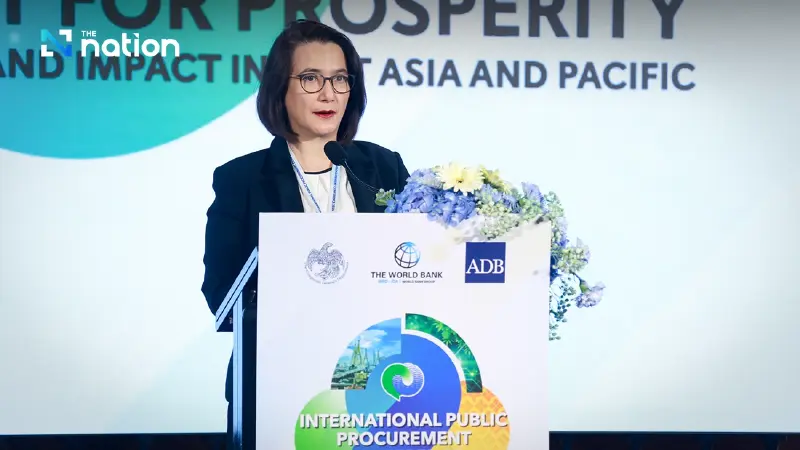


Director General Patricia Mongkhonvanit tells IPPC 2026 that strategic procurement reform has driven historic gains for small businesses, sustainability and global governance standards
- Through strategic reforms, Thailand has directed over $20 billion in government contracts to small and medium-sized enterprises (SMEs), accounting for nearly 40% of the total national procurement value.
- A new Green Public Procurement (GPP) framework has been launched to advance sustainability goals by creating a permanent market for environmentally friendly goods and services within the public sector.
- The procurement overhaul supports Thailand's ambition to join the OECD by increasing transparency and aligning with international standards through measures like open data sets and mandatory Integrity Pacts.
Director General Patricia Mongkhonvanit tells IPPC 2026 that strategic procurement reform has driven historic gains for small businesses, sustainability and global governance standards.
Thailand has transformed public procurement from a bureaucratic formality into a strategic lever for economic development, Patricia Mongkhonvanit, director general of the Comptroller General's Department (CGD), declared on Monday as she delivered the opening keynote address at the International Public Procurement Conference 2026 in Bangkok.
Speaking before an audience of procurement officials, multilateral lenders and policy specialists from across the East Asia and Pacific region, Patricia set out an ambitious vision in which government purchasing power drives job creation, nurtures domestic industry, and anchors Thailand's aspirations to join the Organisation for Economic Co-operation and Development (OECD).
SMEs at the Centre of Procurement Strategy
The centrepiece of Patricia's remarks was the government's programme to integrate small and medium-sized enterprises (SMEs) into the formal procurement system.
Under a policy providing a 10 per cent price preference in competitive bidding, SMEs secured 60 per cent of all government contracts in the past year — a combined value exceeding $20 billion (approximately 730 billion baht) and representing close to 40 per cent of Thailand's entire national procurement volume.

"Last year, our strategic support resulted in SMEs winning contracts worth over $20 billion, representing nearly 40% of our total national procurement value."
To ensure that contract awards translate into project delivery rather than cash-flow crises, the CGD has launched the PromptBiz platform, a digital bridge connecting SME contractors with financial institutions.
The tool is designed to guarantee the liquidity small firms need to mobilise on site and complete their works without depending on delayed government payments.
A Green Public Procurement Framework
Patricia described sustainability as the defining thread of her career, citing her earlier role launching Thailand's inaugural sustainability bond whilst at the Public Debt Management Office (PDMO).
That commitment has now been institutionalised across the entire public procurement cycle. Last month, the CGD formally launched a comprehensive Green Public Procurement (GPP) framework and announced a benchmark target of $100 million in green procurement value for its inaugural year.
"We are moving beyond simple compliance to create a permanent market for sustainable goods and services within the Thai public sector," she told delegates, framing the initiative as a structural market intervention rather than a voluntary aspiration.

Modernising Cost Mechanisms Amid Global Volatility
The director general also addressed the knock-on effects of global conflicts and the resulting surge in energy prices on infrastructure delivery.
The CGD has updated its cost-calculation mechanisms, adjusting oil price benchmarks to reflect current market conditions rather than outdated reference data.
The reform is intended to keep critical infrastructure projects financially viable and prevent contractors from walking away from civil works that become uneconomic under legacy pricing models.

Integrity, Transparency and OECD Alignment
Thailand's broader ambition — accession to the OECD — was a recurring motif in Mongkhonvanit's address.
She outlined two instruments central to that goal: participation in the Construction Sector Transparency Initiative (CoST) and the mandatory use of Integrity Pacts on major public contracts. By the third quarter of this year, the CGD will release its first comprehensive open data set for public procurement, providing citizens and oversight bodies with unprecedented visibility into government spending.
"My commitment is to shift the perception of procurement from a high-risk area for corruption to a global benchmark for integrity through radical transparency. As Thailand moves toward OECD accession, we are ensuring our procurement landscape is competitive, fair, and fully aligned with international standards," she said, encapsulating the government's twin commitment to domestic development and international credibility.
Patricia's address set a confident tone for the three-day conference, positioning Thailand not merely as a host nation but as a country with concrete — and measurable — lessons to share with the region.
