
AIIB Reports 75% of Financed Contract Value Won by Local Firms as It Champions Open and Fair Procurement
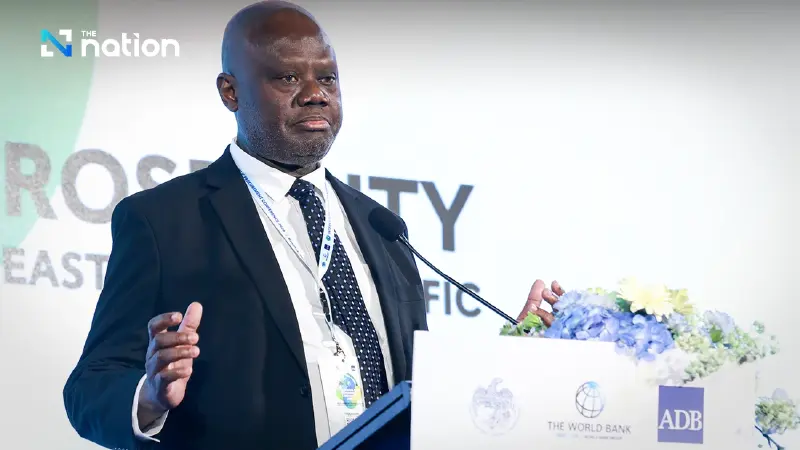


Fiduciary Governance Manager Kofi Awanyo tells IPPC 2026 that transparent competition and co-financing with multilateral partners are delivering measurable social and economic benefits at country level
- Local firms win 75% of the total contract value on projects financed by the Asian Infrastructure Investment Bank (AIIB).
- This outcome is attributed to the bank's commitment to open and fair procurement, with 98% of its contract value awarded through open competition, rather than preferential policies.
- An additional 20% of contract value is awarded to joint ventures between local and foreign companies.
- The AIIB promotes fair procurement practices by co-financing over 55% of its projects with other multilateral banks, using their established and harmonized frameworks.
Fiduciary Governance Manager Kofi Awanyo tells IPPC 2026 that transparent competition and co-financing with multilateral partners are delivering measurable social and economic benefits at the country level.
The Asian Infrastructure Investment Bank (AIIB) has moved from a standing start of nine projects worth $1.7 billion in 2016 to a global institution financing more than 350 projects valued at approximately $70 billion across 40 economies — and its procurement data, Kofi Awanyo, the bank's manager for fiduciary governance, told IPPC 2026 on Monday, proves that openness and fairness in competitive tendering deliver concrete benefits to host communities.
Awanyo addressed delegates with a pointed message: infrastructure is no longer merely about building physical assets.
It is about building resilience, trust and sustainable economic opportunity for future generations — a framing that he argued aligns precisely with the overarching theme of the conference.
The Data Behind Open Competition
The headline figures presented by Awanyo were striking. Ninety-eight per cent of AIIB's contract value by volume is procured through open competition. Of that, 68 per cent is procured specifically through open international competitive tendering.
Perhaps most significantly for the development mission of the bank, 75 per cent of total contract value is won by local firms — a result that Awanyo attributed directly to a commitment to transparent, non-discriminatory procurement rather than to deliberate preferential policies.
"These outcomes demonstrate that open, fair, and transparent procurement delivers real economic and social benefits at the country level."

A further 20 per cent of contract value is awarded to joint ventures between local and foreign companies, with the bank's three largest individual contracts all falling into that joint-venture category.
On the labour side, 90 per cent of workers employed by foreign contractors on AIIB-financed projects are sourced from the local labour market — a figure that Awanyo said underscores the employment multiplier effect of well-structured infrastructure investment.
Co-financing as a Harmonisation Strategy
A distinctive feature of the AIIB's operating model is its deliberate use of co-financing to promote procurement harmonisation across the multilateral development bank (MDB) system.
More than 55 per cent of the bank's procurement is conducted through co-financing arrangements with other institutions – among them the World Bank, the Asian Development Bank, the European Bank for Reconstruction and Development (EBRD), and the Islamic Development Bank.
In these arrangements, recipient countries use the procurement frameworks of the co-financing MDB, avoiding duplication and reducing the administrative burden on borrower governments.
"We are talking the walk and making harmonisation happen on the ground," Awanyo said, positioning co-financing not merely as a financing mechanism but as a vehicle for practical governance reform.

Responding to Global Supply Chain Disruption
Addressing the impact of the Middle East crisis on the Bank's project portfolio, Awanyo described the immediate steps taken: a review of all ongoing contracts, direct engagement with recipients and contractors to invoke force majeure and exceptional event clauses under FIDIC conditions, and assessments of the time and cost implications for each individual project.
He stressed that no two contracts were affected identically and that the bank's response has been necessarily case-by-case rather than systemic.
For future procurement, the bank is now requiring the inclusion of price adjustment mechanisms in all new contracts regardless of the contract duration and is mandating that evaluation criteria explicitly address supply chain resilience.
Emergency financing, rapid response mechanisms and project restructuring instruments have also been deployed in the most severely affected cases.

Digital Platforms and Analytics
The AIIB has developed an AI-enabled digital platform covering procurement, financial management and project intelligence tools.
The system is designed to shift the bank's decision-making culture from compliance-driven to insight-driven — using real-time data to strengthen analytics, oversight and transparency across the full project lifecycle.
Awanyo closed with a message that echoed the broader conference theme.
"Sustainable infrastructure is not just an investment in physical assets," he said, "but an investment in people, institutions, and the future."
The Bank, he pledged, stands ready to advance that shared goal alongside governments, partners and procuring authorities across the region.
The AIIB's guiding operating principles — to be lean, clean and green — reflect, he argued, precisely the values that procurement systems must embody if public infrastructure investment is to deliver prosperity rather than merely expenditure.
