
Smart tenders, big gains: How public contracts are driving a 10% productivity boost
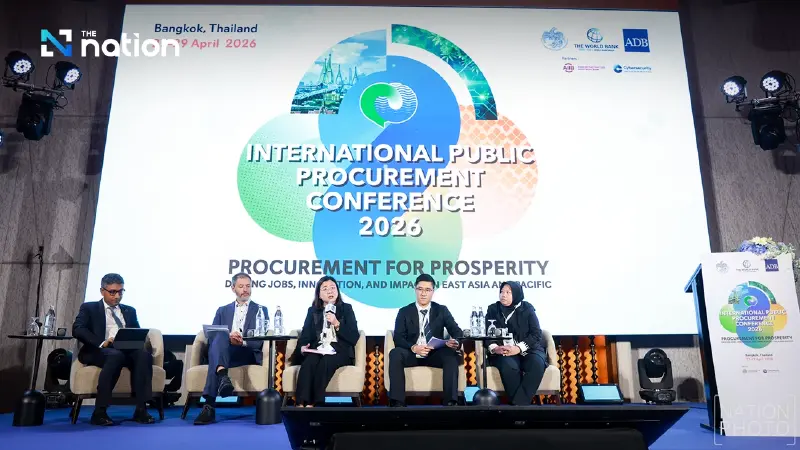


Researchers and practitioners from the Philippines, China and Indonesia present evidence and country experience showing that open, competitive procurement — backed by active SME policies and digital tools — can deliver measurable gains in productivity, employment and economic inclusion
- Winning a public contract can increase a firm's productivity, measured as sales per worker, by an average of 10% within two years of the award.
- This productivity boost is almost exclusively driven by high-integrity, competitive tenders; contracts awarded through non-transparent or single-bidder processes produce no measurable gains.
- The positive economic effects are largest for small and medium-sized enterprises (SMEs), challenging the traditional preference for awarding contracts to larger suppliers.
- Countries are actively implementing policies like reserving contracts for SMEs (China), simplifying digital procurement (Indonesia), and focusing on social impact (Philippines) to achieve these gains.
Researchers and practitioners from the Philippines, China and Indonesia present evidence and country experience showing that open, competitive procurement — backed by active SME policies and digital tools — can deliver measurable gains in productivity, employment and economic inclusion.
Public procurement accounts for as much as 14 per cent of GDP in advanced economies and around 10 per cent in Thailand. Yet, the economic returns on that enormous spending hinge almost entirely on how contracts are designed, awarded, and managed—not simply how much money is spent.
That was the central message of the International Public Procurement Conference (IPPC) 2026. The session, moderated by the World Bank’s Habib Nasser Rab, brought together academic research and front-line experience to examine how government purchasing power can be turned into a practical engine for job creation and inclusive development.
Integrity: The Decisive Variable
Prof Mihály Fazekas of Central European University opened the session with a keynote that challenged the traditional view of procurement as mere administration.
Drawing on empirical literature made possible by linking procurement databases to tax records, he demonstrated that procurement's impact on productivity is real, substantial, and highly sensitive to process quality.
Analysing data from across Europe and Central Asia, Fazekas identified two distinct channels of impact.
First is the selection effect: by choosing which firms to award contracts to, governments shape the long-term dynamism of the private sector.
Second is the dynamic effect: winning a government contract provides firms with the revenue and confidence to invest in productivity-enhancing technologies.

The data showed an average productivity gain—measured as sales per worker—of approximately 10 per cent in the two years following a contract award.
Crucially, the gains were largest for small and medium-sized enterprises (SMEs) with fewer than 50 employees. This challenges the conventional preference for awarding contracts to larger, established suppliers on the grounds of perceived reliability.
However, the most striking finding concerned integrity. When Fazekas decomposed productivity effects by corruption risk—using indicators such as single-bidding rates and inadequate advertisement periods—he found that virtually the entire positive economic effect came from high-integrity, competitive tenders.
Contracts awarded through non-transparent processes produced no measurable gain in firm productivity. Had countries like Bulgaria consistently applied open procedures, aggregate productivity could have been 8 to 10 per cent higher.

Philippines: From Control to Inclusion
Sofia C. Yanto Abad, of the Philippines’ Government Procurement Policy Board (GPPB-TSO), described an evolution in the philosophy of procurement law: a shift from preventing abuse to actively enabling participation.
While the core principles of transparency and accountability remain, the new Government Procurement Act (Republic Act 12009) introduces a broader conception of "value for money" that weighs sustainability and social impact alongside price.
A concrete example is the Sagip Saka (Save Our Farming) initiative. This mandates government agencies to procure agricultural products directly from farmers, bypassing intermediaries.
Uniquely, agencies are permitted to purchase above farm market price—a deliberate policy choice to make government supply chains attractive to small producers.
Currently, jails and school feeding programmes are sourcing directly from cooperatives, creating stable demand and jobs in communities previously untouched by formal procurement.

China: Ring-Fencing for Small Business
In China, SMEs already account for 70 per cent of total government procurement value. Jiaqi Guo, of the Ministry of Finance, presented the country’s structured SME support framework, which has been significantly expanded since 2020.
Government departments are now required to audit procurement plans and "ring-fence" contracts suitable for SMEs. For projects above a certain value, no less than 30 per cent of the budget must be reserved for SMEs—a share that rises to 40 per cent for construction projects. Of that reserved portion, at least 60 per cent must go to micro and small businesses.
These "set-asides" are complemented by price preferences. Micro-businesses benefit from a 10 to 20 per cent price deduction during bid evaluation. To ensure these policies aren't just "paper gains," a special inspection programme was launched in 2022 to scrutinise compliance and address unfair rules.

Indonesia: The Digital Inclusion Gateway
Indonesia’s journey has been defined by rapid digital transformation. Widya Prima Sari Fultanegara, from the National Public Procurement Agency (LKPP), noted that the procurement budget for micro and small enterprises grew to over $30 billion by 2025—representing 43 per cent of the total budget.
The "e-catalogue"—an online government marketplace—has been the primary driver. After the registration process was simplified from nine stages to two in 2022, transactions through the platform surged by 400 per cent.
However, Fultanegara was candid about the "unintended consequences" of digital success. The rapid growth in listed products created duplication and categorisation errors, making it harder for buyers to compare goods. To combat this, a new, more user-friendly version of the e-catalogue, resembling a commercial marketplace, was launched in 2024.

Managing the SME Trade-Off
A recurring theme during the panel discussion was the "SME trade-off": the fact that smaller firms are often less productive than giants at the moment of selection.
Panellists argued that this risk is manageable. In Indonesia, budget allocations are treated as a temporary "privilege" paired with business incubators to help firms "graduate" into open competitive markets.
Prof Fazekas added that the greatest gains come not from a single award but from placing SMEs on a trajectory of successive contracts that encourage formalisation and improved accounting standards.
The Data-Driven Shift
The session closed with a consensus on the future of the field: data integration. Prof Fazekas was direct: "Without linking e-procurement data with company registry and tax data, we are flying blind."
The IPPC 2026 underscored that procurement reform is not merely a matter of passing better laws. It is about changing behaviour—creating systems where competitive, transparent processes are the path of least resistance, and treating the integrity of the tender as a vital economic variable in its own right.
