
Thai TV faces ‘slow collapse’ without urgent NBTC roadmap before 2029
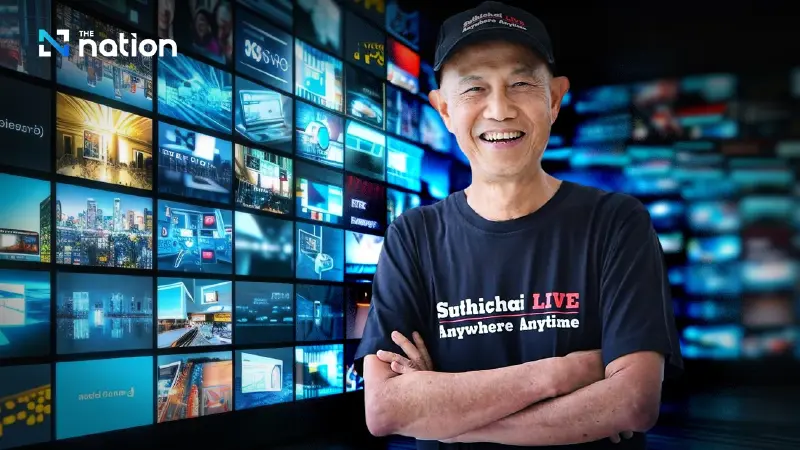


Suthichai Yoon warns Thai TV faces a 75% risk of “slow collapse” unless the government and NBTC set a clear digital TV roadmap.
- Veteran journalist Suthichai Yoon warns that Thailand's TV industry faces a 75% chance of a "slow collapse"—a gradual erosion of quality, revenue, and credibility—if no structural reforms are implemented.
- The core problem is the lack of a clear future roadmap from the National Broadcasting and Telecommunications Commission (NBTC) as the industry's digital TV licenses are set to expire in 2029.
- This uncertainty prevents operators from planning and securing investment, threatening television's role as a public space for reliable, professionally vetted news and information.
Thailand’s television industry is at risk of a “slow collapse”, with a 75% chance of gradual deterioration if no structural reforms are introduced by the government and the National Broadcasting and Telecommunications Commission (NBTC), veteran journalist Suthichai Yoon has warned.
The warning is based on research by a Srinakharinwirot University team, supported by the Thai Media Fund, which examined possible futures for Thai television over the next decade.
Suthichai, a senior media figure and former co-founder of Nation Group, raised the issue on his Suthichai Live Facebook page, arguing that the television sector is already under serious pressure and facing deep uncertainty over its future.
At the centre of the concern is the lack of clarity from the NBTC over the future roadmap for digital television, with existing licences due to expire in 2029.
More than a business problem
Suthichai warned that the issue should not be seen merely as a problem for digital TV operators. Thai television, he argued, remains a public space for information at a time when society is flooded with content from social media, much of which may not go through proper fact-checking, professional editorial standards or journalistic ethics.
In such an environment, the public still needs reliable news, analysis and programming that meets professional standards and serves the wider public interest, he noted.
That is why media professionals, academics and those involved in the television industry are calling on the NBTC to clearly define the future direction of digital TV, he added.
Without an urgent roadmap, operators will be unable to plan their businesses, investors will hesitate to commit capital, and media workers will be left uncertain about how to move forward as the 2029 licence expiry approaches.
Suthichai also referred to two questions previously raised by Pirongrong Ramasoota, an NBTC commissioner: “What is television for?” and “How will people in the television industry survive?”
He described the questions as deeply significant because they go beyond business survival. They also touch on the survival of the media profession and the role of television as a social institution.
After 2029, Thailand must be able to answer whether Thai television will survive or disappear, and whether household TV screens will still offer space for Thai content, Thai news and trusted media, he argued.
Otherwise, Suthichai warned, television screens may become little more than monitors for foreign platform applications.
Four possible futures for Thai television
Suthichai cited a study by researchers from Srinakharinwirot University, which was presented at a forum titled “The image of Thai TV in the next decade: creating a sustainable content industry and Thai society”.
The study outlined four possible scenarios for the future of Thai television, all of which reflect the industry’s vulnerability at a critical turning point.
-
Scenario 1: ‘Slow Collapse’
The first scenario, “Slow Collapse”, was described as the most alarming. The study estimated a 75% probability of this outcome if the industry is left to drift without structural intervention from the government and the NBTC.
Suthichai explained that “Slow Collapse” does not mean television stations would suddenly shut down all at once. Instead, the industry would quietly deteriorate from within, as revenue, content quality, personnel, credibility and the social value of Thai television are gradually eroded.
Under this scenario, advertising money would permanently move away from traditional television to over-the-top (OTT) platforms and social media.
Only some operators would remain, possibly around 10 to 12 channels. However, their survival would depend heavily on cutting costs across the board, leading to a further decline in programme quality.
As operators struggle to stay afloat, high-quality programmes, children’s programming, local content and serious knowledge-based programmes that require significant budgets would gradually disappear from screens, he explained.
In their place, viewers would see more sensational news, rating-driven drama, shallow content and product sales.
Suthichai observed that some signs of this scenario are already visible, including the growing use of airtime to sell products, common medicines, supplements and items targeted at elderly viewers and audiences in the provinces, who may still have limited access to new technologies.
As Thai television gradually loses its role, public-interest programming would shrink. People would become more exposed to one-sided information environments, or “echo chambers”, where they receive only content that confirms their existing views and are rarely challenged by different information or perspectives.
If the algorithms of foreign platforms are designed mainly to maximise engagement, likes, shares and views, rather than prioritise content quality, Thailand could lose important mechanisms for checking information, filtering news and providing trusted media during crises, he cautioned.
Suthichai described “Slow Collapse” as a “silent killer” because there would be no clear warning signal and no dramatic shutdown to shock the public.
Instead, the public value of television would slowly wear away while people continue to reassure themselves that the situation will eventually improve or that capable players will survive on their own.
He argued that this belief is not entirely true. In a system left to run without direction, those who survive may not be the most capable or professional. They may simply be those best at exploiting opportunities, generating drama and avoiding responsibility for content quality.
-
Scenario 2: ‘Survival of the Fittest’
The second scenario is “Survival of the Fittest”, in which only the strongest players remain.
According to the study, the industry may be reduced to just six to eight serious operators. Those that survive will need to answer one key question: what value can they create that global platforms such as Netflix, YouTube, TikTok or Facebook cannot?
In this scenario, strong operators would no longer be able to depend on the traditional advertising model. They would need to develop their own intellectual property, sell content rights, build fan economies, export content, and expand artists or content brands into new markets.
However, Suthichai questioned whether survival under this model would serve only the interests of individual businesses, or whether it would also preserve television’s role as a public space and trusted media.
If surviving operators focus only on selling intellectual property, managing artists or producing content for fan communities, without maintaining a public-interest news function, Thai society may still lose the media it needs during times of crisis.
-
Scenario 3: ‘State-Dependent Limbo’
The third scenario, “State-Dependent Limbo”, refers to an industry trapped in uncertainty while waiting for the state.
Under this scenario, the government may eventually introduce policies or a roadmap, but the industry may be unable to keep up, or support measures may arrive too late after many operators have already run out of strength.
Thai television would remain dependent on linear TV and existing transmission networks, while new licensing rounds could take place at a time when operators are still making losses, investment funds have dried up, workers lack digital skills, and organisational cultures have failed to adapt to competition from foreign platforms.
Suthichai compared this to providing oxygen only after operators have already collapsed financially. Even if policies are well designed, or a national platform is introduced, the industry may not recover if the private-sector machinery has already stopped turning.
He also warned of the possible failure of a national streaming platform if the state pushes ahead with such a project but user numbers remain low. Content producers may lack the funds to invest in new technology, lack skilled workers, and be unable to produce content capable of competing with foreign platforms.
If that happens, Thai television could become half-awake and half-asleep — a “zombie” industry that still exists but lacks competitive strength. It may no longer be able to compete globally, regionally within Asean, or even meaningfully at the national level.
-
Scenario 4: ‘Phoenix Rising’
The fourth scenario, “Phoenix Rising”, is the most positive but also the most difficult. It would require genuine structural change, not simply an extension of the old system or leaving each operator to struggle on their own.
Under this scenario, Thai television would need to improve its technology, content and business structure. This could include upgrading remaining channels to HD quality, reducing duplicated costs in multiplex transmission networks, considering more efficient network models, and changing the criteria for the next licensing round.
Instead of price-based bidding, licences could be allocated through a “beauty contest” system that prioritises content quality and public value.
Suthichai argued that Thai operators must stop working in isolation and consider building a shared platform to compete with foreign OTT services.
Although difficult, such cooperation may be necessary if the media industry wants to preserve a channel that Thai society can rely on, rather than producing content only to leave all distribution power in the hands of foreign platforms.

‘Must Find’ and the risk of information dependency
Suthichai also highlighted the “Must Find” proposal raised by Pirongrong as an important issue in the smart TV era.
In the past, “Must Carry” rules focused on ensuring that free TV channels were carried across all platforms. However, in the new environment, the problem is no longer just whether Thai channels are available. The bigger question is whether viewers can actually see and find them.
Future smart TV screens will be controlled by operating systems such as Android TV and WebOS, as well as platforms run by global device makers and service providers.
These systems will become the new gatekeepers. Without regulatory mechanisms, Thai channels may be pushed into positions where viewers cannot easily find them and may be replaced by foreign streaming applications.
Suthichai pointed to countries such as Australia and the United Kingdom, where national television services or public media are required to remain visible on the main screens of smart TVs so that people can still access their own country’s media and are not swallowed by a global ocean of content.
He stressed that the future of Thai television after 2029 will not depend only on advanced technology. It will depend on whether Thailand has a serious and courageous strategy, and whether policy can keep pace with the world.
If everything is left to drift, “Slow Collapse” could become reality, Suthichai warned.
Free TV as a public right
Suthichai warned that “Slow Collapse” is more frightening than a normal collapse because there is no clear alarm bell and no one can say when the countdown will end.
The system would simply wear away until it collapses in front of everyone, possibly before anyone can respond in time, he warned.
If the state fails to urgently create a “Must Find” mechanism, and operators fail to develop their own intellectual property, Thailand may be left with television screens that are full of applications but empty of meaning for future generations.
If foreign platforms are allowed to control everything the public sees, Thailand could fall into a state of complete “information dependency”, he warned, adding that Thai information, news, culture and ideas would then be shaped by algorithms driven mainly by business interests.
Suthichai also referred to a key principle raised at the forum: free TV is a basic public right. Not everyone can afford internet fees or streaming subscriptions, he noted.
Therefore, even if terrestrial television is facing losses, it should not be easily abandoned because it remains a free channel through which many people can access information.
He concluded that the crisis facing Thai television is not just a media business crisis. It is a national issue involving people’s rights, democracy, culture and the country’s sovereignty over information.
Suthichai urged the government, the NBTC, operators, public media, academics, professional organisations and civil society to work together urgently to find answers before the slow collapse of Thai television becomes a reality that can no longer be reversed.
