
Thailand’s Neutral Bet: Gold and Food Security Emerge as Pillars of a New Trade Strategy


Deputy PM Suphajee Suthumpun unveils a "just-in-case" trade strategy built on food security and gold, as Bangkok resists picking sides in Washington-Beijing rivalry
- Thailand is implementing a new "just-in-case" trade strategy to maintain neutrality amid US-China rivalry, positioning itself as a reliable hub built on the pillars of food security and gold.
- As a key part of its strategy, Thailand is leveraging food security by encouraging foreign investment in local agricultural processing to add value to exports and narrow its trade deficit with China.
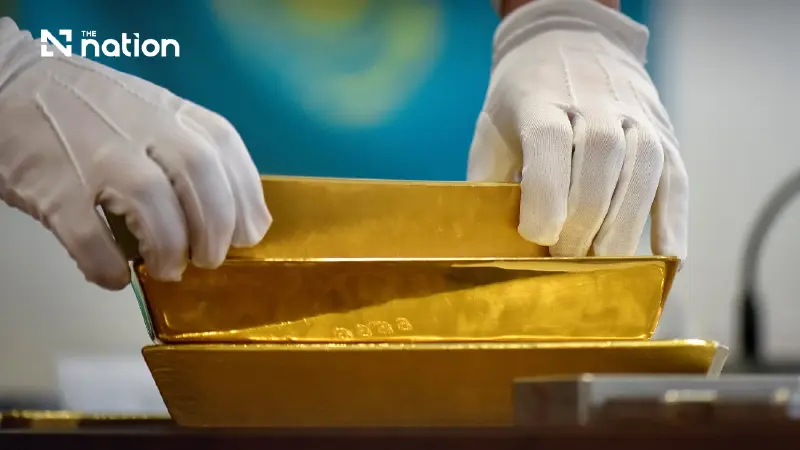
- Gold is being elevated from a traditional savings vehicle to a strategic national asset, valued for its role as a neutral reserve, a risk management tool, and an industrial input for technology.
- The strategy aims to carefully balance Thailand's trade relationships, managing its surplus with the US (its largest export destination) while narrowing its deficit with China (its largest overall trading partner).
Deputy PM Suphajee Suthumpun unveils a "just-in-case" trade strategy built on food security and gold, as Bangkok resists picking sides in Washington-Beijing rivalry.
Thailand is positioning itself as a resilient, neutral hub in a fracturing global economy, leveraging its geography and gold's growing strategic value to navigate the deepening rivalry between the United States and China.
Speaking at the Thailand Gold Summit 2026 on Sunday, Deputy Prime Minister and Minister of Commerce Suphajee Suthumpun set out a "mutual benefit" trade strategy intended to balance ties with the world's two largest economies while elevating gold from a traditional savings vehicle to what she termed a "strategic national asset".
Suphajee said the global order had shifted from treating security and trade as separate spheres to one in which major powers now use security concerns as leverage over economic relationships. Thailand, she noted, sits awkwardly between the two: the US is its largest single export destination, absorbing roughly 20 per cent of last year's 11.1 trillion baht in total exports, while China is its largest trading partner overall once imports and exports are combined.
The country currently runs a trade surplus with the US but a widening deficit with China — a dynamic Suphajee said Bangkok must actively manage rather than simply absorb.
"Our task is to prove that we have no intention of running up an excessive surplus with America, while also finding ways to narrow the gap with China," she said, adding that Thailand had accepted a 19 per cent reciprocal tariff rate in talks with Washington, though negotiations over non-tariff barriers remain ongoing.

On China, she proposed redirecting the nature of Chinese investment rather than simply managing the deficit through trade talks alone.
"We want to encourage China to invest in ways that draw more on our domestic raw materials and build up a local supply chain, rather than investment that uses none of our resources at all," she said.
Beyond its two largest partners, Thailand is also pursuing a free trade agreement with the European Union, having just completed a ninth round of negotiations, with a tenth scheduled for September.
Officials are separately courting Canada and South Korea, while emergency market diversification — such as redirecting rice exports to South Africa and Latin America after regional disruption earlier this year — has underscored Bangkok's push to avoid overreliance on any single bloc.
From "Just-in-Time" to "Just-in-Case"
Suphajee described a broader philosophical shift in how Thailand positions itself commercially. The traditional "just-in-time" model, built around speed and cost efficiency, is giving way to a "just-in-case" approach centred on reliability amid volatility.
"Uncertainty has become the only certainty," she said, pointing to food security and gold as the two pillars underpinning this shift. "If you want certainty that your population will have food to eat, come and talk to Thailand," she said, framing food security as a deliberate point of leverage in trade negotiations.
That food security pitch is not merely rhetorical. Suphajee highlighted a rebound in agricultural exports in the first half of the year — the sector's first meaningful growth in several years — despite agriculture contributing only 8 to 9 per cent of GDP while employing roughly a third of the Thai workforce.

To build on this, she is pushing to change the character of Chinese investment in the sector: rather than China simply importing raw Thai produce, she wants Chinese firms to establish processing facilities inside Thailand — turning fresh fruit into processed goods, for instance, before export.
The intended effect is twofold: narrowing the bilateral trade deficit while insulating farmers from the boom-and-bust pricing that follows seasonal oversupply.
Overall export performance has strengthened this argument. Thailand posted record first-quarter export growth this year, with year-on-year growth exceeding 20 per cent in the first half, against 12 per cent growth for the whole of last year — figures Suphajee cited as early validation of the strategy.
The Five Dimensions of Gold
Turning to the summit's central theme, Suphajee set out five distinct roles gold now plays in the Thai and global economies: a personal asset passed between generations; a strategic national reserve; a vehicle for global institutional investment; a risk management tool; and, increasingly, an industrial input for future technologies.
"We are relying on gold in a dimension that goes beyond a legacy asset — it is also a material for the future," she said, citing global data showing that gold demand tied to electronics and technology rose sharply last year, with total industrial demand climbing to over 300 tonnes and electronics-specific demand up some 84 per cent.
Overall global gold demand reached roughly 5,144 tonnes last year, she noted, up 2 per cent, while investment-related demand alone rose to around 2,204 tonnes, an increase of 83 per cent.
Gold's appeal as a reserve asset, she added, lies partly in its structural neutrality: unlike currency reserves, it carries no counterparty risk and no exposure to exchange rate volatility — a feature she said matters more as currency markets grow less predictable.
A Note of Caution
Suphajee closed her remarks with a warning to prospective investors. Gold, she said, is not a one-way bet: "It carries its own volatility — it tends to gain value when the world grows more uncertain, but when stability returns and interest rates fall, gold falls too."
She urged attendees to invest only with a clear understanding of these dynamics, to work solely through licensed dealers and reputable financial institutions, and to treat any promise of above-market returns as an immediate red flag.
"If someone advertises returns far above the ordinary, be cautious — it is simply not realistic," she said.
Her closing message tied the summit's commercial theme back to her broader trade argument: in a world where "uncertainty has become the only certainty", Thailand's pitch — whether on rice, gold, or trade negotiations — rests on positioning itself as the reliable, neutral counterparty others can return to.
