
Thailand to Showcase Economic Model at 2026 IMF-World Bank Annual Meeting
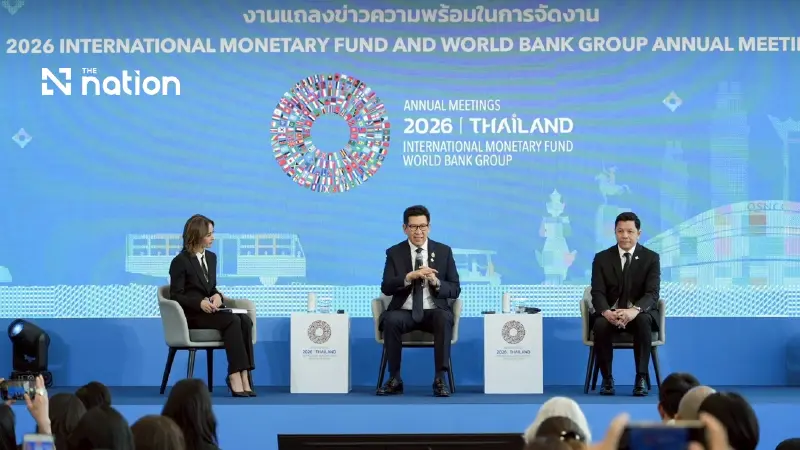


Finance Minister Ekniti Nitithanprapas says Bangkok summit will showcase Thailand's economic model to delegates from 191 nations
- Thailand will host the 2026 IMF-World Bank Annual Meeting in Bangkok, using the event to showcase its economic development model to over 15,000 delegates from 191 countries.
- The country's theme, "Thailand's New Horizons: Empowering People, Building Resilience," is based on the late King Rama IX's Sufficiency Economy Philosophy, which emphasizes moderation and balanced growth.
- The economic model will be presented through four key pillars: Digital and AI Transformation, Building Resilience as a "Trusted Hub" for trade, a New Financial Architecture for Climate Adaptation, and the Longevity Economy.
- A key deliverable will be the "Bangkok Blueprint," a policy framework developed with the IMF and World Bank to help other nations build trust in safe and inclusive digital finance.
Finance Minister Ekniti Nitithanprapas says Bangkok summit will showcase Thailand's economic model to delegates from 191 nations.
With exactly 90 days left until the world's financial leaders descend on the capital, preparations are reaching a fever pitch. Thailand's Ministry of Finance and the Bank of Thailand have jointly declared the kingdom's absolute readiness to host the 2026 Annual Meetings of the International Monetary Fund (IMF) and the World Bank Group, an event set to draw more than 15,000 delegates from 191 countries to Bangkok this October.
Deputy Prime Minister and Minister of Finance Ekniti Nitithanprapas told a press conference on Tuesday that hosting the summit, often dubbed the 'Olympics of Finance', is a rare opportunity to present Thailand's economic development model to the world whilst delivering tangible benefits to Thai citizens.
He said the gathering would stimulate the domestic economy, elevate the country's global standing, and demonstrate the capabilities of local communities on an international stage, under the concept of "Empowering Community: From Local to Global".
The meetings will run from 12 to 18 October 2026 at the Queen Sirikit National Convention Centre (QSNCC), marking a historic return for Thailand 35 years after it first hosted the event in 1991. Attendees are expected to include global policymakers, central bank governors, economists, private sector executives and members of the international media.

A Platform for Thailand's Development Model
As host nation, Thailand has adopted the theme "Thailand's New Horizons: Empowering People, Building Resilience", which the finance ministry has framed around the late King Rama IX's Sufficiency Economy Philosophy (SEP) — a development approach built on moderation, resilience and balanced growth.
Ekniti said the government's fiscal and economic policies had been organised around four pillars designed to speak to challenges facing countries worldwide:
Digital and AI Transformation for Inclusive and Resilient Growth — showcasing Thailand's digital public infrastructure, including the PromptPay payment system and cross-border QR payment links, alongside the use of artificial intelligence to improve public services and healthcare.
Building Resilience in a Fragmented World — positioning Thailand as a "Trusted Hub" for trade, finance and investment in Asia, with an emphasis on resilient supply chains and new forms of international cooperation.
Building a New Financial Architecture for Climate Adaptation — calling for reform of global financial structures to support fairer energy transitions and climate adaptation financing.
Demographic Change and the Longevity Economy — reframing the challenges of an ageing population as an economic opportunity, underpinned by stronger financial preparedness.
To embed the event as a national priority, the ministry has launched a "Road to Thailand" communication campaign intended to engage government agencies, academic institutions, businesses and the public, with youth, local communities and small enterprises playing an active role in preparations.

Ekniti added that operations had been organised through three dedicated subcommittees — covering substance, protocol and logistics, and security — to ensure the meetings run smoothly.
"Thailand is 100% ready," he said, noting that IMF and World Bank delegations were in Bangkok this July for a final evaluation known as the "July Mission". "We have established a seamless control and operations system to ensure absolute readiness in all aspects".

Bank of Thailand's Supporting Role on Digital Finance
Working in support of the Finance Ministry as co-host, the Bank of Thailand (BOT) is focusing its contribution on the future of digital finance. BOT Governor Vitai Ratanakorn said Thailand's position as a global leader in digital financial infrastructure, demonstrated through systems such as PromptPay and cross-border QR payments, would underpin efforts to showcase the concept of "Safe & Inclusive Digital Finance" (SIDF) at the summit.
Vitai said building a safe and inclusive financial system required progress on three fronts: managing digital fraud and cybercrime that undermines confidence in the financial system; strengthening resilience against cyber risks in an environment still reliant on concentrated infrastructure and service providers; and creating a fair, accessible financial ecosystem to prevent exclusion, particularly as unequal access to AI and digital tools risks creating new forms of inequality.

As part of this effort, the BOT is preparing to unveil the "Bangkok Blueprint", a policy framework developed jointly with the IMF and World Bank that other countries can adapt to build trust in digital finance.
The framework covers legal and policy foundations, fraud prevention and detection, cross-border and inter-agency cooperation, and public financial literacy.
"The Bangkok Blueprint is designed to be one of the key deliverables of this summit, bridging Thailand's national theme with global priorities," Vitai said, adding that the framework would turn shared concerns over digital financial threats into "actionable, concrete frameworks" for international cooperation.
