
Thailand Pushes 27bn-Baht Rail Link Connecting Gulf to Andaman Coast
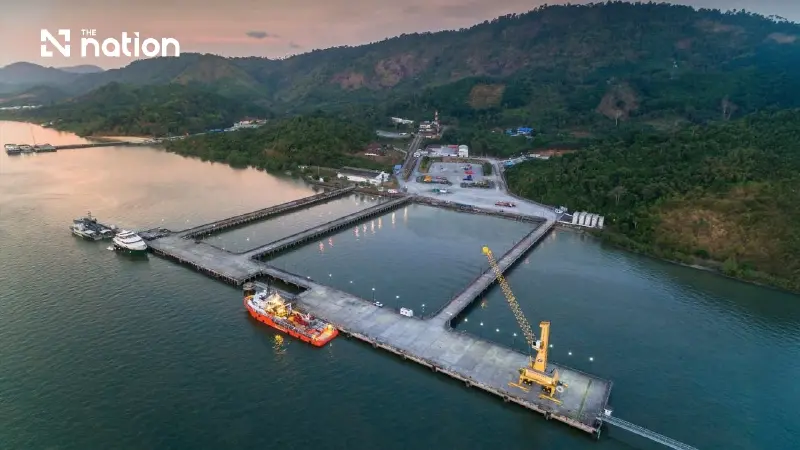


Ministry of Transport advances 110-km Chumphon–Ranong dual-track railway project to link main rail network to Andaman deep-sea port for the first time
- The Thai government is advancing a 27 billion-baht, 110-km dual-track railway to connect Chumphon on the Gulf coast to Ranong Port on the Andaman coast.
- This project will link Thailand's main national rail system to a deep-sea port on the Andaman Sea for the first time, creating a strategic land bridge for freight.
- The new line is intended to provide direct rail access to the Indian Ocean, facilitating trade with BIMSTEC nations, the Middle East, and Africa.
- With the detailed design complete, the project is awaiting environmental approval, with a target to open bidding for construction in 2027.
The Ministry of Transport advances the 110-km Chumphon–Ranong dual-track railway project to link the main rail network to the Andaman deep-sea port for the first time.
The Ministry of Transport is pushing ahead with a strategic 27-billion-baht ($750 million) dual-track railway line connecting Chumphon to Ranong Port, aiming to link Thailand’s primary national rail system with a deep-sea port on the Andaman coast for the first time.
Speaking on Wednesday, Deputy Minister of Transport Sanphet Boonyamanee outlined the initiative as a critical step in completing a "missing link" within the national logistics framework, aligning with infrastructure policies set out by Prime Minister and Minister of Interior Anutin Charnvirakul.
The project encompasses a 110-kilometre stretch designed to create a seamless multimodal transport network integrating roads, railways, ports, airports, and border crossings.

CHUMPHON–RANONG PORT DUAL-TRACK RAIL PROJECT
│ Distance │ 110 km
│ Estimated Budget │ 27 billion baht (~$750 million)
│ Primary Objective │ Connect main rail network to Andaman Deep-Sea Port
│ Current Status │ Detailed design complete; EIA report pending review
│ Target Bidding │ 2027 (Earliest)

Strategic Trade Gateway to the Indian Ocean
Although relatively short compared to trunk lines across the country, the Chumphon–Ranong line is positioned as a pivotal land bridge. Once operational, freight originating from northern, north-eastern, central, and southern agricultural and industrial zones can travel directly by rail to Ranong Port without requiring road transfers for the final leg.
The route will provide Thailand with dual-coast maritime access. While existing rail infrastructure connects to Gulf of Thailand hubs—including Laem Chabang, Bangkok, and Map Ta Phut—the new line establishes direct access to the Andaman Sea and the Indian Ocean.
This connection is expected to facilitate trade with Bay of Bengal Initiative for Multi-Sectoral Technical and Economic Cooperation (BIMSTEC) member states, as well as expanding markets across the Middle East and Africa.

Local Economic Growth and Next Steps
Beyond international trade, officials project that the infrastructure investment will stimulate local economies in Chumphon and Ranong by attracting private capital into warehousing, distribution centres, and logistics operations.
To ensure balanced development, the Office of Transport and Traffic Policy and Planning (OTP) and the National Economic and Social Development Council (NESDC) are carrying out comprehensive evaluations across economic, environmental, and social dimensions. Studies are also assessing whether to expand existing facilities at Ranong Port or construct a new deep-sea terminal capable of handling larger container ships.
The State Railway of Thailand has completed the detailed engineering design and submitted its Environmental Impact Assessment (EIA) report for review. Subject to environmental approval later this year, competitive bidding for the construction contract is expected to open in 2027.
