
Ekniti to lead BOI delegation to Japan to boost investor confidence and court high-tech industries
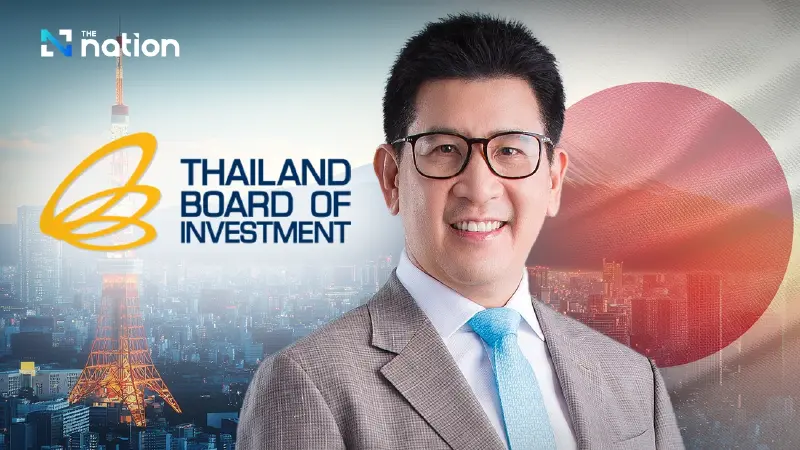


Deputy PM Ekniti to visit Japan for a major BOI roadshow, aiming for investor confidence and attract high-tech investment in EVs, semiconductors and new energy
- Thailand’s BOI delegation will visit Japan to reinforce investor confidence and attract new investment in future-focused industries.
- Meetings will be held with six major Japanese automakers—Toyota, Honda, Isuzu, Mazda, Mitsubishi and Nissan—to support the transition to xEV.
- The delegation will also meet major banks and leading companies in semiconductors and smart electronics to encourage expansion in Thailand.
- The key goal is to reaffirm that the Thai government remains committed to supporting Japanese investors and deepening collaboration in strategic industries such as semiconductors, electric vehicles and new energy.
Narit Therdsteerasukdi, Secretary-General of the Board of Investment (BOI), announced that from November 27–29, 2025, Deputy Prime Minister and Minister of Finance Ekniti Nitithanprapas will lead the BOI delegation on an official investment roadshow to Japan.
This will be the first major roadshow to a top investing country since Ekniti assumed office. The programme is co-organised by the BOI, SMBC Bank, and Japanese business partners.
The delegation will host the “Thailand–Japan Investment Forum 2025” at Tokyo Kaikan, where the Thai government will outline its investment policies and long-term direction.
More than 400 Japanese investors and senior executives have already registered for the event.
During the forum, the Deputy Prime Minister will present Thailand’s economic policies, while the BOI Secretary-General will highlight investment opportunities in target industries, together with BOI incentives and support measures designed to boost investor confidence.
The Thai government delegation will also meet with Japan’s Minister of Economy, Trade and Industry (METI) to discuss industrial competitiveness, new-energy development, and long-term cooperation to maintain and expand Japan’s investment base in Thailand—particularly amid global economic uncertainty.
Meetings with major Japanese automakers
The roadshow includes a high-level meeting with six major Japanese car manufacturers with large production bases in Thailand: Toyota, Honda, Isuzu, Mazda, Mitsubishi and Nissan.
The delegation will listen to industry feedback and present Thailand’s latest incentives to support the transition from internal combustion engines (ICE) to a comprehensive range of electric vehicle technologies (xEV).
Engagement with banks and high-tech industries
The BOI aims to encourage these companies to expand investment into Thailand.
Japan remains Thailand’s largest investor
“Japan has long been a vital partner in driving Thailand’s economic development—through trade, investment, industrial upgrading and technology,” Narit said.
“It is also the single largest source of accumulated foreign direct investment in Thailand.”
The roadshow aims to send a clear signal that Thailand remains committed to supporting Japanese investors—both those already operating in the country and those considering relocating production to Thailand.
The BOI also hopes to strengthen cooperation in advanced industries where Japan is a global leader—such as semiconductors, advanced electronics, electric vehicles, batteries, new energy technologies, as well as attracting high-potential Japanese SMEs and startups expanding overseas.
Over the past five years (2020–2025, first nine months), Japan has continued to increase investment in Thailand, filing 1,493 investment applications worth over 420 billion baht.
Key sectors include electrical appliances and electronics, chemicals and petrochemicals, and automotive parts.
In the first nine months of this year alone, Japanese investment applications more than doubled—from 35.47 billion baht to 73.75 billion baht.
