
Bangkok office supply up 250,000 sq.m. in H2 as demand slows
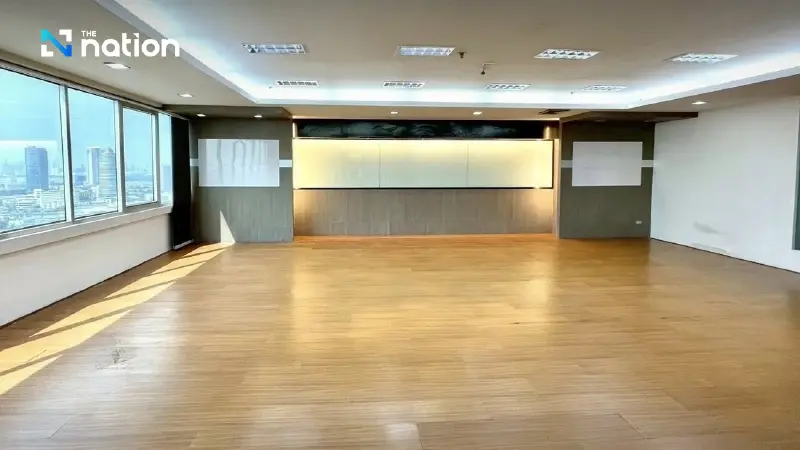


Bangkok to see 250,000 sq.m. of new office supply in H2, while sluggish economy curbs space demand. Landlords turn to flexible leases and price cuts to stay competitive.
Thailand’s economy continued to slow in the second half of 2025, but Bangkok’s office market showed resilience in the second quarter, supported by strong leasing demand, particularly for premium and “green” buildings.
This demand has intensified competition amid new supply and wider economic uncertainty.
Panya Jenkijwattanalert, Partner and Executive Director, Head of Office Agency service at Knight Frank Thailand, noted that while the economy faces headwinds from weaker exports and private consumption, the capital’s office market performed strongly in Q2, with nearly 200,000 sq.m. of new leasing activity.
Latest data shows Bangkok’s total office stock grew 1.7% quarter-on-quarter to 6.42 million sq.m. Four new towers entered the market, APAC Tower, KingBridge Tower, BTS Visionary Park and One Origin Sanampao, adding roughly 180,000 sq.m.
However, not all space was released to the market immediately, as some was reserved for owner use. Net absorption stood at 67,000 sq m.

“These new buildings all achieved environmental standards such as LEED Gold, underlining a rising shift in demand towards sustainable offices. Post-Covid companies are increasingly prioritising wellness, energy efficiency and brand image,” Panya said.
Still, selectivity remains key. Overall occupancy fell by 0.7 percentage points to 76.8%. Grade A offices dropped to 75.3% and Grade B slipped sharply to 74%, reflecting intense competition. Grade C buildings, however, saw occupancy climb to 80.5%, as cost-conscious tenants sought more affordable space.
Rents rise overall, but not across the board
Average monthly office rents in Bangkok edged up slightly to THB847 per sq.m. in Q2. However, a closer look reveals that rents by grade actually declined. Grade A rents fell 1.2% to THB1,233, Grade B dipped 0.7% to THB866, while Grade C remained flat at THB543.
“The overall increase was driven by new buildings entering the market. Although their asking rents are lower than the existing stock of the same grade, they are still above the market average. Meanwhile, older properties are cutting rates to stay competitive, narrowing the price gap between grades,” Panya noted.
The central business district (CBD) continued to soften, with average rents down 1.3% to THB957 per sq.m and occupancy slipping to 76%. The Ploenchit–Chidlom–Wireless Road area saw the sharpest rental decline of 2.6%.

The Nana–Asoke–Phrom Phong zone recorded lower rents but higher occupancy, while Silom–Sathorn–Rama IV rents held steady but occupancy fell.
In contrast, non-CBD areas are showing renewed strength. Average rents outside the CBD rose 2.2% to THB688 per sq.m., with mixed dynamics across sub-markets.
Phetchaburi–Ratchada posted modest rent growth alongside strong occupancy. Phahon Yothin–Vibhavadi rents jumped 5.8% on the back of new projects, though occupancy dropped 6.2%. Bangna–Srinakarin saw slight rental growth but lower occupancy as well.
Holding steady rather than expanding
Although the second quarter appeared positive, the broader economic slowdown in the second half of 2025 may weigh on new leasing decisions, particularly among firms affected by US import tariffs.
At the same time, declining consumer confidence has prompted many occupiers to delay investment, opting to “hold steady” rather than expand.
Adding further pressure, around 250,000 sq m. of new supply is expected to enter the market by year-end, intensifying competition. Landlords are responding by offering greater flexibility in lease terms, fit-out support, and additional value-added services to attract tenants.
“Today, competition is no longer just about price, but about the value tenants can gain while navigating uncertainty,” Panya observed.
Flexibility is the key to survival
If one word defines Bangkok’s office market in 2025, it is “flexibility.” From space design and rental pricing to contract negotiations, adaptability is becoming the decisive factor for both landlords and tenants. Organisations increasingly demand office solutions that can adjust to shifting conditions.
This quarter underscores a clear message: while the economy presents significant headwinds, the office market has not ground to a halt. Instead, it is entering an “era of adaptation,” where flexibility and a deep understanding of occupiers’ evolving needs will determine the long-term survival of building owners.
