
Thai Property Leaders Call for Government Action on Sustainable Urban Development


Industry experts urge policy reforms to make green building standards accessible whilst addressing Bangkok's affordability crisis
- Property leaders urged the government to adopt a holistic view of sustainability that balances environmental concerns with social inclusivity and economic viability.
- A key call to action is for the government to introduce long-term, fixed-rate mortgages to make housing more affordable for low-income buyers without direct subsidies.
- Panelists demanded fair and consistent enforcement of existing regulations to ensure that companies following sustainable practices are not at a financial disadvantage.
- Further recommendations include providing incentives for green developers and implementing the long-delayed carbon tax to penalize polluters.
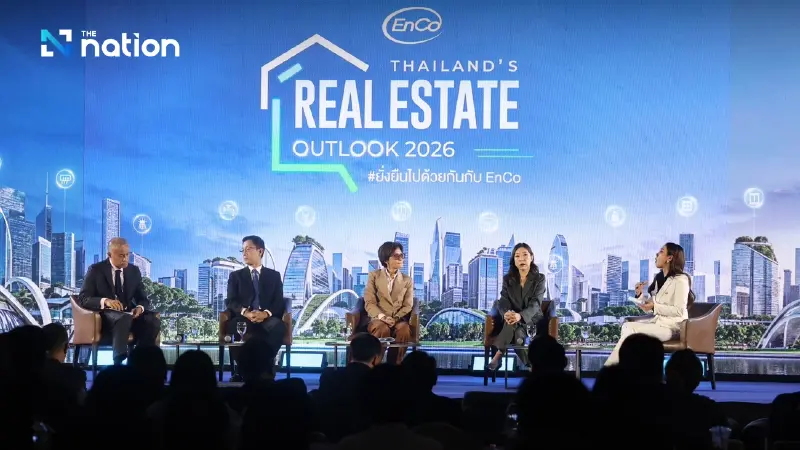
At a panel discussion on sustainable urban development held in Bangkok on 30 September 2025, leading Thai property sector figures highlighted critical barriers preventing the country from achieving truly sustainable cities—and issued urgent calls for government intervention.
The "Green Living, Smart City" forum, part of the Thailand's Real Estate Outlook 2026 conference at The Synergy Hall, EnCo C Building, brought together four industry leaders: Kessara Thanyalakpark, managing director of Sena Development; Narongwet Wajanapanich, managing director of Quality Construction Products; Samatcha Promsiri, chief of staff at Sansiri; and Phatsareephak Srikanchananon, head of Property Management at CBRE Thailand.
Beyond Environmental Concerns: A Holistic Vision
The panellists emphasised that sustainable urban development extends far beyond environmental considerations.
Dr Kessara stressed the importance of inclusiveness, citing Sena Development's Rent-to-Own programme developed in partnership with the Government Housing Bank, which enables low-income and freelance workers to transition from renting to homeownership within two years.
"A sustainable city isn't just about the environment, green spaces, or smart city technology—it's about people," Dr Kessara explained. "It's about ensuring everyone has access to opportunities for sustainable living."
Samatcha echoed this sentiment, outlining three critical pillars for urban sustainability: planet (environmental concerns), people (inclusive access), and profit (economic viability).
He cited Singapore's desalination facility as an exemplary model, where infrastructure serves dual purposes—providing essential services whilst creating public green spaces that enhance quality of life.

The Affordability Paradox
A central theme emerged around the tension between sustainability and affordability. Dr Kessara was blunt about the commercial reality: "If we're going to be green long-term, we must be profitable. Green cannot be a premium cost that makes products unaffordable."
She detailed how Sena Development, which focuses on the affordable segment (properties priced at 1-2 million baht), navigates this challenge.
"We measure everything constantly. We need to think carefully about how to be green without making it too expensive, and crucially, how to maintain that green standard affordably once people move in."
The discussion revealed a critical insight about housing affordability in Thailand.
Dr Kessara explained that buyers don't pay the full house price upfront—they pay monthly instalments determined by a combination of house price and interest rates.
Currently, a 1 million baht home requires monthly payments of approximately 6,000 baht, necessitating an income of around 18,000 baht for bank approval.
"This stems from banks hedging against 30-year uncertainty regarding interest rates," she noted. "If we could establish fixed rates—say 3% for 20 years, similar to Japan—that same 1 million baht home would require only 3,000 baht monthly, making it accessible to someone earning 9,000 baht instead of 18,000 baht."

Material Matters: Quality Versus Cost
Narongwet provided a stark illustration of the sustainability challenge from a manufacturer's perspective, asking attendees to visualise two factories: one prioritising worker safety, environmental standards, and product quality; another cutting corners to offer lower prices.
"If the responsible factory charges more, will you buy from them?" he asked. "That's the issue. Green must be profitable, or it becomes unsustainable."
He revealed compelling data: homes built with lightweight concrete blocks can reduce electricity costs by approximately 20%—a savings of 600 baht monthly, or 72,000 baht over 10 years.
"Consumers need to understand this value proposition. It's not expensive; it's higher cost but better value because of long-term savings."
However, he noted that some developers still prioritise initial construction costs over lifecycle value, with some even requesting reduced warranty periods to lower material costs—practices that undermine long-term sustainability.

Green Building: From Niche to Necessity
Phatsareephak outlined the evolution of green building standards in Thailand, noting that certification requirements have expanded beyond environmental concerns (LED, water management) to encompass health and safety (particularly post-COVID) and connectivity (smart building features).
She revealed that 100% of Grade A Plus buildings in Bangkok's Central Business District now hold at least one green building certificate.
"It's become a competitive necessity, not a value-add," she explained. "In today's oversupplied office market—this year will see the highest supply in history at nearly 500,000 square metres—buildings without green certification are losing tenants to certified competitors."
CBRE's research shows that whilst green buildings require higher initial investment, operating costs—which constitute 40% of total building expenses—can decrease by 10-20% over time, making them economically viable in the long term.
Systemic Barriers to Progress
Despite industry readiness, panellists identified significant structural obstacles.
Dr Kessara described the complexity of implementing seemingly simple policies like car-free zones in Bangkok, where a single city block might involve 30 different government agencies with overlapping jurisdictions.
"It's not that Thai people lack capability," she stressed. "We've received support from the World Bank and Asian Development Bank. But internal bureaucratic complexity makes execution extraordinarily difficult."
She also highlighted the tension between long-term sustainability goals and immediate economic pressures: "When policy clashes with livelihoods—when a street vendor says, 'My child starts school tomorrow'—how do you prioritise?"

Calls for Government Action
The panellists issued specific recommendations for Thailand's next government:
Dr Kessara urged exploration of social housing policies similar to those in Singapore and Japan, particularly long-term fixed-rate mortgages to improve affordability without government subsidies.
She noted that current tax incentives for affordable housing (properties under 1.5 million baht) have limited impact because developers cannot profitably raise prices anyway due to buyers' inability to secure bank financing.
Samatcha called for forward-thinking urban planning that considers social transformations, citing "gig economy" workers who increasingly work remotely across different cities, requiring flexible housing solutions.
"We need visionary policy that understands social change and designs infrastructure accordingly. Private developers can adapt quickly, but we need the right foundation."
Narongwet made a simpler but pointed request: "Just enforce existing regulations fairly. Ensure that doing things correctly isn't more expensive than doing them wrong—that would be punishing those who follow the rules. Don't create new policies; just properly supervise existing ones."
Phatsareephak advocated for incentives to reward environmentally responsible developers and building owners, whilst also calling for enforcement of the long-delayed carbon tax.
"If we can't help those who invest in sustainability, at least tax those who emit pollution. That policy was announced last year but never implemented."

The Long Road Ahead
The panellists agreed that sustainable urban development is not achieved overnight. As Dr Kessara concluded: "Sustainable cities aren't built in a day. Everything we're discussing requires investment today with returns in 5, 10, or 20 years. But if we don't start today, it will never happen."
Narongwet characterised the challenge through three dimensions: it's "difficult" (requiring fundamental shifts in thinking from short-term to long-term perspectives), "complicated" (involving numerous stakeholders from government to contractors to end-users), and "demanding" (requiring higher investment and sustained collaboration).
"This is a long journey," he acknowledged. "But we're doing this to deliver better cities and society to the next generation—so they won't criticise us for wasteful resource use."
