
Thai Property Market Faces Toughest Challenge in Decades as 2026 Looms
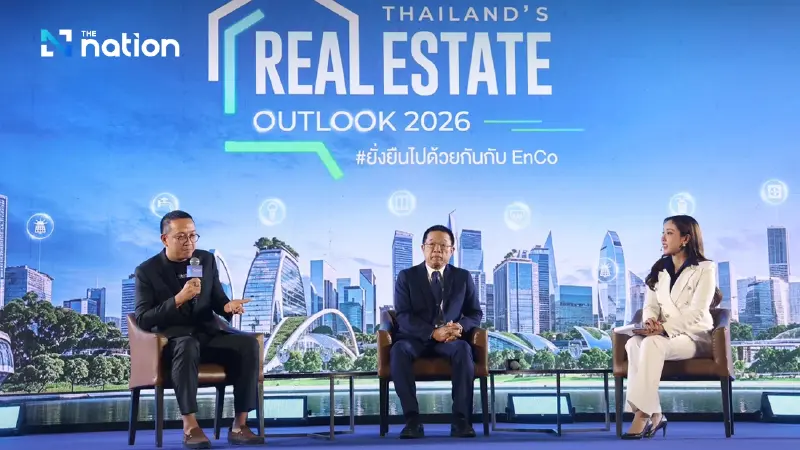


Industry experts warn of 'Long COVID' effect on real estate sector, with transfer values set to plunge 10-20% amid economic headwinds
- Thailand's property market is facing a severe and prolonged downturn, expected to continue through 2026, driven by a domestic economic slowdown that has severely weakened consumer purchasing power.
- The crisis is compounded by a significant drop in foreign buyers (particularly from China), high rates of bank loan rejections, and increasingly unaffordable new property prices.
- Experts predict the market's value could plummet to 700 billion baht, the steepest decline since the 1997 Asian financial crisis, with new housing supply at its lowest point in over 20 years.
Thailand's property market is confronting its most severe challenges in years, with experts warning that the prolonged downturn affecting the sector since the brief post-COVID-19 recovery shows no signs of abating through 2026.
Speaking at the "Thailand's Real Estate Outlook 2026: Challenges & Opportunities" forum on Tuesday, 30 September 2025, at The Synergy Hall, EnCo C Building, Energy Complex, industry leaders painted a sobering picture of the market's current state whilst identifying potential pathways forward.
Four Factors Drive Market Pressure
Chetthawat Songprasert, senior analyst at SCB Economic Intelligence Centre (SCB EIC), outlined four primary factors creating a cascading impact on the residential property market.
The domestic economic slowdown tops the list, with GDP growth projected to fall short of 2%. This has severely weakened purchasing power, particularly amongst middle to lower-income groups earning less than 50,000 baht monthly—a demographic representing nearly 70% of the market.

"This population segment faces continuous pressure from household debt and living costs rising faster than income, creating a significant barrier to purchasing decisions," Chetthawat explained.
More concerning still, the impact has begun spreading to higher-income groups above 50,000 baht monthly, who are delaying purchases due to economic uncertainty.
The global economic slowdown and policy uncertainties, particularly US tariff policies, comprise the second factor. Whilst initial clarity has emerged, detailed uncertainties remain, directly affecting foreign investors and purchasing power.
Chinese buyers, who previously represented nearly 60% of foreign purchases over the past 2-3 years, have declined to just 30%. Although buyers from other nations have emerged, they cannot fully compensate for the shortfall.
Financial institutions' credit rejections present the third challenge, particularly impacting lower-end buyers.
"Consumers have demand for residential properties but cannot purchase because banks won't extend loans," Chetthawat noted.
The fourth factor is the high and increasingly unaffordable pricing of new properties.

Market Value Could Plunge to 700 Billion Baht
These factors have driven nationwide property transfer values towards double-digit negative growth of approximately 10-20% this year—markedly worse than the previous year.
Issara Boonyoung, chairman of the Real Estate, Design and Construction Business Association Committee at the Thai Chamber of Commerce and honorary president of the Housing Business Association, reinforced the severity of the situation.
He estimates the residential market value, typically around 900,000 to 1 trillion baht annually, could decline to approximately 700,000 million baht this year—the steepest drop since the 1997 Asian financial crisis.
Issara revealed that supply has reached its lowest point in over 20 years, with new condominiums in Bangkok at their lowest level in 15 years. However, he views declining new supply as a "positive factor," representing healthy market adjustment by developers to maintain equilibrium.
He described the prolonged downturn, compounded by negative factors, as "Long COVID"—a continuing impact stemming from the loss of tourists and aggravated by global and regional issues affecting construction material costs.
Broader Economic Impact
The property sector's impact extends far beyond project developers, affecting the broader economic system. Real estate and construction account for approximately 5-6% of GDP and employ substantial numbers of workers.
Issara highlighted the sector's "multiplier effect" of 2.8-3 times, meaning every property investment creates ripple effects throughout upstream businesses such as construction materials and downstream sectors including furniture, electrical appliances, and other services.
Given this scale, governments have historically used the property sector as an economic driver.
Hidden Opportunities Remain
Despite these challenges, opportunities persist. Chetthawat identified the sub-5 million baht residential market, which developers and financial institutions may perceive as high-risk, as holding continued strong demand that remains inaccessible.
Alternative financing solutions beyond traditional bank loans—such as hire-purchase or rent-to-own schemes—could unlock substantial purchasing power within this demographic.
Meanwhile, Issara presented another significant positive indicator: Board of Investment (BOI) applications have surged to historic levels.
The first half of this year saw applications totalling 1.08 trillion baht, with promotion certificates issued exceeding 600,000 million baht—a 49% increase from the previous year.
These investments, concentrated primarily in the Eastern region, will create employment centres and industrial estates, ultimately generating residential demand.
However, Issara cautioned that during economic downturns, diversifying into unfamiliar businesses may not be optimal strategy.
International research suggests maintaining core business strength whilst using crisis opportunities to acquire businesses or assets at appropriate prices represents a shrewder approach.
Future Trends and Government Recommendations
Looking ahead five years, Chetthawat identified "value for money" as the most critical trend for buyers—not merely low prices, but value across dimensions including time and cost savings on commuting, explaining condominiums' continued popularity.
Sustainability and green building trends are gaining traction, but must be "tangible" and linked to value—such as designs reducing electricity costs or materials promoting wellbeing.
Both speakers delivered important recommendations to the new government. Issara emphasised that property will recover when the economy improves, making overall economic recovery acceleration paramount.
This includes expediting government formation and budget disbursement according to plan, and maintaining currency stability to support exports and tourism.
He urged the Bank of Thailand to consider policy interest rates to reduce debt burdens and improve credit accessibility, and called for extending property stimulus measures such as transfer fee and mortgage registration reductions, plus relaxing LTV criteria set to expire.
He also proposed more flexible lending criteria for freelancers.
Chetthawat added that whilst short-term stimulus measures are necessary to support the market, government must not neglect long-term structural solutions for the large population segment not yet ready to purchase.
This includes addressing debt problems and developing sustainable income structures—though difficult and time-consuming, it remains essential for building strong foundations for the economy and national purchasing power long-term.

Building Sustainable Growth
Thailand's property market stands at a crucial turning point.
Navigating this crisis requires developer adaptation—focusing on core business and addressing consumer value propositions—alongside balanced government policies combining short-term stimulus measures with long-term economic structural reforms to restore purchasing power for the majority.
This will prove key to driving the economic cycle and property industry towards sustainable growth once again.
Sirasak Chandrema, managing director of Energy Complex Company Limited (EnCo), stated that EnCo operates under a vision to develop real estate and manage buildings with excellent service for sustainable business growth, aiming to reduce greenhouse gas emissions and advance towards Net Zero Emissions by 2050, aligned with PTT Group policy frameworks.
The company is developing Energy Complex as a LEED Platinum energy-efficient building—an energy business hub designed for optimal resource utilisation, contributing to Smart City creation and employing Green Living technology to enhance operational efficiency towards Smart and Green innovation-driven organisational management, whilst creating long-term value for business, society, and the environment.
The forum aims to create understanding about Thai property market direction in 2026, enhance in-depth information exchange, and establish private sector cooperation frameworks to drive quality Thai property development whilst considering environmental and sustainable societal quality of life.

