
Sansiri and Mitsui Fudosan Expand Thai Ventures with THB28bn Roadmap
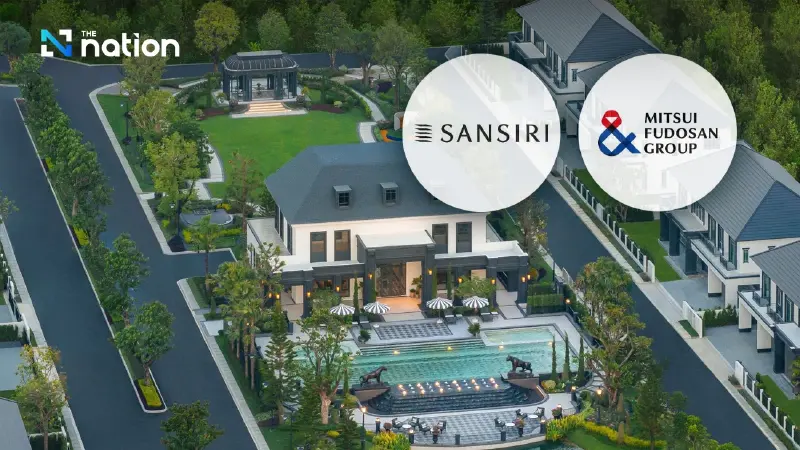


As domestic household debt and rising rates crush mass-market real estate, Sansiri and Mitsui Fudosan double down on high-resilient luxury housing
- Thai developer Sansiri and Japan's Mitsui Fudosan are expanding their joint venture with a THB 28 billion investment roadmap for 2025-2026.
- The partnership will strategically focus on Thailand's resilient luxury and ultra-luxury housing market, pivoting away from the mass-market segment affected by high household debt.
- The first major project under the new plan is "Setthasiri Krat Wongwaen-Chatuchot," a THB 3 billion premium housing estate in northern Bangkok.
- The collaboration allows Sansiri to diversify risk and integrate international standards, while signaling Mitsui Fudosan's confidence in Southeast Asia's premium property sector.
As domestic household debt and rising rates crush mass-market real estate, Sansiri and Mitsui Fudosan double down on highly resilient luxury housing.
Thai property giant Sansiri Public Company Limited has solidified its long-term growth strategy by broadening its joint-venture roadmap with Mitsui Fudosan Group.
The leading Japanese real estate developer and Sansiri have outlined a massive collaborative investment pipeline for 2025–2026, valued at 28 billion baht ($860 million).
The aggressive expansion comes at a challenging time for Thailand's broader real estate sector. With the domestic economy under heavy pressure from weakening consumer purchasing power and soaring household debt, major developers are forced to pivot away from the mass market.
Instead, the industry's largest players are targeting the luxury and ultra-luxury tiers—demographics that remain highly insulated from economic downturns.
Marking their first major joint deployment of 2026, the partners have launched "Setthasiri Great Wongwaen-Chatuchot," a premium detached housing estate with a project value of 3 billion baht ($92.2 million).
Located in northern Wongwaen-adjacent suburban corridors, the choice of the Chatuchot–Wongwaen neighbourhood reflects a highly optimistic outlook for northern Bangkok, which is currently benefiting from extensive transit network expansions and rapid outer-ring decentralisation.

Premium Demand Outpaces Market Slump
Architecturally themed around classic Berlin design aesthetics, the development targets affluent families with four distinct low-density house designs.
Living areas range from 287 to 504 square metres on land plots starting at 100 square wah (400 square metres). The high-end estate boasts over 10 rai (1.6 hectares) of communal parkland and a large central lake, with prices ranging between 18.99 million and 30 million baht ($583,000 to $922,000).
Indicating robust underlying liquidity within the premium segment, Sansiri managed to completely sell out the development's first phase within two days of its pre-sale window, prompting an immediate rollout of the subsequent phase.
Corporate analysts note the figures prove high-net-worth demand remains fundamentally intact, successfully independent of the higher interest rates gripping consumer-level retail banking.
Furthermore, local land value indicators within the Chatuchot–Wongwaen sector continue to show steady capital growth, climbing at an average rate of 8% to 12% annually.
Concurrently, the regional secondary resale market for detached homes has maintained a healthy clip of 7% to 9% per year, establishing the location as a resilient long-term asset haven for wealth preservation.

Strategic Capital and Global Alignment
From a corporate governance perspective, scaling the cross-border joint venture allows Sansiri to diversify macro risk, improve equity deployment efficiency, and systematically integrate institutional construction and design standards from a major international partner.
For Tokyo-listed Mitsui Fudosan, deepening its financial exposure in Thailand signals long-term institutional confidence in Southeast Asia’s premium property yields, driven firmly by affluent domestic buyers and real estate investors looking for stable yield alternatives.
The corporate alliance is further supported by Sansiri's defensive balance sheet. Reporting its financial results for the first quarter of 2026, the developer posted a total revenue of 6.69 billion baht ($205.6 million) and a net profit of 864 million baht ($26.5 million)—representing a 6% increase year-on-year.
The latest joint-venture rollout goes beyond a single high-end estate launch. It serves as a clear signal that Sansiri and Mitsui Fudosan are consolidating their market dominance by shifting resources directly into the luxury tier, which stands out as the most insulated and robust segment within the Thai property sector today.
