
Thai Dairy Reform Urged as Imports Undercut Domestic Cooperatives
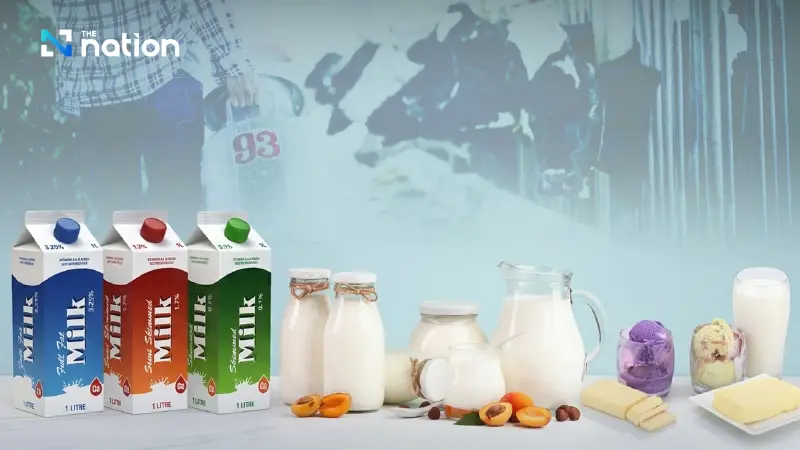


A sharp drop in dairy cattle populations and a heavy reliance on the school milk scheme leave local smallholders highly vulnerable to foreign imports
- Thai dairy farmers are abandoning the industry due to high feed costs and intense competition from cheap foreign imports, causing a sharp decline in the number of farmers and cattle.
- Despite a crisis in domestic raw milk production, Thailand's exports of processed dairy goods like yoghurt and UHT milk are surging, as large companies predominantly use imported milk powder.
- The local industry is highly vulnerable due to its over-reliance on a shrinking government school milk program, which is contracting because of the country's declining birth rate.
- Experts are urging a structural overhaul, including building centralized milk powder plants for local milk and implementing a "local content linkage" policy to force importers to buy a quota of Thai-produced milk powder.
A sharp drop in dairy cattle populations and a heavy reliance on the school milk scheme leave local smallholders highly vulnerable to foreign imports.
Thailand's processed dairy sector is experiencing an alarming structural paradox. While international exports of Thai yoghurts, UHT milk, and ice cream are surging, the country's domestic production base is quietly crumbling as local dairy farmers abandon the industry en masse.
According to data compiled by the Trade Policy and Strategy Office (TPSO) under the Ministry of Commerce, the upstream livestock sector is facing critical supply-side bottlenecks.
Skyrocketing feed costs, persistent labor shortages, outdated farm management, and intense competition from cheap Western imports are driving local smallholders out of business.
Nantapong Chiralerspong, director of the TPSO, revealed that dairy export values have enjoyed steady growth, exceeding 21 billion baht in 2025.
This momentum has carried into 2026, with first-quarter exports (January–March) reaching $134.3 million (approximately 4.16 billion baht). Yoghurt and drinking yoghurt led the trade at $35.1 million (26.1% of dairy exports), followed by ice cream at $31 million (23.1%), and UHT milk-based beverages at $21.5 million (16.0%).
The primary destination remains the ASEAN region, which absorbs 81.3% of Thailand's dairy exports, with East Asian markets following at 13.3%.
Crucially, however, much of this export success is driven by large-scale processing companies utilising imported skimmed milk powder, masking a severe recession among domestic dairy farmers.
Thailand's modern dairy industry began in 1962, following a royal initiative by King Bhumibol Adulyadej and the Danish government, which introduced systematic cattle farming via the Dairy Promotion Organisation of Thailand (DPO).
To safeguard the industry and combat childhood malnutrition, the state launched the National School Milk Programme in 1992, creating an artificial demand cushion by mandating that a massive portion of local fresh milk supply be directed to schools.
However, the signing of Free Trade Agreements (FTAs) with Australia and New Zealand in 2005 eventually eliminated import tariffs and quotas, leaving local smallholders heavily exposed to advanced, highly subsidized global competitors.
The modern domestic supply chain is facing severe strain. The TPSO notes that agricultural price volatility has made animal feed costs unpredictable and risky for small and micro-farmers, who constitute the backbone of local production.
Lacking capital, these smallholders cannot automate their milking or management systems to offset acute agricultural labour shortages.
On the demand side, local fresh milk remains heavily reliant on the government’s school milk scheme. However, with Thailand's birth rate plummeting, a shrinking student population means the programme's consumption capacity is naturally contracting.
At the same time, local raw milk cannot compete on price or consistency with premier global producers like New Zealand, Australia, and the European Union.
The livestock figures highlight a worrying trend:
In 2021, Thailand had 24,145 active dairy farmers tending to a national herd of 810,518 cattle.
By 2025, the number of registered dairy farmers collapsed to 15,638, while the cattle population shrank to 560,551.
Industry figures warn that emergency measures are needed to preserve national food security. Emeritus Prof Dr Sorntep Tumwasorn, an advisor to the Animal Husbandry Association of Thailand, has called for a complete structural overhaul, urging the state to transition from an ad-hoc welfare system to a data-driven infrastructure model.
Dr Sorntep has proposed the establishment of centralised milk powder processing plants across three major hub provinces—Saraburi, Ratchaburi, and Nakhon Ratchasima—to absorb local raw milk surpluses.
Crucially, he argues this should be bound to a "local content linkage" policy, legally requiring commercial importers of foreign milk powder to purchase a proportional quota of Thai-manufactured milk powder.
Further recommendations include reforming the school milk program by replacing relationship-based quotas with a transparent, quality-led bidding process based on actual solid milk content.
Dr Sorntep also advocates deploying blockchain technology to track supply chains and eliminate "ghost milk"—unregulated or smuggled foreign milk that enters the local market and illegally undercuts the prices paid to legitimate Thai farmers.
The urgency comes amidst a rapidly expanding global market. Fortune Business Insights projects the global dairy market will hit $1.06 trillion in 2026, scaling to nearly $2 trillion by 2034.
While the Asia-Pacific region commands the lion's share of this growth (41.09%) due to rising protein demands in China and India, Thai experts warn that without immediate domestic supply-side intervention, Thailand will miss out on the boom, transforming from a regional production hub into a mere processor of foreign ingredients.
