
EGAT’s LandMoS landslide warning system set for nationwide installation at dams
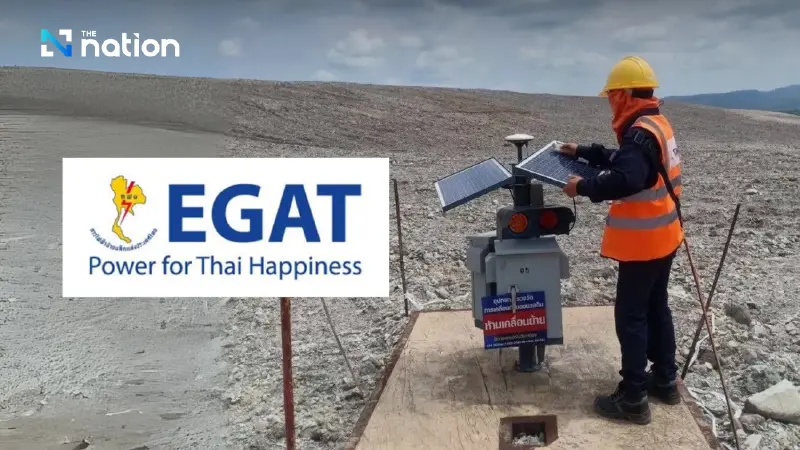


When a major landslide struck the Mae Moh mine in Lampang in 2018, causing damage of more than 100 million baht, the Electricity Generating Authority of Thailand (EGAT) responded by enhancing ground-movement monitoring with Global Navigation Satellite System (GNSS) surveys at over 100 points around the mine.
However, this method required staff to physically access high-risk areas, often with delays due to travel and work schedules. As a result, data could not be collected frequently enough for effective analysis.
The process also exposed personnel to risk. Existing commercial ground-movement monitoring devices were found to be costly and unable to fully meet operational needs.

From challenge to innovation: LandMoS
To address these shortcomings, EGAT partnered with Chiang Mai University in 2021 to develop a more affordable but accurate and fully automated monitoring system called Landslide Monitoring System (LandMoS).
Tests conducted at the Mae Moh mine showed the system performed effectively, helping to mitigate losses in at least two subsequent landslide incidents in 2021 and 2023. In both cases, timely alerts enabled surrounding communities and mine workers to take preventive action, preventing harm to residents and disruption to power generation.
The system cut direct damages by more than 52 million baht and reduced conveyor downtime from 96 days after the 2018 landslide to just 15 days in the 2023 event, despite both incidents being of similar scale.

How LandMoS works
LandMoS achieves high-precision positioning accuracy of 1–5 centimetres using GNSS satellites in Real Time Kinematic (RTK) mode. It operates continuously, powered by solar panels with backup batteries lasting two to three days.
The system automatically transmits position data to a central server every five minutes, with results accessible via a web application and mobile alerts.

Expansion plans
EGAT’s Mae Moh mine planning and services division told Post Today that 60 LandMoS stations are currently installed at the Lampang mine, with additional stations at two high-voltage transmission towers in Songkhla and two at the Lam Takhong pumped-storage power plant in Nakhon Ratchasima.
By 2029, EGAT plans to expand the system to more than 233 stations across its dams nationwide. Discussions are also under way to extend deployment to coal mines in the Lao PDR.

