
Thailand emerges as a top hub for PCB production as nearly 60 companies set up factories
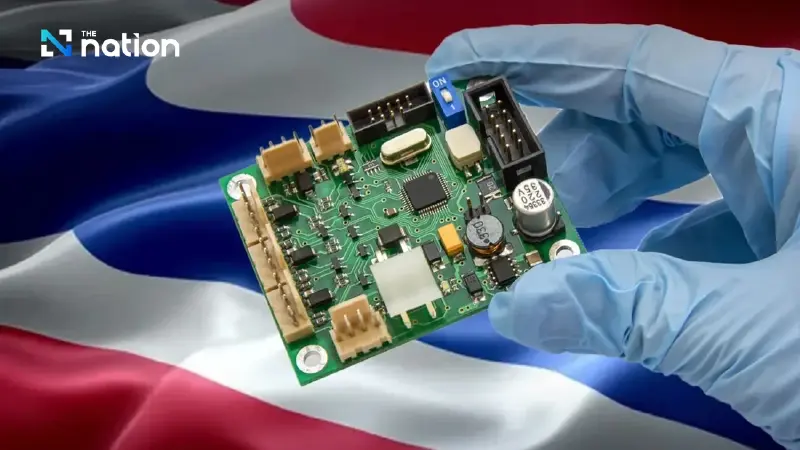


Amid the global AI boom, Thailand is positioning itself as a key PCB production hub, attracting major companies like VGT and GCE to set up factories.
Amid the global shift towards the AI era, the value of companies in the AI chip supply chain has surged. While Thailand may not be as innovative as China or the US, it is determined not to be left behind. The country is aiming to become a global hub for printed circuit board (PCB) production, capitalising on the influx of foreign investment fleeing China due to pressure from the US and moving towards ASEAN instead.
PCBs, or Printed Circuit Boards, are the essential foundation of the electronics world, serving as the base for placing electronic components such as chips, resistors, capacitors, and connectors. They are as crucial as AI training chips in enabling the operation of smartphones, cars, AI servers, and supercomputers.
Nikkei Asia reports that Ayutthaya province has become an attractive location for PCB production, with the latest move from Victory Giant Technology (VGT), a leading Chinese PCB manufacturer and key supplier for Nvidia’s chip products. VGT is rapidly setting up new equipment at its second factory in Thailand, having acquired the facility from Taiwan’s APCB Group less than a year ago.

VGT is not alone. Taiwan’s Gold Circuit Electronics (GCE), which produces PCBs for Nvidia’s networking equipment, is also running full production at its first Thai plant.
Global PCB giants Zhen Ding Tech and Unimicron are also securing space in Thailand, adding to the growing interest in the country as a manufacturing hub.
Several PCB manufacturers acknowledge that the AI demand is the driving force behind Thailand’s selection as a new production base. VGT, capitalising on the AI boom, has seen its market value soar to $32.6 billion, surpassing Zhen Ding Tech, the world’s largest PCB manufacturer by revenue, which stands at $5.97 billion. This highlights how the AI trend has spurred rapid growth.
The Taiwan-based Industry, Science and Technology International Strategy Center projects that the value of PCB production in Thailand will grow from $3.5 billion in 2024 to $5.62 billion by 2030, with an annual average growth rate (CAGR) of 7.6%, surpassing the global average.
Nearly 60 companies set up factories in Thailand
Amid geopolitical pressures, particularly the US-China tensions and the risk of China potentially using military force against Taiwan, the "Taiwan plus one" strategy has emerged. This strategy involves expanding production bases outside of Taiwan to spread political and supply chain risks.
Following the visit of former US Speaker Nancy Pelosi to Taiwan in 2022 and China's large-scale military drills around Taiwan in response, investors have increasingly sought safe havens for their electronics supply chains. Thailand has thus become an attractive target.
In less than three years, nearly 60 PCB manufacturers from China and Taiwan have set up new factories in Thailand, including major players like Unimicron, Zhen Ding Tech, Shennan Circuits, and Victory Giant. These investments have also attracted suppliers of equipment and raw materials, who have established service offices in Thailand.
Thailand has high expectations for this new wave of investment, aiming to become the world’s second-largest PCB manufacturing hub, just behind China. Despite the Trump administration’s 19% tariff on Thai imports, the impact on the PCB sector has been limited, as these components are passed on to assembly plants in Vietnam, India, and other countries before being used in final products exported to the US.
Charles Shen, President of Zhen Ding Tech, said that expanding investment in Thailand is a key part of the company’s record-high investment plan, amounting to over $60 billion Taiwan dollars this year and in 2026. This strategy aims to capture major growth opportunities driven by the demand for AI.
Meanwhile, T.J. Tseng, President of Unimicron, revealed that the company is expanding its investment in Thailand, having secured land for up to five new factories. If demand remains strong, the first products to be produced here will include PCBs for satellites and gaming consoles. Cheng also did not rule out the possibility of shifting some high-end chip production to Thailand.
Challenges from global economic and geopolitical factors
A technology analyst and PCB industry expert from International Standard for Testing and Investigations (ISTI), predicts that foreign PCB manufacturers in Thailand will gradually increase production of mid-to-high-end PCBs, which will help the country’s manufacturing value continue to grow. However, this analyst warns that global economic dynamics, geopolitical risks, domestic infrastructure, and rising labour costs may impact the development of Thailand’s PCB industry.
Meanwhile, a supply chain analyst from Taiwan Institute of Economic Research (TIER), views Thailand’s current situation cautiously, stating that the direction of Thailand becoming a PCB hub is still unclear at this time. The main reason for this uncertainty lies in the demand volatility in markets unrelated to AI, which may be impacted by US tax policies.
This senior analyst further added that many new PCB producers in Southeast Asia have only set up 1-2 production lines. Whether they expand to economies of scale will depend on the recovery of the global economy amidst the uncertainties surrounding tax policies, the analyst said.
In summary, Thailand is at a crossroads, with the opportunity to become a global PCB production hub amidst the influx of foreign investment. If it can address weaknesses in skilled labour, cost, and domestic ecosystem, Thailand may become the third base of the global technology supply chain, after China and Taiwan.
