
Universal Robots hosts Southeast Asia's largest collaborative robotics conference in Bangkok
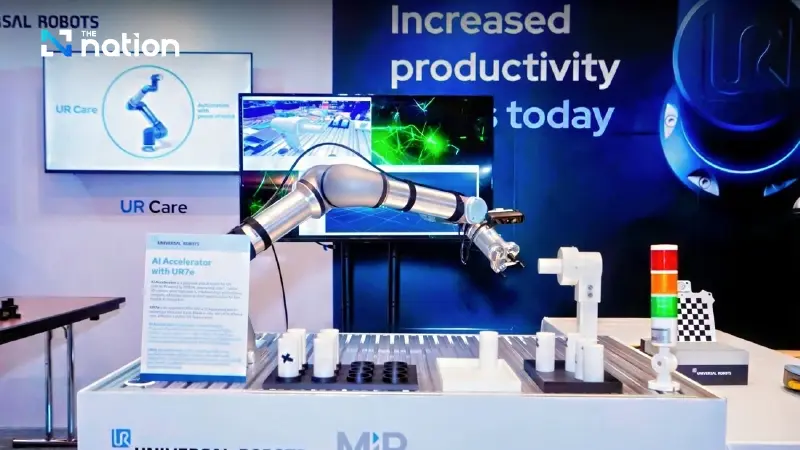


Event showcases AI-powered automation solutions and next-generation cobots, strengthening Thailand’s position as a regional Industry 4.0 hub
- Universal Robots hosted "Collaborate Thailand 2025" in Bangkok, Southeast Asia's largest conference on collaborative robotics, which gathered over 350 industry leaders.
- The event featured live demonstrations of more than 15 collaborative robots (cobots) and showcased new products, including AI-powered solutions to address manufacturing challenges.
- A key highlight was the introduction of the AI Accelerator platform, which enables developers to build adaptive automation solutions for tasks like defect detection and smart path planning.
- The conference aimed to reinforce Thailand's position as a regional automation hub and demonstrated Universal Robots' commitment to making advanced automation more accessible to local businesses.
Universal Robots has reinforced Thailand's position as a growing automation hub by hosting Collaborate Thailand 2025, the largest collaborative robot conference in Southeast Asia, in Bangkok on October 8th.
Bringing together more than 350 industry leaders and decision-makers to explore the future of manufacturing automation, the event featured live demonstrations of more than 15 collaborative robots (cobots).
Collaborate 2025 also showcased cutting-edge AI-powered solutions designed to address mounting challenges facing manufacturers across the region, including labour shortages, cost pressures, and increasingly complex production demands.
"Automation is no longer a choice but a strategic imperative for manufacturers," said Poi Toong Tang, Vice President for Asia Pacific at Teradyne Robotics, Universal Robots' parent company. "The conversation has shifted from 'why' to 'how fast.' We are leading this transformation, bringing physical AI and flexible automation from concept to real-world impact."

Next-generation hardware and AI integration
The conference introduced several groundbreaking products, including the UR8 Long—globally launched last month—and the UR15, which delivers a maximum tool centre point speed of 5 metres per second.
The company also showcased market-tailored models including the UR7e and UR12e, specifically designed to meet regional manufacturing needs.
A standout feature was Universal Robots' AI Accelerator, which runs on the NVIDIA Jetson AGX Orin system-on-module and is powered by NVIDIA Isaac CUDA-accelerated libraries.
The platform enables developers to build adaptive automation solutions with applications including AI object detection, smart path planning, defect detection, and workspace calibration.
Colin Soh, Sales Director for Southeast Asia and Oceania at Teradyne Robotics, emphasised Thailand's strategic importance: "Thailand has the right ingredients to become a regional leader in automation with strong government support, skilled talent, and a robust manufacturing base. We are committed to making advanced automation more accessible as Thailand accelerates its Industry 4.0 goals."

Real-world applications demonstrated
Live demonstrations with Universal Robots' ecosystem partners showcased practical applications across pick-and-place operations, assembly, welding, inspection, and spraying.
These demonstrations illustrated how businesses of all sizes can achieve measurable productivity and quality gains through collaborative automation.
Japanese automotive supplier Toyoda Gosei Thailand provided a case study in successful cobot integration.
The company has combined Japan's Karakuri craftsmanship philosophy with Universal Robots' collaborative systems to create flexible and efficient automation solutions.
"To address labour shortages on our production lines, we have integrated Japan's craftsmanship philosophy with UR collaborative robots to build a more flexible and efficient automation system," said Keigo Kimura, Vice President at Toyoda Gosei Thailand. "This approach not only eases the physical workload for our employees but also helps cultivate the next generation of automation engineers."

Localisation strategy for regional growth
In a media briefing, Tang outlined Teradyne Robotics' commitment to localisation, noting that many manufacturers prefer to work with local suppliers and system integrators rather than importing entire production lines from overseas.
"We are very invested in Thailand," Tang said, confirming the company maintains a local team in Bangkok.
The strategy includes developing an ecosystem of distributors and system integrators whilst collaborating with higher education institutions to supply cobots and curriculum for training the next generation of robotics engineers.
Looking at Thai SMEs’ adoption on collaborative robots, Thanakrit Thaneerat, Regional Manager, Indo-China, Teradyne Robotics explained that what SMEs need is customization, the approach that differs from standard practices, and utilizes specialized technology that fit specific tasks of the SMEs.
“For SMEs, our technology functions as a flexible platform, with our cobots serving as the core “arms and legs” that can be expanded through our ecosystem of partners. They help guide SMEs on compatible add-ons—such as grippers for object handling or cameras for vision applications. This platform-based design allows high flexibility and easy customization to meet specific business needs.”
Teradyne Robotics operates two main product lines: Universal Robots' collaborative robots for production lines, and Mobile Industrial Robots' autonomous mobile robots (AMRs) for material transport.
Whilst the company primarily serves manufacturing sectors including automotive, electronics, semiconductors, and metal fabrication, it also provides material transport solutions for medical and pharmaceutical facilities.

AI adoption and sustainability focus
Looking ahead, Tang identified AI adoption as "the next big transformative event" in robotics over the next three years. The focus, he said, will be on making AI easier for end-users and system integrators to adopt.
On environmental commitments, Axel Gustafsson, Sr Director Product Management, Universal Robots highlighted three core areas: deploying recycled materials in product construction, designing for lower power consumption, and optimising the robot-weight-to-payload ratio to minimise energy requirements.
The company aims to achieve one of the industry's best ratios, significantly reducing the electrical energy needed to operate its robots.
“By using robots and our products we can improve productivity; and, by improving productivity we can also reduce the amount of energy use in production. All that contributes to sustainability or lower environmental impact” said Axel.
Tang also added that their put focus on the total weight of the robot as a ratio to the payload that it can carry.
“We have one of the best lowest ratio. The lower the weight of the robot to the payload, the energy use to drive the robot is also much lower.”
For manufacturers still hesitant about cobot adoption, Tang recommended starting small with pilot projects to evaluate financial benefits, minimise downtime risks, and improve safety before progressing towards wider automation deployment.

“The future is going to be competitive. Manufacturers are required to be agile. The hesitation to robotic adoption is understandable, but to overcome challenges, robotics and automation is the key” said Tang.
Universal Robots has sold more than 100,000 cobots worldwide and positions itself as a global leader in collaborative robotics.
The company is part of Teradyne Inc., a NASDAQ-listed supplier of automatic test equipment and advanced robotics technology with more than 60 years of history.
