
Thailand Charts Path to Carbon Neutrality Through International Energy Collaboration
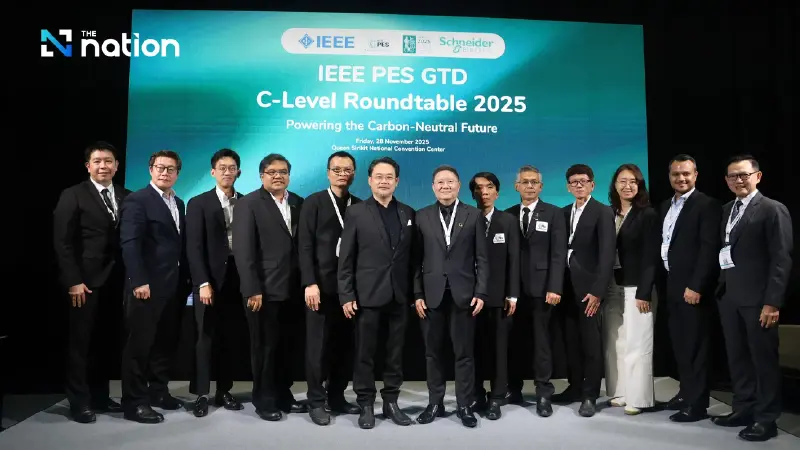


Industry leaders converge at IEEE PES GTD Asia 2025 to discuss renewable integration, grid modernization, and digital solutions for Thailand's energy transition
- Thailand is fostering international collaboration, exemplified by the IEEE PES GTD Asia 2025 forum, to unite government, industry leaders, and technology providers in planning its energy transition to carbon neutrality.
- The national strategy involves integrating renewable energy, modernizing the grid, and exploring future technologies such as small modular reactors (SMRs), hydrogen, and carbon capture systems.
- International technology partners like Schneider Electric play a crucial role by providing digital, automated, and SF₆-free solutions to make the adoption of sustainable energy economically feasible.
- Key challenges to achieving carbon neutrality include the need for clearer government policies and regulations to support renewable energy adoption and overcoming the high initial costs of green technology.
Industry leaders converge at IEEE PES GTD Asia 2025 to discuss renewable integration, grid modernization, and digital solutions for Thailand's energy transition.
Thailand's energy sector took centre stage in the regional spotlight as industry leaders, government officials, and technology providers gathered for a high-level roundtable discussion at IEEE PES GTD Asia 2025, underscoring the nation's commitment to achieving carbon neutrality whilst navigating the complexities of energy security and economic feasibility.
The exclusive forum, held in collaboration with Schneider Electric Thailand, brought together C-suite executives and policy architects to address the pressing challenge encapsulated in its theme: "Powering the Carbon-Neutral Future: From Ambition to Action in a Decentralized, Digital Energy World."

International Recognition and Strategic Positioning
The event marked a significant milestone in Thailand's efforts to position itself as a regional leader in the energy transition.
Assoc Prof Dr Somporn Sirisumrnnukul, IEEE PES GTD Programme Chair from King Mongkut's University of Technology North Bangkok, emphasised the strategic importance of the gathering, noting that it represented a crucial moment in the global energy transition.
Thailand’s strengthened commitment to carbon neutrality has intensified the urgency for collaborative solutions across sectors—government, energy, infrastructure, and technology—bringing stakeholders together for strategic dialogue under the theme:
“Powering the Carbon-Neutral Future: From Ambition to Action in a Decentralized, Digital Energy World.”
We are now at a pivotal moment in the global energy transition. Organizations are moving beyond ambition by translating net-zero commitments into concrete actions, shifting from passive energy consumers to active producers and participants within the energy system. Digital technologies, decentralized energy systems, and smart energy trading mechanisms play a critical role in accelerating the transition toward a carbon-neutral economy.
This ambitious national direction has catalyzed unprecedented engagement among utilities, technology providers, and industrial consumers, fostering deeper discussions on practical and scalable pathways to decarbonization.

The Technology-Policy-Market Nexus
A central theme emerging from the discussions was the intricate interplay between technological advancement, regulatory frameworks, and market dynamics.
Warit Rattanachuen, Deputy Governor for Strategy at the Electricity Generating Authority of Thailand (EGAT), outlined a phased approach to energy transformation, identifying renewable energy integration as the immediate priority, followed by emerging technologies including small modular reactors (SMRs), hydrogen, and carbon capture systems.
"We compared the three technologies that we're hearing about now: hydrogen, carbon capture, and SMR," Warit explained, noting that whilst all three have pilot projects globally, commercial viability remains elusive.
He suggested that SMRs appear closest to widespread deployment, with existing maritime applications providing a technological foundation that requires adaptation rather than fundamental innovation.

However, the path forward is not without substantial hurdles.
Vuthikorn Anusasamornkul, Manager, Business Innovator and Strategy in Energy at PTT Public Company Limited, emphasised Thailand's dual challenge of managing both physical climate risks and transition risks.
PTT's pioneering carbon capture and storage (CCS) project at Arthit field represents Thailand's commitment to this technology, which has been incorporated into the nation's updated Nationally Determined Contributions.

Schneider Electric's Leadership in Sustainability Technology
Schneider Electric's presence at the forum highlighted the critical role technology providers play in Thailand's energy transition.
Mongkhon Tangsiriwit, Cluster President for Thailand, Myanmar, and Laos at Schneider Electric, shared the company's remarkable achievement of being ranked the world's most sustainable company by Time magazine and Corporate Knights in 2025 – recognition stemming from over a decade of embedding sustainability into core business strategy.
The company's approach demonstrates the commercial viability of sustainability-focused business models.
Schneider Electric has targeted 80 per cent of its revenue to come from sustainability-related products and services by the end of 2025, whilst simultaneously achieving carbon neutrality across its global operations, including more than 200 factories worldwide.

Perhaps most impressively, the company has helped suppliers, partners, and customers avoid or reduce 792 million tonnes of carbon emissions as of Q3 2025, approaching its 800-million-tonne target.
"Our mission as a technology provider is to make sustainability economically feasible," Mongkhon emphasised, addressing concerns about the cost implications of green technology adoption. "Otherwise, sustainable solutions remain theoretical rather than practical."
Schneider Electric's comprehensive approach encompasses three pillars: electrification, digitisation, and automation.

Bilal Arif, Global Launch Leader for Air Insulated Switchgear at Schneider Electric, detailed how the company is addressing utility sector challenges through proactive electrical asset management, deploying smart sensors for condition monitoring and IoT-enabled devices that use AI-based algorithms to predict equipment behaviour and optimise operations.
The company's commitment to SF₆-free equipment represents another dimension of its sustainability focus.
Schneider Electric has transitioned its entire portfolio of gas-insulated switchgear for medium voltage applications to SF₆-free alternatives using clean air technology – a shift that addresses both environmental concerns and operational efficiency whilst managing costs through innovative engineering approaches.

Nancy Lin, Power System Commercial Vice President for East Asia at Schneider Electric, stressed the importance of considering total cost of ownership rather than merely initial capital expenditure.
"Globally, we've conducted studies showing average total cost savings of 10 to 15 per cent when factoring in operational expenses, predictive maintenance, and avoided failures," she noted, challenging traditional procurement approaches that focus primarily on upfront costs.

Grid Modernization and Regulatory Evolution
The integration of variable renewable energy sources presents perhaps the most immediate challenge for Thailand's distribution utilities.
Dr Somchai Songsiri, Assistant Governor for System Planning at the Provincial Electricity Authority (PEA), painted a vivid picture of both the opportunity and the challenge facing the sector.
With approximately 20 million residential customers connected to PEA's low-voltage grid and average household consumption of 200 units monthly, the theoretical potential for rooftop solar deployment is staggering.

If each household were to install just 2 kilowatts of solar capacity, Thailand could add up to 40 gigawatts of distributed generation, equivalent to approximately 20 per cent of national electricity consumption.
“The technology is already available. With sufficient investment, we can procure any technology we need,” Somchai stated candidly. “The real challenge in this country lies in the lack of clarity and consistency in regulations and policy.”
He highlighted the current zero-export policy, which prevents households from sending excess solar generation back to the grid, as a significant barrier to renewable energy adoption.
This regulatory constraint, designed to protect grid stability, paradoxically limits the very distributed generation that could accelerate Thailand's energy transition.

Pisanu Tantitavorn, Deputy Governor for Strategy and Sustainability at the Metropolitan Electricity Authority (MEA), echoed these concerns whilst outlining MEA's "smart retrofit" approach, which balances three critical factors: reliability, cost, and environmental impact.
MEA is deploying smart metres, transformer monitoring systems, and IoT sensors to gather the data necessary for intelligent grid management, though he acknowledged that green equipment often carries a 50 per cent cost premium over conventional alternatives.

Industrial Sector Perspectives
Industrial energy consumers brought practical perspectives to the discussion, highlighting the immediate challenges of energy transition.
Chanwut Limpichai, Energy Management Director at Eco Plant Services Co., Ltd. under the SCG Group, discussed biomass energy's role in the industrial portfolio, noting its advantage of providing continuous power unlike intermittent solar generation.
However, biomass availability varies significantly by region, with central Thailand facing supply constraints whilst northern and southern regions offer better prospects.

The data centre sector, represented by Tanapong Ittisakulchai, Chief Executive Officer of NTT DATA Thailand and Cambodia-Laos-Myanmar, emphasised the industry's focus on immediate efficiency gains whilst awaiting longer-term technological breakthroughs.
“At NTT DATA, net-zero is not just a commitment - it’s how we operate. We are targeting net-zero emissions in our own operations by 2030 and across our entire value chain by 2040, employing advanced cooling systems and AI-based optimisation to reduce energy consumption whilst improving operational efficiency.”

The Digital Imperative
Daren Gong, East Asia One Software Leader and Solution Architect at Schneider Electric, provided perhaps the most comprehensive analysis of the technological pathway forward.
He identified two fundamental challenges hindering renewable energy adoption: the mismatch between intermittent renewable generation and stable demand requirements, and the energy losses inherent in converting between different energy forms.
"Throughout renewable power-to-X applications, energy is transformed from one form to another multiple times," Gong explained. "Every transformation results in energy loss, which ultimately makes production costly."
His proposed solution emphasises three interconnected pillars: technology evolution, supportive government policy, and robust market demand. Critically, he argued that technology represents the most stable of these three factors, continuing to advance regardless of political or economic cycles.
"In the past 30 years, we've progressed from electrification to automation to digitalization, and now to industrial artificial intelligence," Gong noted. "Technology always moves in one direction."
Schneider Electric's power-process integration approach exemplifies this digital transformation.
By combining electrical system design with process optimization from the earliest planning stages, the company has demonstrated significant capital expenditure reductions for large-scale projects, including a 1.5-gigawatt green ammonia facility in China.
This integrated approach allows for better convergence between renewable power supply profiles and load requirements, improving both technical feasibility and economic viability.

Future Challenges and Opportunities
The discussion revealed several emerging challenges requiring sustained attention.
The Eastern Economic Corridor (EEC), Thailand's ambitious special economic zone, faces resource constraints that extend beyond electricity to include water availability.
Warit suggested that whilst demand continues growing in the EEC, Thailand must carefully consider the optimal scale of development given infrastructure limitations.
Small modular reactors emerged as a potential long-term solution for baseload power, though participants acknowledged significant regulatory and public acceptance hurdles.

The International Atomic Energy Agency's assessment indicates Thailand faces a 10 to 12-year timeline before SMRs could be deployed, primarily due to gaps in regulation and public engagement.
Waste-to-energy systems, particularly in industrial areas like the EEC, represent a more immediate opportunity. EGAT's investment in US-based waste-to-hydrogen projects demonstrates the potential of this approach, which addresses both energy needs and waste management challenges.
The roundtable also touched on more speculative technologies, including geothermal energy for the EEC development.
Whilst participants expressed scepticism about shallow geothermal applications in eastern Thailand, noting geological constraints, the discussion highlighted the sector's openness to exploring diverse energy sources.

Looking Forward
As Thailand prepares for implementation of its Climate Change Act and updated Nationally Determined Contributions, the discussions at IEEE PES GTD Asia 2025 underscore both the complexity of the energy transition and the collaborative spirit necessary to achieve it.
The convergence of international utilities, technology providers, and Thai government entities at this forum demonstrates the country's emergence as a regional hub for energy innovation.
Schneider Electric's dual achievement of commercial success and sustainability leadership provides a template for how technology companies can drive the energy transition whilst maintaining economic viability.
The company's emphasis on making sustainable solutions economically feasible addresses one of the primary barriers to widespread adoption of clean energy technologies.
For Thailand's energy sector, hosting Asia's largest energy exhibition delivers multiple strategic benefits.
It positions Thai utilities and regulators at the forefront of global energy discussions, facilitates knowledge transfer from international technology leaders, and attracts investment in sustainable energy infrastructure.

Perhaps most importantly, it creates the collaborative ecosystem necessary for addressing the interlinked challenges of energy security, affordability, and sustainability.
As Assoc Prof Dr Nopbhorn Leeprechanon, the forum's moderator from Thammasat University, noted in his closing remarks, the discussions ranged across solar energy, security concerns, cost effectiveness, government policy, and market dynamics.
The real-world case studies and solutions presented offer pathways forward for Thailand's energy transition.
The message from IEEE PES GTD Asia 2025 is clear: Thailand's journey to carbon neutrality will require continued international collaboration, regulatory evolution, and sustained commitment to both technological innovation and economic pragmatism.
With events like this roundtable fostering dialogue between all stakeholders, Thailand is positioning itself not merely as a participant in the global energy transition, but as a regional leader shaping its trajectory.
