
Schneider Electric Unveils Comprehensive Decarbonisation Solutions at IEEE PES GTD Asia 2025
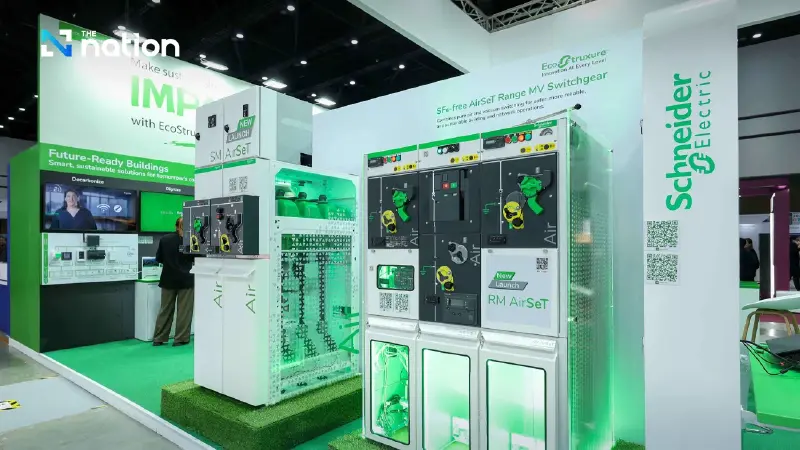


Global technology leader demonstrates SF6-free switchgear, AI-powered grid management, and digital energy solutions across three innovation zones
- Schneider Electric showcased its SF6-free medium-voltage switchgear, a key technology for decarbonising the power sector by eliminating a greenhouse gas significantly more potent than CO2.
- The company unveiled AI-powered digital solutions, such as the EcoStruxure Advanced Distribution Management System (ADMS), to modernise grids, manage distributed renewable energy, and improve operational efficiency.
- Intelligent energy management systems for buildings and homes were presented, including platforms to reduce commercial energy consumption and solutions for "prosumers" to optimize solar generation and EV charging.
Global technology leader demonstrates SF6-free switchgear, AI-powered grid management, and digital energy solutions across three innovation zones.
Schneider Electric has showcased an extensive portfolio of energy transformation technologies at IEEE PES GTD Asia 2025, presenting integrated solutions designed to address the complex challenges of grid modernisation, renewable energy integration, and carbon neutrality across industrial, commercial, and residential sectors.
The global energy technology leader organised its exhibition across three strategic zones at Queen Sirikit National Convention Centre, demonstrating how digital integration with electrical infrastructure can accelerate the transition towards sustainable energy systems.
Building Carbon-Neutral Grid Infrastructure
Yada Rungrueang Wisetrat, Cluster Business vice president, Power System at Schneider Electric Thailand, Myanmar, and Laos, explained during a media tour session on Thursday that the company's approach centres on intelligent energy transformation from foundational grid flexibility through to precise energy transition management.

"Every product displayed at IEEE PES GTD Asia 2025 reflects Schneider Electric's commitment as an energy technology partner, creating efficiency and sustainability by integrating electrical systems, automation, and digitalisation across industry, business, and residential applications," Yada stated.
The Carbon-Neutral Grid zone featured the company's latest SF6-free switchgear technology, addressing one of the power sector's most significant environmental challenges.
The SM AirSeT and RM AirSeT medium-voltage switchgear eliminate sulphur hexafluoride gas, where one kilogramme of SF6 carries a global warming potential equivalent to 25,000 kilogrammes of carbon dioxide.
The newly launched MCSeT with EvoPacT represents a significant advancement in primary switchgear technology, incorporating digital vacuum circuit breakers with plug-and-play design for simplified maintenance.
The equipment features thermal sensors at critical connection points—addressing the primary cause of equipment failures and power disruptions—whilst enabling remote monitoring and control to minimise outage duration.
These solutions arrive ahead of regulatory changes, with the European Union implementing an SF6 ban for 24kV systems from 1 January 2026, positioning utilities and industrial facilities to meet emerging environmental standards whilst maintaining operational reliability.

Sustainable Communities Through Intelligent Building Management
The Sustainable Communities & Industries zone demonstrated how cloud-based platforms can transform building operations and industrial energy consumption.
The EcoStruxure Building Activate platform simplifies intelligent building deployment through remote configuration, real-time monitoring, and seamless automation integration.
The system manages environmental controls, including temperature, lighting, and air conditioning, based on scheduling and ambient conditions, whilst integrating energy management with building automation.
When combined with EcoStruxure Building Operation and Power Monitoring Expert systems, facilities can monitor and control multiple utilities—water, air, gas, electricity, and steam—with simulation and automated scheduling proven to reduce annual energy consumption by 10-15%.
For residential applications, Schneider Electric introduced solutions addressing the growing prosumer market, where households both consume and generate electricity through solar installations.
The New Energy Land panel serves as an intelligent control centre for solar-equipped homes with electric vehicle chargers, incorporating direct current protection to manage the distinct electrical characteristics of solar inverters and EV charging equipment.
The system enables load prioritisation, ensuring critical equipment such as medical devices or essential business operations receive power priority during outages.
Integration with smart applications optimises solar utilisation by coordinating EV charging with peak solar generation periods, maximising self-consumption efficiency.

Advanced Grid Operations and Data Centre Solutions
The Intelligent Energy Operations zone featured the EcoStruxure Advanced Distribution Management System (ADMS), providing utilities with real-time network visibility, predictive analytics, and advanced automation capabilities.
The platform supports the transition towards flexible, low-carbon energy systems whilst managing distributed energy resources and storage integration.
Recognising data centre expansion driven by artificial intelligence applications, Schneider Electric presented comprehensive lifecycle services encompassing design, construction, operation, and assessment.
The company supplies nearly the complete product suite required for data centre construction, with management systems incorporating planning, modelling, digital twins, and AI assistance to simultaneously achieve high availability and sustainability objectives.
The portfolio includes liquid cooling solutions specifically developed for AI data centre requirements, addressing the intensive thermal management challenges associated with high-density computing infrastructure.

Engineering Integration and Cybersecurity
Advanced engineering capabilities were demonstrated through the Power and Process solution, integrating AVEVA process engineering software with ETAP electrical design tools.
This integration enables simulation to optimise designs balancing process requirements with electrical supply, reducing both design costs and operational expenses whilst improving energy efficiency and profitability.
Schneider Electric also emphasised comprehensive cybersecurity services protecting operational technology systems through 24-hour expert monitoring, network segmentation, vulnerability management, and endpoint protection—critical capabilities as grid digitalisation expands the attack surface for critical infrastructure.
The Advanced Service Platform utilises IoT sensors to reduce power outage downtime by up to 40%, shifting maintenance strategies from time-based schedules to condition-based approaches.
The system's Health Index provides real-time equipment status assessment, enabling proactive intervention before failures occur whilst detecting issues such as overheating from loose connections or electrical stress from harmonic distortion.
Schneider Electric's exhibition at IEEE PES GTD Asia 2025 continues through 29 November at booth F17 in Exhibition Hall 2-4, Ground Floor, Queen Sirikit National Convention Centre, providing industry professionals with detailed technical demonstrations of the complete solution portfolio.
The comprehensive presentation underscores the critical role of integrated digital and electrical technologies in achieving regional carbon neutrality targets whilst maintaining grid reliability and operational efficiency across diverse applications.
