
Thailand Takes Centre Stage as Regional Energy Leader at IEEE PES GTD Asia 2025
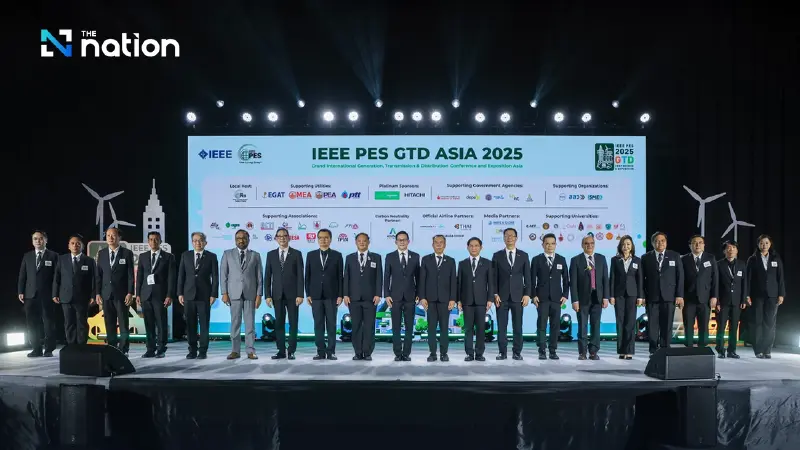


Energy Minister opens landmark global conference showcasing Thailand’s pathway to carbon neutrality through renewable integration and smart grid innovation
- Thailand is hosting the IEEE PES GTD Asia 2025 conference, a major global event with over 10,000 participants, to showcase its leadership in the regional energy transition.
- The country is promoting its national strategy to achieve carbon neutrality by 2050, led by the Electricity Generating Authority of Thailand (EGAT).
- EGAT's roadmap includes significant investment in grid modernization and developing diverse clean energy sources such as floating solar, hydrogen power, and Small Modular Reactors (SMRs).
- The conference serves as a platform for Thailand to attract clean energy investment, aiming to enhance energy security and drive sustainable economic growth.
Energy Minister opens landmark global conference showcasing Thailand’s pathway to carbon neutrality through renewable integration and smart grid innovation.
Thailand has firmly positioned itself as Southeast Asia's energy transition leader as Energy Minister Auttapol Rerkpiboon opened the IEEE PES GTD Asia 2025 conference in Bangkok on 27 November, bringing together over 10,000 participants and 400 leading companies from more than 40 countries to chart the region's path towards carbon neutrality.
The four-day event at Queen Sirikit National Convention Centre marks a pivotal moment for Thailand's energy ambitions, with Minister Auttapol emphasising the conference's strategic importance in advancing the nation's clean energy transformation.

"This is Thailand's most significant opportunity to demonstrate leadership in ASEAN's energy sector, driving technological change and attracting clean energy investment that will strengthen long-term energy security, develop infrastructure, and propel sustainable national economic growth," Minister Auttapol stated during the opening ceremony.

EGAT's Vision for Sustainable Transformation
Dr Narin Phoawanich, Governor of the Electricity Generating Authority of Thailand (EGAT) and President of IEEE Thailand, outlined the state enterprise's comprehensive roadmap to achieve net-zero emissions by 2050, with an ambitious interim target of halving greenhouse gas emissions by 2037.
"As the nation's primary energy organisation, EGAT remains committed to driving Thailand's energy transition through innovation, digital transformation, and the integration of clean and intelligent energy technologies, aiming for sustainable net-zero emissions for future generations," Dr Narin explained.
EGAT is implementing the government's Quick Big Win energy policy through Direct Power Purchase Agreements (Direct PPA), enabling businesses to access renewable energy directly from producers.
The utility has also introduced the Utility Green Tariff 1 (UGT1) for non-source-specific green electricity, supporting Community Solar initiatives and upgrading grid infrastructure to accommodate renewable integration and emerging industries including electric vehicles, data centres, and AI IoT robotics.

To advance towards carbon neutrality, EGAT is studying and developing technologies to increase clean energy capacity.
The utility's roadmap includes a 600-megawatt Small Modular Reactor (SMR) for round-the-clock low-carbon power, piloting 2,725 megawatts of floating solar capacity across nine reservoirs under EGAT's management, and advancing pumped-storage hydroelectric projects, solar farm and battery installations, as well as Battery Energy Storage Systems (BESS).

Concurrently, EGAT is developing transmission systems and modernising grid networks to increase flexibility for renewable energy integration.
The transmission system development programme comprises three implementation phases during 2025-2037, with a total budget of 33,500 million baht (approximately 33 billion RMB). This infrastructure investment will expand Thailand's transmission capacity by 580 billion baht and create 4,680 jobs.
Grid modernisation efforts focus on enhancing system flexibility through several critical initiatives: a Digital Control Platform for automated power system control, Infrastructure Expansion Sharing for renewable energy management, and a New Agreement for Construction Flexibility to mitigate generation variation.
The utility is also deploying Transmission Protection Control Monitoring and Asset Management systems to enhance grid stability, alongside a cybersecurity-focused data analysis platform.
These infrastructure investments will support EGAT's deployment of substantial renewable capacity, including over 3,000 MW of hydrogen-based power and large-scale solar projects, whilst enabling industrial growth, data centres, and regional connectivity across the Eastern Economic Corridor.

The utility is also studying three carbon dioxide capture technologies: amine solution absorption, advanced nanomaterial Metal-Organic Frameworks (MOFs), and Cryogenic Carbon Capture (CCC), whilst examining Carbon Capture Utilisation and Storage (CCUS) for commercial deployment by 2040.
These efforts align with Environmental, Social, and Governance (ESG) principles, ensuring transparent operations whilst supporting Thailand's climate commitments and the EGAT Carbon Neutrality plan targeting net-zero emissions by 2050.

Global Perspectives on Grid Resilience
The opening forum featured insights from international energy leaders addressing the sector's rapid transformation. Raj Beasla, Senior Director of Electric Transmission and Substation Engineering at Pacific Gas and Electric Company, emphasised technology's crucial role in building resilient systems.
"The pace of change continues to accelerate exponentially due to rapid advancement of AI technology," Beasla noted, highlighting how artificial intelligence is revolutionising electricity generation, management, and delivery.
He cited PG&E's deployment of 18,000 hazard detection devices that achieved "65% reduction in outages in 2024 through safety protocols such as enhanced power line settings, which shut power within one-tenth of a second when hazards are detected."

Dr Pheerapat Vithayasricharoen, Senior Energy Analyst at the IEA Regional Cooperation Centre, provided critical context on Southeast Asia's renewable integration challenges.
The region's electricity demand has tripled over two decades and is expected to reach 2,000 terawatt-hours by 2035—a 50% increase from current levels.
"Southeast Asia can integrate higher shares of wind and solar with modest efforts at least to the medium term," Dr Pheerapat explained, noting that whilst the region possesses abundant renewable potential—over 20 terawatts of combined solar and wind capacity—strategic policy measures and infrastructure investments remain essential for successful integration.

Comprehensive Conference Programme
Conference Chairman Professor Dr Weerakorn Ongsakul emphasised the event's significance amid global climate challenges, noting it provides a crucial platform for senior executives, government officials, experts, and researchers from leading institutions worldwide to exchange insights and develop concrete energy transition strategies.
The programme features extensive exhibitions showcasing cutting-edge technologies including smart grid systems, greenhouse gas-free switchgear, and intelligent automation controls.

High-profile panel sessions address critical topics such as hydrogen in electrical systems, AI-driven grid management, women's roles in the energy sector, and pathways to net zero.
Deputy Director Puripan Bunnag of the Thailand Convention and Exhibition Bureau (TCEB) highlighted the conference's broader economic impact, noting it reinforces Bangkok and Thailand's position as ASEAN's premier energy conference and exhibition hub, generating substantial economic and technological value.

The event has garnered extensive support from Thai organisations including EGAT, Metropolitan Electricity Authority (MEA), Provincial Electricity Authority (PEA), PTT Group, and leading technology companies such as Hitachi Energy Thailand and Schneider Electric Thailand, alongside government agencies including the Digital Economy Promotion Agency (depa), Federation of Thai Industries (FTI), and Engineering Institute of Thailand (EIT).
The conference concluded on 29 November, having provided participants comprehensive access to the latest energy innovations and strategic discussions shaping the region's sustainable energy future.
