
Energy Minister unveils power plan to support data centre investment
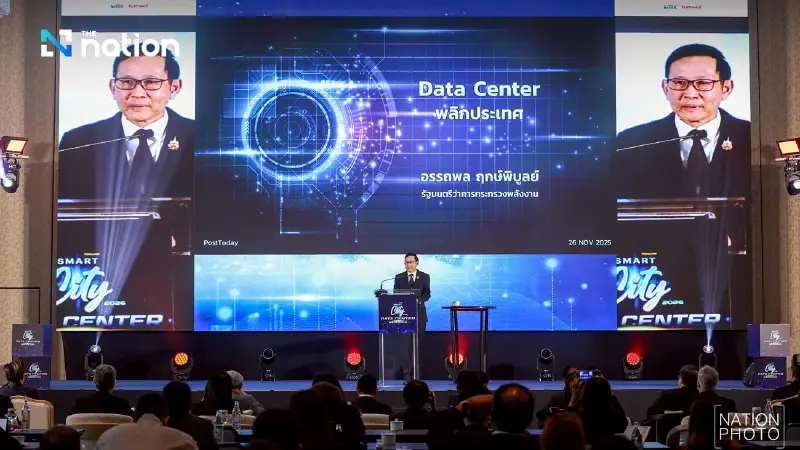


Auttapol Rerkpiboon outlines Thailand’s strategy to attract data centre investments, including new energy infrastructure, green energy use, and AI workforce development
• Auttapol Rerkpiboon unveils power plan to accommodate growing data centre investments in Thailand, following a surge of more than 600 billion baht in investment commitments.
• Urgent solutions for the EEC bottleneck and plans to approve Direct PPA by December.
• Thailand can leverage this golden opportunity to set investment terms, develop AI skills, and create local employment.
• The goal is to transition the country from a consumer to a technology creator and move towards a high-value economy.

Auttapol Rerkpiboon, Minister of Energy, delivered a speech on “Data Centre: Transforming the Country” at the Thailand Smart City 2026 Data Centre Seminar organised by PostToday. He revealed that Thailand has developed a strategy to attract major data centre investments, aligning with the global trend where data centres and artificial intelligence (AI) are key drivers of the modern economy. The Energy Ministry is currently accelerating the development of infrastructure to meet rising demand.
Auttapol explained that:
“In the past, it was said that data is like crude oil, but today, the new saying is AI is the new electricity — this will be the driving force for the future of the world.”
Currently, global data centre energy demands account for approximately 1.5% of total global electricity consumption, which is equivalent to 1.7 times the total electricity consumption of Thailand. It is forecasted that by 2030, this demand will grow by 2–3 times, equal to the electricity demand of Japan.

Southeast Asia emerging as data centre investment hotspot
Southeast Asia is becoming a key target region for data centre investments. While Singapore has invested 1,000 MW, Thailand is strategically positioned to offer a more sustainable long-term energy solution.
Large investors seek reliable, stable, clean energy at reasonable prices, with long-term goals to use green energy for nearly 40% of their consumption by 2035, with some companies targeting 100%.

Auttapol noted that Thailand is in an advantageous position to attract data centre investments, with the Board of Investment (BOI) having approved more than 30 data centre projects, worth over 600 billion baht in total.
Thailand should leverage this opportunity
Auttapol stressed that Thailand must seize this opportunity and set terms with investors, including AI workforce development and local employment, to shift from being a consumer of technology to becoming a technology creator. This will help Thailand transition into a high-value economy.
The Minister of Energy stated that managing energy requires a balance of three factors:
- Security
- Cleanliness and sustainability
- Economic growth
This will ensure maximum impact, and the government is implementing the “Quick Big Win” programme during the transitional period, dividing key energy measures into three parts:
- Promoting solar energy for the public
- Developing energy infrastructure
- Ensuring long-term security for Net Zero targets
Infrastructure development for data centres
1. EEC bottleneck issues: Over 90% of data centre requests are concentrated in the EEC, with the primary problem being insufficient transmission lines and substations, not a lack of power generation. The government has allocated 3 billion baht from EGAT’s remaining funds to address the immediate problem, with plans for further investment of around 30 billion baht to meet future demand for an additional 3,800 MW.
If investors consider areas outside the EEC, such as Bangkok, Samut Prakan, Prachinburi, Ayutthaya, and Saraburi, which already have sufficient transmission and substation capacity, projects could move forward more quickly.
2. Direct PPA (Power Purchase Agreement) projects: This measure will allow data centre operators to directly negotiate with green energy producers, using EGAT’s transmission lines while paying only for transmission costs.
This policy is expected to be finalised by December 2025, leading to investments of over 30 billion baht, creating 3,000 jobs, and reducing 1.6 million tons of CO2 emissions annually.
