
THEOS-2A mission fails after Indian rocket malfunctions at 380 seconds
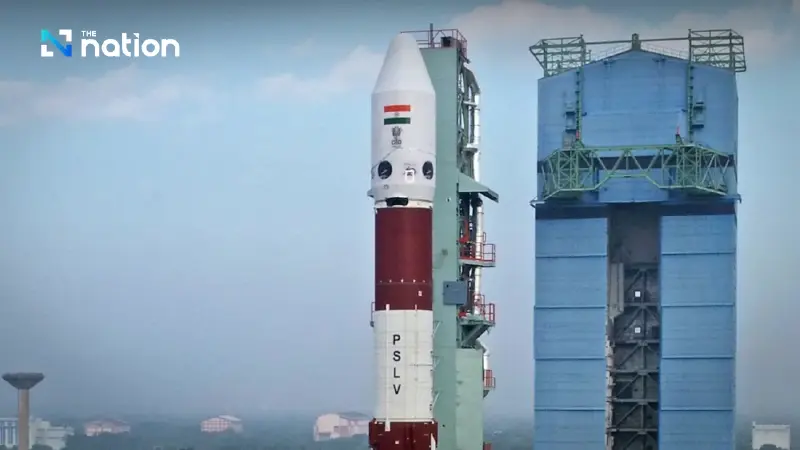


The THEOS-2A satellite mission failed after the PSLV rocket malfunctioned at the third stage in the 380th second, preventing the satellite from reaching its designated orbit.
The mission to launch the THEOS-2A satellite into space on Monday, January 12, faced failure after the third stage of the Indian Polar Satellite Launch Vehicle (PSLV) rocket malfunctioned at the 380th second post-launch.
This failure resulted in the satellite failing to reach its intended orbit. Indian Space Research Organisation (ISRO) has acknowledged the situation, and Geo-Informatics and Space Technology Development Agency (GISTDA) is now working on gathering data to conduct an official in-depth analysis of the cause.
GISTDA embarked on its important mission to launch the THEOS-2A satellite into space at 11.47am (Thai time), using the PSLV rocket from the Satish Dhawan Space Centre in India.
However, after the launch, GISTDA's live broadcast team reported that a malfunction occurred during the third stage of the PSLV rocket at the 380th second. This caused the satellite to fail in reaching its intended orbit.
ISRO promptly released a statement acknowledging the situation, although further analysis is still pending. GISTDA is closely monitoring the progress and will provide official updates on their official page.
At 3pm, GISTDA posted a message referring to a statement from Dr V Narayanan, Chairman of ISRO, stating that the PSLV rocket under mission PSLV-C62 EOS-N1, launched on January 12, 2026, was designed with four stages: two solid fuel stages and two liquid fuel stages.
The rocket launch proceeded smoothly until the latter part of stage three, when an anomaly was detected—specifically, a disturbance that caused a slight deviation in the rocket's roll rate. This deviation led to the rocket's flight path veering off course.
ISRO is currently analysing the data and will report further progress as soon as possible.
