
MFEC positions AI as the new enterprise infrastructure amid economic headwinds
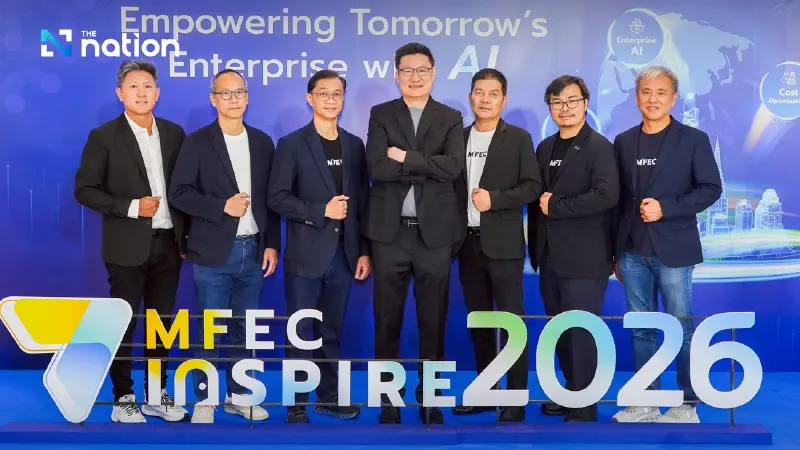


MFEC Inspire 2026 showcased Enterprise AI solutions focused on real business outcomes, urging organisations to treat AI as core infrastructure for long-term competitiveness.
MFEC, a leading IT service provider, held MFEC Inspire 2026 – Empowering Tomorrow’s Enterprise with AI, presenting enterprise AI concepts and solutions focused on delivering real business outcomes, rather than technology experimentation.
The event drew a strong turnout of senior executives from leading organisations across a wide range of industries at the Grand Centre Point Lumphini hotel in Bangkok on Wednesday (March 25).
Against a backdrop of rapidly shifting economic conditions and intensifying competitive pressure, MFEC shared its strategic view that investment in technology, particularly AI, can no longer be measured solely in terms of innovation. Instead, it must address value for money, business outcomes and long-term competitiveness.
Organisations therefore need to move beyond using AI as a point solution or a standalone tool and instead position it as part of their enterprise infrastructure.
“MFEC Inspire is an event that MFEC holds once a year to respond to changes in IT, whether in technology, customer needs or the economic environment,” said Siriwat Vongjarukorn, Chief Executive Officer of MFEC.
Turning AI strategy into practical actions
Thanakorn Charlee, MFEC’s Chief Operating Officer, said the company had repeatedly encountered the same challenge from clients over the past two to three years: that IT investment was often seen as too costly or failing to justify itself against customers’ ability to compete and generate profit.
He said MFEC’s solutions therefore focus on what is appropriate for customers’ economic conditions, whether by helping them reduce costs or create new competitive advantages.

To help organisations translate this concept into practice, MFEC Inspire 2026 was designed to be more than a seminar. The event was divided into four main sections to help businesses better understand and apply AI in practical ways:
- Seminar: Strategic Insights – a platform for strategic perspectives from executives and experts from both the public and private sectors
- Pavilions: Explore the Foundations – exhibition spaces showcasing MFEC’s success cases those generated real business outcomes for customers
- Marketplace: Partner Ecosystem – a space connecting participants with more than 20 global technology partners
- Workshop: Design & Build – hands-on sessions allowing participants to co-design solutions to real business challenges

The event was held under three key pillars of technology investment that deliver tangible results.
Enterprise AI: from use cases to enterprise workflows
AI adoption cannot deliver meaningful outcomes if it remains at the experimental stage or is used in isolated ways by individuals. What organisations need to do is elevate AI from being a tool to becoming part of a workflow that connects processes across the entire organisation.
By using real use cases as the starting point for solution design, businesses can ensure AI addresses genuine operational needs. Once AI is embedded systematically into workflows, organisations can improve efficiency, reduce duplication and generate clearly measurable business outcomes.
“AI differs from other technologies in that it cannot simply be procured centrally by a chief technology officer and rolled out uniformly across the business, as each department has different AI needs,” Siriwat said.
He added that what matters is whether every investment can deliver measurable results immediately.

Cost optimisation: good technology must deliver value
At a time when organisations are under growing cost pressure, investment in technology can no longer be judged by sophistication alone. It must also answer a more pressing question: is it worth the investment?
“In the past, when businesses were expanding rapidly, IT was seen as an enabler that strengthened competitiveness and supported market expansion,” Siriwat said. “Today, however, many companies increasingly view IT as a burden, as costs continue to rise while profit margins shrink.”
MFEC therefore emphasised designing solutions that enable organisations to manage IT costs efficiently without undermining their competitiveness. This approach is not merely conceptual, but is reflected in real success cases showing that businesses can cut costs while improving operational performance at the same time.

Data and resilient IT infrastructure: the foundation for long-term growth
Although AI is a major catalyst for transformation, sustainable outcomes cannot be achieved without strong IT infrastructure and sound data management.
Organisations therefore need to invest in data platforms, cloud systems and cybersecurity in parallel so they can support AI deployment effectively and scale their systems in the future. Flexible and resilient infrastructure will be a crucial factor in helping businesses adapt to change and sustain long-term growth.
MFEC also stressed that achieving results from AI adoption requires three elements to work together: people, process and technology. In particular, developing employees’ skills so they can work effectively with AI will be a critical factor in the success of any AI transformation.
“AI adoption must be based on team learning, with employees learning together and adjusting their mindset. Unlike in the past, when staff could simply wait for new applications to be purchased and deployed for them, AI requires more active engagement,” Siriwat added.

MFEC reinforces role as strategic technology and AI enabler
Overall, MFEC continued to underline its role as a strategic technology and AI enabler, working alongside client organisations to design and develop solutions that genuinely address business needs — whether in data platforms, AI, cloud, security or IT infrastructure. Its focus is on delivering the right options across technology, cost and business outcomes.
At one point during the MFEC Inspire 2026 stage programme, Siriwat said the discussion did not begin with the economy or war, but with the phrase “The Long Crisis” — a crisis that does not end soon and is not easily resolved.
“Throughout this period and up to today, what we are facing is not merely a short-term crisis. We have seen shortages in many areas, but what is even more worrying is the instability of the most important thing in the business world — relationships, particularly those between technology vendors and customers. Things are no longer the same,” he said.
He reiterated that MFEC’s mission is to help clients rebalance costs, not merely by cutting spending, but by identifying the right solutions at the right price in order to create real choices for organisations.
This, he said, would help ensure clients are not locked in and can preserve long-term organisational agility.
Siriwat said that AI has now become the only strategy capable of building competitiveness, while addressing both productivity and cost at the same time.
Over the past two to three years, despite substantial investment in AI, very few organisations have been able to turn that investment into actual returns reflected in their profit and loss statements. Most, he said, remain at the stage of experimentation.
MFEC’s approach, he said, is to move AI into the application layer. Rather than allowing AI to remain just a tool dependent on individual prompting skills, the company embeds AI into real business systems so that every use of AI can generate outcomes and deliver a return on investment immediately.
With extensive experience serving large enterprises and a strong understanding of the Thai business landscape, MFEC is committed to helping organisations deploy AI effectively, achieve measurable results and drive sustainable growth.
MFEC Inspire 2026, he added, was not merely a technology showcase. It also featured success cases demonstrating how MFEC had helped organisations gain better technology choices at the right price, reflecting a central belief:
“AI only has meaning when it can create real business outcomes,” Siriwat said, adding that organisations able to integrate AI effectively with people, processes and strategy would be the ones best placed to compete and grow over the long term.
