
IBM warns delay on AI investment could cost firms their edge by 2030


IBM urges businesses to act on AI now, warning that waiting for full clarity could cost them growth, profit and competitive advantage by 2030.
AI will sit at the centre of everything organisations do by 2030, with 79% of executives believing it will become a major source of business revenue by then. Yet only 24% can clearly identify where that revenue will come from.
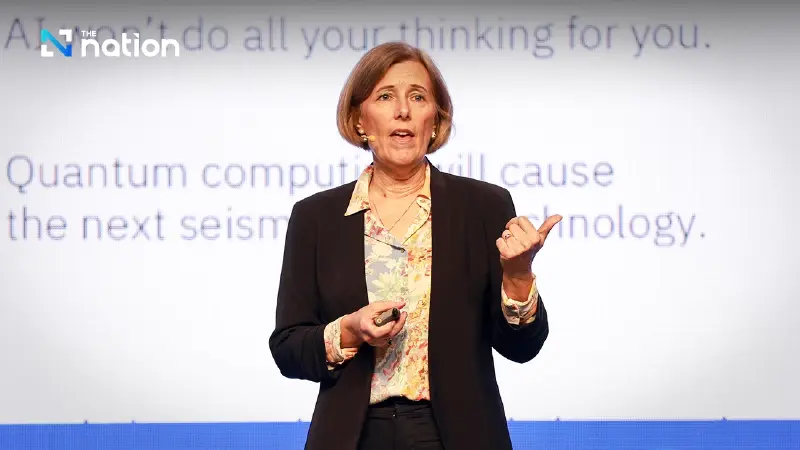
Cindy Anderson, CMO and Global Lead for Thought Leadership Engagement and Eminence at the IBM Institute for Business Value, shared the findings from research spanning 23 industries at the AI Revolution Shift 2026: Shaking the Global Economy seminar, organised by Bangkokbiznews on Tuesday (March 31).
Anderson said IBM had produced a report titled Enterprise in 2030, based on interviews with executives and CEOs. The report sets out five key predictions as a roadmap for organisations seeking to become what IBM calls a “Smarter Enterprise” — one that can continuously learn and adapt in the AI era.
She stressed that, regardless of industry, organisations should be looking ahead to 2030 and preparing now, because less time remains than many people think.
Prediction 1: Big bets will become unavoidable
Some 79% of executives believe AI will generate revenue for their organisations by 2030, but only 24% know clearly where that revenue will come from. Anderson said this reflects a dangerous gap between ambition and clarity, leaving many organisations stuck in hesitation rather than moving forward.
Executives around the world, she said, are delivering the same message: the business environment is rewarding boldness, not caution. Some 64% said organisations would need to take greater risks than their competitors in order to survive and grow.
Anderson explained that risk-taking in this context does not mean guessing blindly or acting without reason. Rather, it means having the courage to experiment seriously with AI and to place bold bets on innovation that could fundamentally transform a business.
In addition, 55% of executives said competitive advantage later in the decade would depend more on speed of action than on waiting for complete information. In other words, waiting for certainty could mean missing the opportunity altogether.
IBM’s data showed that organisations that made successful big bets generated 21% higher revenue and 24% stronger operating profit than those that did not.
Prediction 2: Today’s productivity is tomorrow’s transformation fund
Anderson said many organisations are already using AI to cut waste in workflows, accelerate operations and strengthen employee capability. While that is a positive start, she said it will not be enough to remain competitive towards the end of the decade.
Some 67% of executives said AI is already extracting productivity gains from existing business models close to their limit. The key question, then, is what organisations will do next.
According to the research, 70% of business leaders said the answer is to reinvest the savings generated by AI into new forms of growth. That means AI will not merely reduce costs, but become a source of capital that continuously funds the next round of innovation.
Prediction 3: The best AI is your AI
Anderson said that by 2030 every organisation will have equal access to powerful foundation models. As a result, competitive advantage will no longer come from having a larger or more advanced model than rivals, but from training AI on proprietary data that competitors do not have and cannot replicate.
In the survey, 97% of executives said the distinctiveness and complexity of AI models would determine future advantage, while 85% expect to use multiple models by 2030.
Smaller models designed for specific tasks will become the new norm, replacing reliance on a single oversized model with more capability than needed, which can waste resources and reduce efficiency.

Prediction 4: Humans will augment AI, rather than AI augmenting humans
Some 67% of executives said the shelf life of the skills their organisations need is becoming shorter, while 57% expect most employees’ current skills to become outdated by 2030.
For Thailand, 13.1 million people would need reskilling by the end of the decade. Anderson said this should be seen as an opportunity, not a crisis.
On employee attitudes, the survey found that workers across all age groups were more willing to embrace AI than many employers expected. Some 63% said they were willing to work alongside AI agents, while 48% said they were prepared to be supervised by AI.
In addition, two-thirds said AI was changing organisational culture for the better.
The most valuable skills in this era, Anderson said, will not primarily be technical ones, but problem-solving and crisis management, the ability to innovate and adapt, time management and prioritisation, and a basic understanding of data analysis.
These, she said, will help people use AI to the greatest benefit of both their organisations and themselves.
Prediction 5: Quantum computing will open a new frontier for which most are unprepared
Anderson highlighted what she described as a deeply concerning gap. Some 59% of executives believe quantum computing will fundamentally transform their industries, yet only 27% expect their own organisations actually to use the technology. In other words, most believe change is coming but are still not preparing for it.
Unlike conventional computers, quantum computers can process vast amounts of information simultaneously, allowing them to solve highly complex problems in minutes that traditional systems might take hundreds of years to tackle.
This has major implications for industries that demand speed, precision and optimisation, such as aviation, logistics and pharmaceuticals.
IBM operates what it describes as the world’s largest quantum ecosystem and already has real business examples. Several logistics firms are working with IBM to explore how quantum technology could improve operations and supply chains.
Meanwhile, HSBC has tested a system combining quantum and classical computing and found that it could improve the accuracy of predicting whether a bond trade order would be executed at the desired price by 34%.
Anderson also said 55% of global CEOs believe the first commercial use of quantum technology will emerge in supply chain management and logistics before any other field.
For organisations in those industries, she said, preparation should begin now rather than waiting for the technology to arrive. The organisations with the greatest advantage will not necessarily be those that adopt the technology first, but those that build the skills, partnerships and experimental environment in advance of full commercial readiness.
Anderson closed by saying the most important takeaway for attendees was not knowing every detailed step they must take, but recognising the urgency of doing something now to prepare for the business environment of 2030.
The time for waiting, half-hearted experimentation or partial commitment, she said, has already run out.
