
Thailand and EU Target 2026 for Landmark Free Trade Agreement
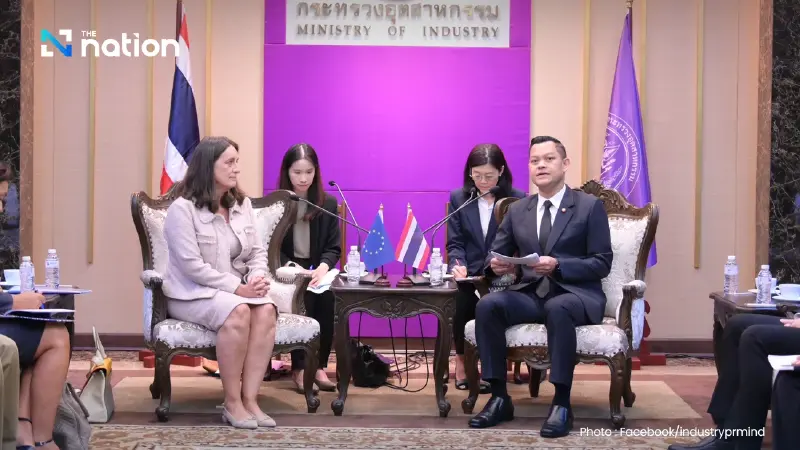


Industry Minister Thanakorn Wangboonkongchana meets EU Ambassador to align on green economy goals and fast-track FTA negotiations by the middle of 2026
- Thailand's Ministry of Industry and the European Union are targeting the middle of 2026 to conclude a Free Trade Agreement (FTA).
- Key negotiations focus on aligning Thailand's manufacturing sector with the EU's green economy goals, including decarbonization and environmental regulations like the Carbon Border Adjustment Mechanism (CBAM).
- The agreement aims to attract high-quality European investment into Thailand's S-Curve industries by leveraging the EU's €300 billion "Global Gateway" initiative.
- Thai officials have reassured the EU that negotiations will proceed on schedule, ensuring policy continuity for investors despite the country's transition to a caretaker government.
Industry Minister Thanakorn Wangboonkongchana meets EU Ambassador to align on green economy goals and fast-track FTA negotiations by the middle of 2026.
Thailand’s Ministry of Industry has signalled its intent to conclude Free Trade Agreement (FTA) negotiations with the European Union by mid-2026, despite the current transition to a caretaker government.
During a high-level meeting on 16 February 2026, Industry Minister Thanakorn Wangboonkongchana hosted H.E. Luisa Ragher, the EU Ambassador to Thailand, to discuss a roadmap for industrial synergy.
The talks focused on harmonising Thailand’s manufacturing sector with stringent European environmental standards.

Addressing concerns regarding the domestic political climate, Thanakorn reassured the delegation that the Ministry remains fully operational.
Under the "Push-Fight-Pull-Persist" policy framework, the government is committed to restructuring the national economy to ensure a seamless environment for European capital.
"The European Union is a cornerstone of our economic strategy," Thanakorn stated. "Even during this caretaker period, our priority is to maintain policy continuity and provide absolute certainty for investors from the bloc."

The Minister outlined a three-pronged strategy to modernise the Thai industrial sector:
Decarbonisation: A concerted push toward Carbon Neutrality and Net-Zero emissions, with a particular emphasis on the Electric Vehicle (EV) supply chain.
Regulatory Alignment: Thailand expressed a proactive stance on aligning with the EU’s Carbon Border Adjustment Mechanism (CBAM) and Regulation on Shipments of Waste (RSW). This move aims to ensure Thai exports meet European ecological benchmarks, thereby reducing trade friction.
The Global Gateway: The Ministry is actively seeking to leverage the EU’s €300 billion "Global Gateway" initiative to attract high-quality investment into Thailand’s S-Curve industries.

Ambassador Ragher noted that Thailand remains the EU's third-largest trading partner within ASEAN, trailing only Singapore and Japan. She highlighted the "natural alignment" between Thailand’s Bio-Circular-Green (BCG) economy model and the EU’s own green transition goals.
The Ambassador further encouraged Thailand to continue streamlining its regulatory environment, noting that the Kingdom’s high market potential would be even more attractive to EU member states if bureaucratic hurdles were reduced.
"Today’s dialogue marks a pivotal step in elevating our relationship to a strategic partnership," Thanakorn concluded. "We are building an economic ecosystem that ensures sustainable growth for both regions well into the future."
