
Thailand and Europe Pledge to Build a "Future-Ready" Partnership Amid Global Uncertainty
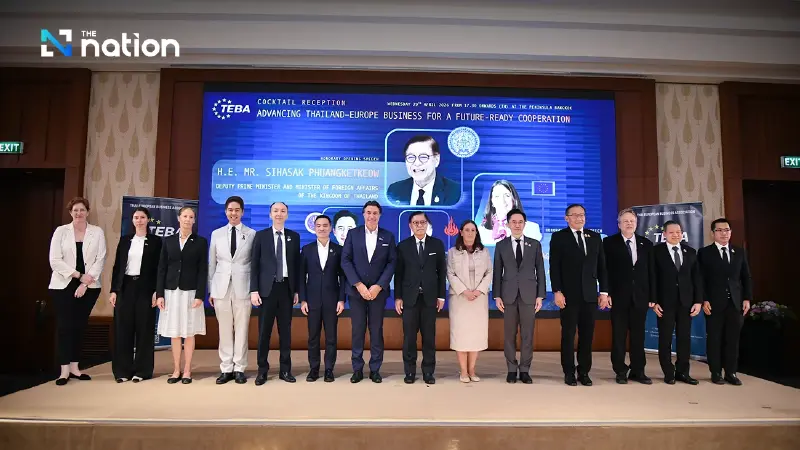


Senior Thai ministers and the EU ambassador reaffirmed the two sides' strategic ties at a Bangkok reception, calling for deeper cooperation on trade, technology and science diplomacy as a once-stable world order fragments
- Thailand and the European Union have pledged to elevate their strategic partnership, citing the urgency created by global uncertainty and the belief that their relationship has yet to reach its full potential.
- The enhanced cooperation will focus on key areas including trade, technology, and a new emphasis on "science diplomacy" to address modern challenges.
- Negotiations for a "transformational" EU-Thailand Free Trade Agreement (FTA) are a central component of the plan to unlock the partnership's potential.
- The EU ambassador identified three priority areas for collaboration: strengthening supply chain resilience, advancing the green transition, and promoting digital transformation.
- A senior Thai minister acknowledged that Thailand had fallen behind its regional peers but asserted that renewed political stability would help restore its standing and drive the partnership forward.
Senior Thai ministers and the EU ambassador reaffirmed the two sides' strategic ties at a Bangkok reception, calling for deeper cooperation on trade, technology and science diplomacy as a once-stable world order fragments.
Thailand and the European Union have vowed to elevate their partnership to a new level, with senior officials on both sides acknowledging that the relationship has yet to reach its full potential — and that the current volatile global climate makes acting swiftly all the more urgent.
The pledges came on Wednesday evening at a cocktail reception hosted by the Thai-European Business Association (TEBA) in Bangkok, under the theme Advancing Thailand-European Business for a Future-Ready Cooperation.
The event drew Deputy Prime Ministers and Foreign Affairs Minister Sihasak Phuanketkeow, Deputy Minister and Minister of Higher Education, Science, Research and Innovation Yodchanan Wongsawat, Minister of Energy Akanat Promphan, the Permanent Secretary of the Ministry of Transport, European Union Ambassador Luisa Ragher, and a gathering of senior European and Thai business figures.

Deputy Prime Minister and Foreign Affairs Minister Sihasak, who had flown in from an ASEAN-EU ministerial meeting in Brunei earlier that day, set an unusually candid tone, admitting that Thailand had fallen behind its regional peers.
"We have disappeared from the radar screen in a way. When people talked about ASEAN before, Thailand would be in the top tier. Now, I have to admit that we're not in the top tier anymore," he said.

He attributed the slide to political instability and frequent changes of government that had hampered policy continuity and long-delayed structural reforms.
Despite the self-criticism, Sihasak expressed confidence that the current administration was well-positioned to restore Thailand's standing, pointing to what he described as a period of incoming political stability and a competent ministerial team overseeing finance, energy, commerce and higher education.
He argued that diplomacy itself had to evolve, calling for a strategy-driven, speedy and coherent approach focused firmly on economic interests.
"Foreign policy begins at home," he said. "We can have the best of policies looking outward, but if we cannot organise ourselves inside, we won't be able to have an impact."
One of the reception's central themes was the merging of traditional diplomacy with science and technology.
Sihasak revealed that he had recently invited the Minister of Higher Education, Science and Innovation to the Foreign Ministry to explore how "science diplomacy" could be woven into foreign policy.
"These days it's all about technology. Technology is about national power. Technology is about how you get ahead," he said.

TEBA President Pierre Jaffré echoed that sentiment, declaring that the world had undergone a structural — not merely cyclical — shift.
"The world we knew is gone. Not evolving, not adjusting, just gone," he said.
In such an environment, he argued, reliability had become the most valued quality in international partnerships, a quality he said both Europe and Thailand could offer one another.
He expressed strong support for the government's science and technology diplomacy framework, saying it was "totally in line with TEBA's vision."
EU Ambassador Ragher, speaking with similar candour, agreed that the Thailand-EU relationship was not where it should be and made a personal commitment to push it to a significantly higher level of integration before the end of her four-year term.
"I would like to concur that the European Union-Thailand relations should be at a very different level, and we have a lot of work to do," she said.

Trade Figures Show Promise but Highlight a Gap
Bilateral trade in goods between the EU and Thailand reached €42 billion in 2024, with EU imports from Thailand valued at €27.4 billion and EU exports to Thailand at €14.6 billion. More recent figures show further growth: in 2025, bilateral trade reached US$45.03 billion, a 3.44 per cent year-on-year increase, with Thai exports to the EU valued at $26.4 billion and imports at $18.5 billion.
Yet Ambassador Ragher pointed out a telling discrepancy. Thailand is the second-largest economy in ASEAN, she noted, but only the EU's fourth-largest trade partner within the bloc – a gap that she said illustrated just how much untapped potential remained.
The EU is also the second-largest investor in Thailand after Japan, with €24.9 billion in outward foreign direct investment stocks as of 2023.

FTA Negotiations in Focus
Both Sihasak and Ambassador Ragher pointed to an ongoing EU-Thailand Free Trade Agreement as a key vehicle for unlocking the relationship's potential.
Sihasak also raised the idea — discussed at the Brunei ministerial — of an ASEAN-wide FTA with the EU, arguing that a bloc-to-bloc agreement should be pursued as swiftly as possible. Negotiations between the EU and Thailand have progressed through eight rounds, with the most recent held in Brussels in February 2026.
Ambassador Ragher described the proposed agreement as a "transformational" deal built around three pillars: market access, rules, and sustainability.
She also noted that its requirements aligned neatly with Thailand's own declared ambitions — including OECD accession by 2028 and achieving high-income country status by 2037.
"The same reforms that are necessary in order to reach a free trade agreement with the European Union will also be the reforms that Thailand will need to undergo in order to achieve the targets it has set for itself," she said.

Three Priority Areas
The EU ambassador highlighted supply chain resilience, green transition and digital transformation as the three areas where cooperation could most meaningfully flourish.
On energy, both sides expressed interest in advancing the ASEAN power grid project for clean energy, as well as sustainable aviation fuel development and flood management on Bangkok's Chao Phraya River – all potential candidates for financing under the EU's Global Gateway infrastructure initiative.
Jaffré concluded the evening on a note that cut through the high-level language of partnership. "Trust is not built in speeches," he said. "It is built through action over time."
