
China’s exports to Thailand surge as Commerce Ministry monitors risks in automotive and consumer goods sectors
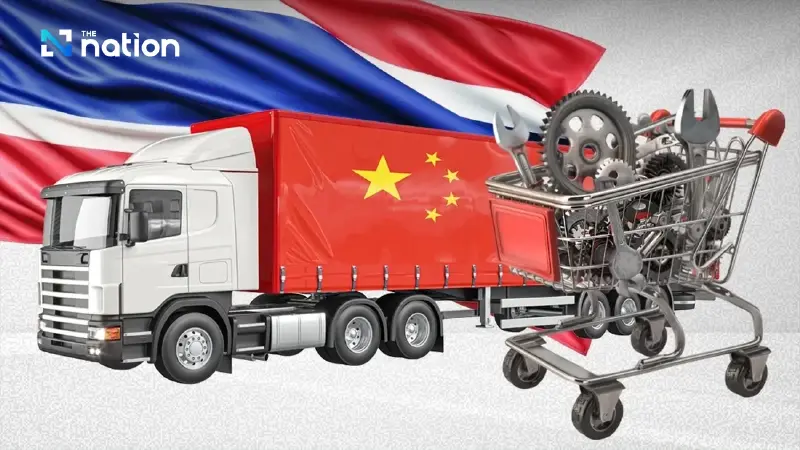


Thailand sees a rise in Chinese imports, with the Commerce Ministry monitoring high-risk sectors such as automotive and consumer goods for trade diversion.
The Trade Policy and Strategy Office (TPSO), under the Ministry of Commerce, has reported a significant increase in Chinese exports to Thailand, following a study on trade diversion. The study revealed that Chinese goods are at the highest risk of flooding the Thai market, with 1,149 items imported from China, including 24 high-risk items and 166 items under surveillance, mainly in the automotive and consumer goods sectors.
The study, titled “Analysis of Trade Diversion: The Case of Chinese Goods Flooding Thailand After the US Imposed a 19% Reciprocal Tariff”, follows the US’s new tariff rates, announced on July 31, 2025, with Thailand’s 19% tariff and other countries like China (34%), Taiwan (20%), Vietnam (20%), and India (25%) facing higher tariffs. This situation creates a risk of trade diversion, with goods from countries facing higher tariffs possibly flooding into the Thai market instead.
Natiya Suchinda, Deputy Director of the TPSO, stated that China poses the highest risk of trade diversion into Thailand. She recommended both short-term and long-term policy responses to address this issue.
While the increased influx of Chinese goods could provide more choices for consumers and stimulate competition, excessive trade diversion could harm Thailand’s domestic production, especially for SMEs unable to compete. This could lead to reduced production capacity, job losses, and a trade deficit, ultimately impacting the broader economy.
In response, the TPSO has conducted a comprehensive study to assess the impact and evaluate risks, preparing proactive measures for both the government and Thai businesses to mitigate negative consequences. The study focused on six main factors that could drive trade diversion:
- Tax rate and cost gaps
- Product structure and demand
- Supply chains and trade agreements
- Logistics and geography
- Macroeconomic factors and exchange rates
- Regulatory policies and enforcement
China remains the highest-risk country for trade diversion into Thailand, with a 15% tariff gap compared to Thailand. This, along with pressure from the US-China trade war, overcapacity issues, and government subsidies, results in lower production costs for Chinese goods.
The existing supply chain connections and ease of trade under the ASEAN-China Free Trade Agreement (ACFTA) have further facilitated the flow of Chinese products into Thailand.
Empirical data from the Spill-over Index confirms the growing issue of Chinese goods flooding into the Thai market. The index rose from 100 in 2018 (pre-US-China trade war) to a peak of 130 in 2024 within just seven years, indicating a significant increase in the flow of Chinese goods.
Key sectors to watch include vehicles and components, industrial products, and consumer goods, which have been identified as particularly at risk.
To identify high-risk products, the TPSO has developed a warning system using three key indicators:
- Market share of imports from China
- Import value growth rate
- Price gap between Chinese imports and global prices.
Products are then classified by their risk of trade diversion into five levels: high, moderately high, under surveillance, moderately under surveillance, and low. The analysis of 1,149 items imported from China showed that 904 items (78.7%) are classified as low-risk, with 38 items in the moderate surveillance category.
However, 24 items were classified as high-risk, 17 items as moderately high-risk, and 166 items are under surveillance.
The high-risk and under surveillance items primarily include capital goods and industrial products, which are beneficial for cost efficiency and improved production in the domestic manufacturing sector. However, over-reliance on Chinese imports in these sectors exposes Thailand to price volatility, potential policy changes, and supply chain disruptions in the future.
Meanwhile, consumer goods such as alcohol, cabbages, clothing, and plastic furniture, which directly compete with local producers, are also categorised as high-risk. This could impact Thai businesses, particularly SMEs.
