
How can AI enhance healthcare access and efficiency in Thailand?
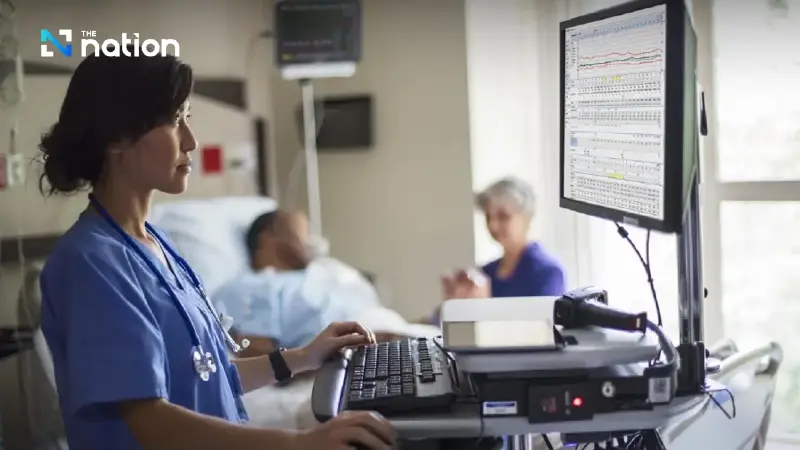


Thailand has been lauded for its efforts in medical technology, ranking as a leader or second in ASEAN. However, it faces challenges due to limited resources and budgets.
Access to healthcare services is a major issue faced by many countries, especially within local communities. Thailand has a pressing need to integrate healthcare services to reach underserved populations.
According to Krungsri Research, the medical equipment market in Thailand, including exports, is valued at over 200 billion baht. It is projected that from 2023 to 2025, Thailand's medical equipment market will grow by an average of 5.5-7.0% annually.
Despite this, healthcare systems globally still face constraints in resources and budgets, with many hospitals using systems that cannot fully integrate data.
Meanwhile, the World Health Organisation (WHO) has forecasted that by 2030, there will be a global shortfall of 15 million healthcare professionals, with Southeast Asia facing a shortage of 6.9 million. This will place additional pressure on healthcare systems and the management of patients in hospitals.
As the number of patients increases, yet the number of healthcare professionals remains insufficient, Philips, a global leader in healthcare, continues to innovate. Their ongoing efforts in developing medical technologies, especially in the connected care portfolio, aim to address these challenges by ensuring continuous connectivity throughout the patient care journey.

Enhance healthcare for over 2.5 billion people globally
Julia Strandberg, Executive Vice President and Chief Business Leader of Connected Care at Royal Philips, discussed with Krungthep Turakij the role of digital technology in advancing healthcare and public health.
She highlighted Philips’ mission to elevate the health and quality of life for over 2.5 billion people worldwide. Currently, Philips’ hospital patient monitoring (HPM) solutions and connected care systems have supported over 700 million patients globally.
Virtual care technology, offering online healthcare services, is also expanding access to health systems and treatments.
"Philips’ connected care medical portfolio provides seamless solutions from hospital patient care to post-discharge home care. By connecting data remotely to centralised hubs, it facilitates consultations with specialists and efficient information exchange,” Julia explained.
“Additionally, managing patient data from various devices in one place allows healthcare professionals to access patient information more conveniently.”

Support accessible and equitable healthcare
Julia continued by noting that Thailand has been praised for its efforts in medical technology, ranking as a leader or second in ASEAN.
However, she acknowledged the limitations of medical technology development, not just in Thailand, but across the region, particularly regarding the resources and budgets required, as well as regulations in each country.
"Medical technology" will be one of the driving forces of Thailand’s economy, contributing to the enhancement of healthcare services to international standards, increasing competitiveness in the global market, and promoting equitable access to healthcare.
It will also encourage the development of the medical equipment industry to become more self-reliant, reducing dependency on imports, and generating new opportunities through health tech startups.
Julia further explained that Philips has supported Thailand’s medical technology sector from the past to the present, working towards improving access to healthcare and ensuring equity for all.
Examples include donations of 100 patient monitoring devices worth around 3 million baht to the Ministry of Public Health to assist hospitals affected by the 2011 floods, as well as providing ultrasound echo machines to various hospitals in collaboration with the Heart Association of Thailand to support mobile healthcare units in rural areas.
"Access to healthcare services is a major challenge faced by many countries, especially within local communities. Thailand must work to integrate medical services effectively,” she said.
“Philips has provided medical technology in various hospitals, both public and private, as well as in medical schools. Our focus is on medical tools for treating diseases such as stroke, heart disease, and lung diseases, which are prevalent among many patients."

AI enhances predictive healthcare solutions
Thailand has been placed on the “shortlist” of countries set to launch Philips’ new products soon after their global release. However, the product launch in Thailand will depend on meeting regulatory requirements, safety standards, and relevant policies for registration.
Julia noted that economic crises, conflicts, or changes in US tariff rates may not significantly impact the importation of medical equipment.
Philips’ direction will continue to focus on connected healthcare solutions, leveraging AI technology for processing and predictive analytics. This allows for early predictions of patient conditions and provides advance warnings to healthcare professionals or caregivers.
Additionally, Philips places significant emphasis on AI research, particularly in the area of heart disease. The company collaborates with innovations in image-guided therapy to connect all devices and patient data for heart disease patients.
This enables doctors and nurses to monitor patient conditions remotely, whether they are in another room within the hospital or outside of it, ensuring accurate diagnosis, treatment, and more efficient patient monitoring.

“Connected care”: seamless healthcare integration
“Connected care” is a solution that supports continuous care by connecting patient information from the moment they arrive at the hospital or emergency department, through surgery, the ICU, general wards, and post-discharge recovery at home.
In Thailand, Philips’ HPM and connected care systems are widely used, particularly in large hospitals and medical schools.
The solution is based on three key principles:
- Seamless: Patient data is continuously linked, from the operating room to the ICU and general wards, without interruption. This differs from traditional systems, where information is often lost in between stages.
- Connected: Medical devices at the bedside, such as drug dispensers, saline drips, and laboratory data, are connected to monitors, providing doctors with an immediate overview of the patient's condition.
- Interoperable: Patient data can be transferred to all departments, enabling doctors to track test results and view patient information anywhere, at any time. This reduces redundant tasks and increases the time available for direct patient care.
