
Medical drone pilot launched in Phang Nga to support island healthcare
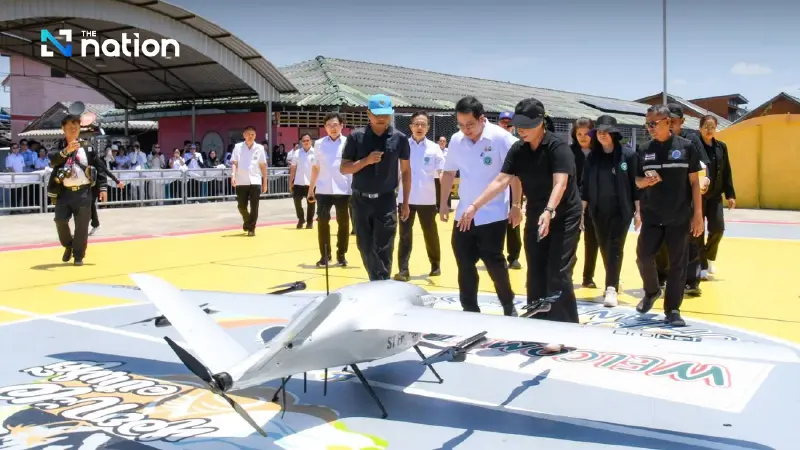


The Public Health Ministry has tested drones to deliver medicines and medical supplies at Koh Panyi in Phang Nga as part of a southern pilot project to develop a practical model for wider use.
Testing and demonstrations of drones for delivering medicines and medical supplies in telemedicine missions kicked off at Koh Panyi Subdistrict Health Promoting Hospital in Phang Nga on Sunday (March 29).
Those attending the test and demonstration included Public Health Minister Pattana Promphat, Department of Medical Services director-general Dr Nutthapong Wongwiwat, AVM Anukool Onchanom, commander of the Intelligence, Surveillance and Reconnaissance Centre under the Air Operations Control Command, and related agencies.
Pattana said the Public Health Ministry has a policy of using modern technology to improve the healthcare service system in order to increase convenience, speed and reduce waiting times, particularly in areas with travel limitations such as islands or marine areas.
Drones could help make the transport of medicines, vaccines, blood and life-saving equipment more efficient and more predictable in terms of timing, he said.

He explained that a working group had been appointed to study, research and develop the use of unmanned aerial vehicles in medical missions, with testing in three pilot settings: marine areas, forest and mountain areas, and urban zones. In the South, tests are being carried out in Krabi, Satun and Phang Nga.
Pattana added that results from the Krabi trial showed transport times could be cut from 20 minutes to just five minutes, while in Satun, cross-sea delivery took around 20 to 30 minutes.
As for the Phang Nga trial, the route from Bang Phat Pier to Koh Mak Noi Subdistrict Health Promoting Hospital and Koh Panyi took a similar amount of time to conventional travel, but offered more certainty in delivery timing as there was no need to wait for scheduled boat services.
Overall, the tests were considered successful and practical for real use. The results from all three pilot areas will now be assessed and refined to develop a model for using drones to deliver medicines, medical supplies and medical equipment in island and marine areas.
Nutthapong said medical drones are already being used in many countries, including the United States, the United Kingdom, Switzerland, parts of Africa, India, Nepal, Indonesia, Malaysia, China, South Korea, Japan and Singapore.
Their uses include emergency deliveries to clinics in hard-to-reach areas, transporting medicines and medical equipment in remote locations, and even carrying organs for transplantation, as first demonstrated by a medical university in the United States.

For Thailand, he said there is currently no commercial medical drone service provider. Only one company has previously conducted a real pilot flight test in Satun.
He said vertical take-off and landing (VTOL) drone technology is currently being developed with operational standards in mind, and coordination is under way with the Civil Aviation Authority of Thailand to establish dedicated medical flight paths.
Efforts are also being made to include drone-based medicine delivery within healthcare benefit schemes so hospitals can adopt the service.
The Phang Nga trial will continue until April 14, 2026, before the findings are evaluated together with results from Krabi and Satun to develop a “medical drone” model that can be used in Thailand’s public health system.
