
Medical drones set to speed up medicine deliveries to Thai islands
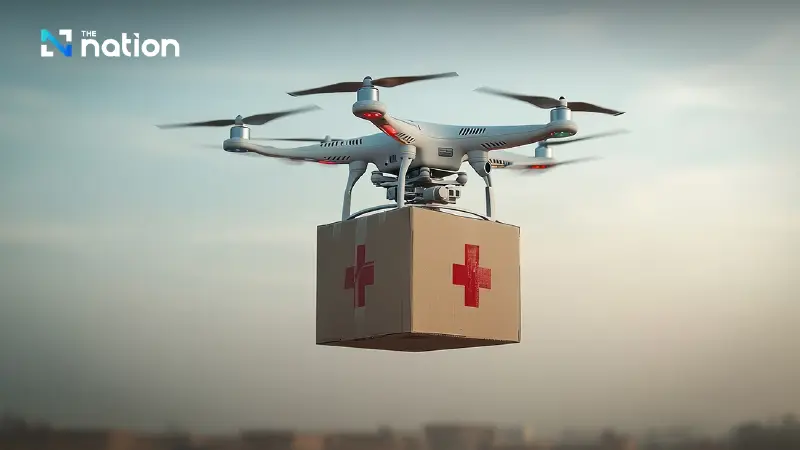


The Department of Medical Services has showcased the success of its medical drone project to improve the delivery of medicines and medical supplies to islands across Thailand.
Dr Nutthapong Wongwiwat, Director-General of the Department of Medical Services, said he did not want the phrase “too far away” to become a reason why anyone should lose their life. The department is working to turn Thailand’s skies into life-saving routes for as many people as possible.
The medical drone project is expected to reduce the limitations of time and distance, while increasing patients’ chances of receiving timely treatment. The Department of Medical Services has therefore joined hands with partner agencies to carry out a pilot project testing unmanned aerial vehicle innovation for medical use, or medical drones, to transport medicines, blood and medical supplies.
The project is designed to address difficulties in accessing healthcare services for people living on islands and in remote areas. Trials have already been carried out in Krabi and Satun, while testing in Phang Nga is due to conclude soon.
One of the key locations in Phang Nga is Panyi Island, where the project is being assessed under real operating conditions to evaluate the efficiency of the aerial transport system.
The initiative marks another important step in the development of the country’s healthcare service system and is being prepared for integration into real-world service delivery, so that people living on islands or in hard-to-reach areas can receive medicines and medical supplies more quickly.
In the past, transporting medicines, blood or medical supplies to island communities relied on ferries, which could take several hours and were often affected by sea and weather conditions. This was especially critical in emergencies, when every minute could mean the difference between life and death.
The use of medical drones is therefore comparable to creating an “aerial expressway” for the healthcare system, enabling medical supplies to reach remote areas much faster.
The Department of Medical Services plans to push the project into actual service delivery by developing standard operating procedures for drone-based medicine transport as formal medical standards.
It is also coordinating with the Civil Aviation Authority of Thailand to establish dedicated medical flight routes and to ensure that drone-based medicine delivery can be included within healthcare benefit schemes, allowing hospitals to adopt the system sustainably.

In the next phase, the medical drone development project will expand testing to island groups in both the Andaman Sea and the Gulf of Thailand. It will also develop links with telemedicine systems at both origin and destination hospitals, as well as explore home delivery of medicines to patients.
In addition, the project will develop temperature-controlled systems for transporting medicines and blood, alongside a mobile application for tracking delivery status.
The Department of Medical Services said its goal is not merely to demonstrate the existence of drone technology, but to ensure that, wherever a patient may be in Thailand, treatment can reach them as quickly as current technology allows.
