
Mahidol Turns Research Into Thailand's Economic Medicine


Thailand's leading university partners with 200 firms to commercialise medical AI, gene-edited organs, and living-drug factories as bulwarks against global economic turbulence
- Mahidol University has launched the "MU Synergy" initiative, partnering with over 200 firms to commercialize its research and drive Thailand's economic growth.
- The strategy focuses on five key pillars: medical AI, a biopharmaceutical factory for "living drugs," xenotransplantation using gene-edited pigs, future food, and next-generation education.
- Specific projects aim for direct economic impact, such as a widely deployed X-ray AI that has already generated over 200 million baht and plans to reduce costly drug imports and national dialysis expenses.
- The university is also revamping its education model to produce "Zero-Day Ready" graduates, aiming to create a skilled workforce that can immediately contribute to the economy.
Thailand's leading university partners with 200 firms to commercialise medical AI, gene-edited organs, and living-drug factories as bulwarks against global economic turbulence.
Mahidol University launched its most ambitious private-sector offensive to date on Tuesday, unveiling "MU Synergy: Real World Impact in Action" — a strategy that repositions one of Asia's foremost research institutions not merely as a generator of knowledge but as a driver of national economic growth.
Speaking at a press conference in Bangkok, university president Prof Dr Piyamitr Sritara described the initiative as the second phase of Mahidol's Real World Impact strategy, which runs from 2024 to 2028.
"We are turning research into an economic weapon," he said, pledging to deepen collaboration with the private sector and convert academic breakthroughs into measurable gains for Thailand's GDP.
The announcement comes as Thailand grapples with sluggish economic growth, geopolitical instability, and intensifying regional competition.
The university is banking on five flagship pillars — medical artificial intelligence, a biopharmaceutical factory, xenotransplantation, future food, and next-generation education — to seed a new economic growth curve for the country.

AI That Already Pays Its Way
The most commercially mature pillar is Medical AI. Mahidol has built a Health Data Lake drawing on roughly eight million patient visits annually from its 11 affiliated hospitals, processed using NVIDIA H200 high-performance computing infrastructure provided through a strategic partnership with Siam AI Corporation.

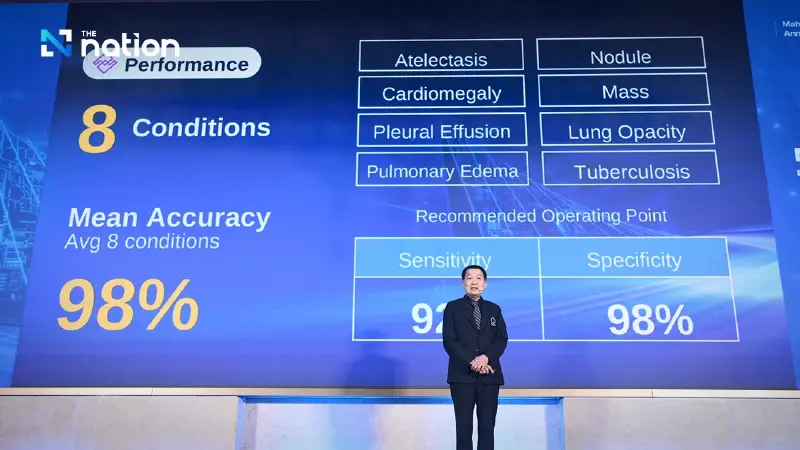
The results are already tangible: an AI system for reading lung X-rays, boasting an accuracy rate of 98 per cent, is now deployed across more than 700 hospitals nationwide, covering 7.4 million patients and generating economic value in excess of 200 million baht.
The system has received reimbursement approval from Thailand's National Health Security Office, a milestone that Assoc Prof Dr Cherdchai Nopmaneejumruslers described as critical to scaling the technology beyond research settings.
To increase the diversity and robustness of its models, Mahidol employs federated learning in collaboration with the Ministry of Public Health and international partners including Taiwan and King's College London — an arrangement that allows data from multiple institutions to train a shared AI model without transferring sensitive patient records.

A Factory for "Living Drugs"
Perhaps the most audacious of the five pillars is the Advanced Therapy Mahidol University (ATMU) biopharmaceutical factory, a joint venture between the university and Siam Bioscience with an investment of over 1,300 million baht.
Using what researchers call a "Twin Facility" model — linking laboratory research directly to commercial manufacturing — the factory aims to produce viral vectors and CAR T-cell therapies for cancers and rare diseases within two years.
Mahidol University’s vice president Assoc Prof Dr Sittiwat Lertsiri and Siam Bioscience CEO Dr Songpon Deechongkit, who presented the project at Tuesday's forum, said the venture is designed to wean Thailand off expensive drug imports and position the country as a regional hub for advanced biopharmaceutical production.
CAR T-cell therapy, which reprogrammes a patient's own immune cells to attack cancer, currently costs millions of baht per treatment when imported; local production could dramatically reduce that burden.

Gene-Edited Pigs as Spare Parts for Humans
Equally striking is Mahidol's xenotransplantation programme, developed in partnership with agro-industrial conglomerate Betagro and biotech firm Nzeno, at a combined investment of over 1,000 million baht.
The project aims to breed pathogen-free, gene-edited pigs in high-biosecurity facilities to serve as a source of kidneys — and eventually hearts — for human transplantation.
The clinical rationale is pressing. Some 120,000 Thais currently require dialysis, at a national cost exceeding 16,000 million baht per year. Assoc Prof Dr Chagriya Kitiyakara, who leads the research, said the team is targeting clinical trials in humans within five years, pending the construction of a designated pathogen-free (DPF) facility that will be central to the programme.

Food as Medicine, Mushrooms as Exports
The Future Food pillar centres on the 'SAI Mahidol' project, developed across a 13-rai strategic site in collaboration with the Federation of Thai Industries.
The initiative is extracting high-value active ingredients from Thai herbs and mushrooms for global health and cosmeceutical markets.
One product already on shelves is Nutriflow, a meal-replacement drink developed by Mahidol's Institute of Nutrition.
Designed for elderly consumers using proprietary AdaptiveFlow texture technology, it has surpassed 21 million baht in cumulative sales and recorded growth of over 100 per cent — modest figures by multinational standards, but a proof of concept that university research can travel from the laboratory to the supermarket shelf.
Kriengkrai Thiennukul, chairman of the Federation of Thai Industries, noted at the forum that AI adoption in a pilot group of 25 Thai factories had reduced production costs by 25–30 per cent on average, underscoring the urgency of transitioning away from Thailand's labour-intensive, first-generation industrial model before 2030.

Zero-Day Graduates
The fifth pillar targets the talent pipeline. Mahidol is expanding its Cooperative and Work-Integrated Education (CWIE) model — which blends academic study with on-the-job training from day one — across partnerships with more than 140 global organisations.
Alongside this, a new Credit Bank System (MU-CBS) allows students to accumulate a flexible skill portfolio rather than following a rigid degree path, addressing what industry leaders describe as a chronic mismatch between graduate qualifications and employer needs.
New courses introduced this year include an associate degree in engineering with a focus on digital manufacturing and a programme in environmental communication aligned with sustainability demands.
The stated aim is "Zero-Day Readiness": graduates who can contribute productively from the first day of employment.

A University Reimagined
The broader ambition, as Jareeporn Jarukornsakul, CEO of WHA Group, framed it at the forum, is for Thailand to seize the moment of global realignment — attracting data centre investment (nearly one trillion baht has flowed in in recent years), electronics manufacturers, and EV producers seeking an alternative to more volatile production bases.
For Mahidol, the measure of success is no longer confined to academic citations. The university has defined three yardsticks: improved public health outcomes, better-informed public policy, and successful commercialisation of research.
Whether living drugs, gene-edited kidneys, or AI-powered diagnostics will ultimately move the needle on Thailand's stubbornly sub-2-per-cent GDP growth remains to be seen. But on Tuesday in Bangkok, at least, one of Asia's most respected universities served notice that it intends to try.
