
Thailand raw fish dishes linked to liver fluke and bile duct cancer risk
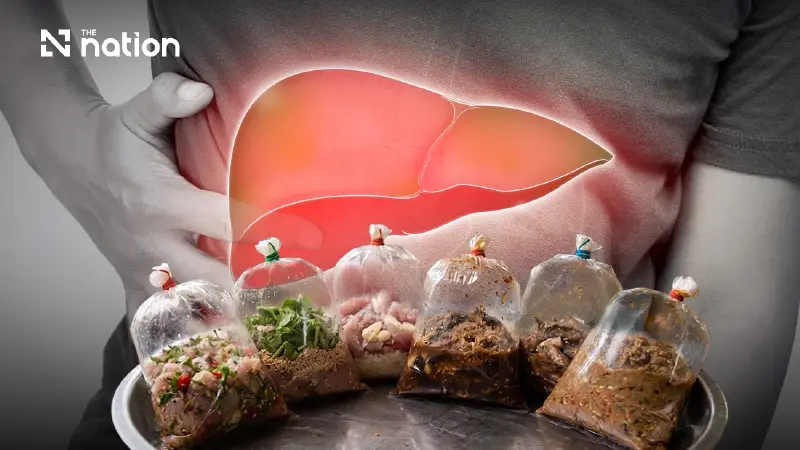


Urine screening at two universities in Maha Sarakham found high liver fluke infection rates, while health data link the parasite to bile duct cancer.
- Eating raw or undercooked freshwater fish dishes in Thailand is a primary cause of parasitic liver fluke infections, which are widespread with an estimated 6 million people affected.
- Liver fluke infection is directly linked to a high risk of developing cholangiocarcinoma (bile duct cancer), leading to Thailand having the highest incidence of this cancer in the world.
- Specific high-risk dishes identified include raw minced fish salad, raw spicy minced fish salad, and various forms of raw or unheated fermented fish.
- To combat the problem, health authorities recommend thoroughly cooking freshwater fish and have introduced a free, rapid urine test for early detection of liver fluke infection.
Reports on screening of more than 12,700 first-year students in the 2026 academic year at Mahasarakham University found that 4,233 tested positive for liver fluke infection, or 33%.
Screening of 1,922 first-year students at Rajabhat Maha Sarakham University (RMU) found 380 positive results, or 19%.
The screening used urine tests.
The Cholangiocarcinoma Research Institute at Khon Kaen University said the OV-RDT urine test kit, marketed as OV-ATK, had shown strong performance in detecting liver fluke infection among people in the Northeast.
Researchers from the institute published the findings in Infectious Diseases of Poverty (2023) 12:102.
Compared with faecal testing, the kit correctly detected most positive cases and correctly ruled out most negative cases, with a sensitivity of 94.2% and a specificity of 93.2%.
The kit also produced results that were highly consistent with urine-based laboratory testing and faecal testing.
It could detect very low levels of liver fluke antigens in urine, while the chance of reacting with other parasites was very low at 2%.

The self-screening kit for liver fluke infection, which uses urine samples, is included under health promotion and disease prevention benefits.
Thai citizens under all healthcare schemes can request the screening kit free of charge.
The test is simple, gives quick results within 10 minutes and helps screen risks at an early stage so that treatment can begin promptly.
Eligible recipients are:
People aged 15 or older with a risk history, such as:
- Previous liver fluke infection.
- Previous use of liver fluke deworming medicine.
- Eating raw or undercooked freshwater fish.
Participating service units can be checked, and bookings can be made through the Paotang app under the Health Wallet menu.
More than 40,000 liver fluke cases were found in 2025
Data from 2008 to 2022 showed that Thailand still had very high rates of cholangiocarcinoma cases and deaths.
During 2008–2022, the mortality rate was about 13–35 per 100,000 population, with most patients found in the Northeast.
Data from the National Health Security Office (NHSO) stated that, for OV-ATK kit screening services for liver fluke infection, more than 140,000 people had been tested in 2025, the first year of service.
A total of 316 service units nationwide had provided the service and claimed reimbursement.
Of all those tested, 29.27%, or more than 40,000 people, had positive results, but only 23.29% returned to receive deworming medicine.
Severe symptoms of liver fluke disease include fever, weight loss, ascites, swollen feet, an enlarged and tender liver, yellowing of the skin and eyes, pale or grey stools and dark urine.
Dilated bile ducts may develop into cholangiocarcinoma, while pathogens from the bile ducts entering the bloodstream can be one cause of death.
Thailand currently has no fewer than 6 million people infected with liver fluke disease, and this group may develop cholangiocarcinoma over the next 20–30 years.
Liver fluke infection can lead to cholangiocarcinoma, a major public health problem in Thailand.
Reports have stated that Thais have the highest rate of cholangiocarcinoma per 100,000 population in the world.
Thailand has been described as “The Capital City of Cholangiocarcinoma” because it has the highest number of cases in the world per 100,000 population.
Data from the National Health Security Office (NHSO) found that the cumulative number of patients over 10 years exceeded 200,000.
Most patients were in health regions 1, 7, 8, 9 and 10, covering the upper North and Northeast.
On average, there were about 20,000 patients per year, or 38 per 100,000 population.
The latest data from the National Cancer Institute showed that liver and bile duct cancer patients numbered as many as 19,491 a year, or 53 a day, with 14,971 deaths a year, or 41 a day.
Meanwhile, data on cancer patient services under the National Health Security system, or the 30-baht gold card, in fiscal 2025 showed that liver and intrahepatic bile duct cancer ranked fourth among the top five outpatient treatment services, with 26,591 patients and 129,387 service episodes.
For the top five inpatient treatment services, liver and intrahepatic bile duct cancer had the highest number of patients receiving services, with 20,312 patients and 44,230 service episodes.
The Department of Disease Control said risky dishes for liver fluke infection come from eating raw or undercooked freshwater fish.
The main source is white-scaled freshwater fish, including silver barb and other similar freshwater species.
The six dishes that should be strictly avoided because they are linked to cholangiocarcinoma are:
- Raw minced freshwater fish salad
- Raw spicy minced fish salad
- Raw fermented fish
- Raw fermented fish paste
- Fermented fish relish
- Fermented fish sausage
Dishes that require particular caution include raw minced freshwater fish salad, spicy minced fish salad, spicy raw fish salad made from seasoned raw fish, raw fermented fish paste, papaya salad made with raw fermented fish paste, chilli paste containing unheated fermented fish paste, and fermented fish dishes that are often eaten raw.
Grilled or roasted fish can also still contain parasite larvae if the flesh in the middle remains raw or undercooked.
Prevention can be achieved by eating fish that is properly and thoroughly cooked with heat; freezing fish at -20 degrees Celsius for seven days, or for four days in the case of whole fish; using separate cutting boards and utensils for raw and cooked food; washing hands and equipment after touching fish; washing vegetables and fruit before eating; placing food in clean containers; and undergoing screening when a risk is found.
However, parasites from raw animal dishes are not limited to freshwater fish.
Apple snails, golden apple snails, small freshwater shrimp, freshwater prawns, pork and chicken can also carry parasites.
These are not limited to liver flukes, but also include other parasites such as rat lungworm or Angiostrongylus cantonensis, pork tapeworm in the form of cysticercosis, and Gnathostoma spinigerum.
