
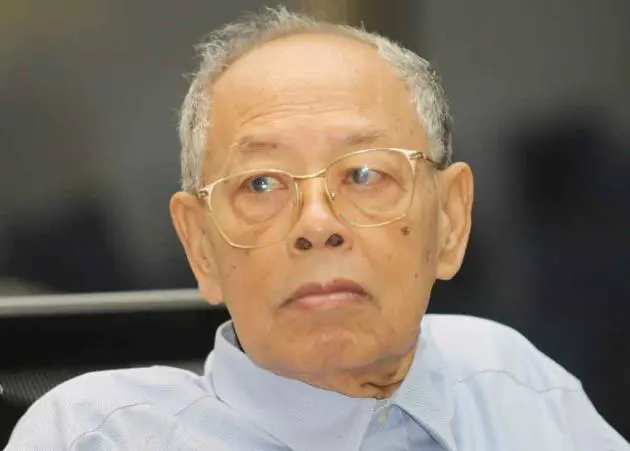
Khmer Rouge war crimes defendant, Ieng Sary, dies aged 87


Play
Phnom Penh - Ieng Sary, the Khmer Rouge's former foreign minister who has been on trial at the UN-backed war crimes courtsince 2011, died on Thursday, the court confirmed.
Ieng Sary was one of three ex-leaders of the ultra-Maoist regime being tried by the Extraordinary Chambers in the Courts of Cambodia (ECCC) on charges of genocide, war crimes and crimes against humanity.
The other defendants in Case Two, as the trial of the ex-leaders is known, are the chief ideologue Nuon Chea, 86, and the former head of state Khieu Samphan, 81.
ECCC spokesman Lars Olsen said the case against the two remaining accused would continue.
"We understand that many people are disappointed that we cannot complete the proceedings against Ieng Sary and determine his guilt ori nnocence on the charges against him," Olsen said. "But Case Two is not over, and the charges against Nuon Chea and Khieu Samphan will be pursued." Ieng Sary had been taken to hospital from the detention facility on March 4. Long regarded as the weakest of the defendants, the 87-year-old suffered from numerous ailments including heart problems and bronchitis that last year saw him hospitalized for more than two months.
Ieng Sary's international defence lawyer, Michael Karnavas, said his client had become increasingly ill in recent months.
"At the end he could not digest food, so that was the problem, "Karnavas said. "That placed a lot of stress on his heart which wasalready weak." Karnavas said he expected the court would release his client's body to the family.
"Our understanding is that they would prefer to have a cremation in conformity with Buddhist practices," he said, adding that the family did not want an autopsy, as it was both unnecessary and contrary to Buddhist beliefs.
The trial of the former leaders opened in November 2011 with four defendants, one of whom was Ieng Sary's wife, the former social affairs minister Ieng Thirith. However, she was released in September after the court ruled that dementia meant she was unfit for trial. All four defendants had denied the charges against them.
The Khmer Rouge took power in 1975 after a bitter civil war and renamed the country Democratic Kampuchea. Ieng Sary, who was the brother-in-law of Pol Pot, the Khmer Rouge leader, was foreign minister and deputy prime minister.
The ultra-Maoist movement emptied the cities and turned Cambodia into a vast gulag where people were put to work growing rice and building irrigation schemes. Over the next four years an estimated 2million people - around a quarter of the population - died from overwork, starvation, execution and illness.
As the public face of the Khmer Rouge, Ieng Sary regularly denied reports of atrocities emanating from the closed state.
The Khmer Rouge were eventually forced from power in January 1979by a combined force of Vietnamese troops and Khmer Rouge defectors. Ieng Sary and other leaders fled to the Thai border where, supported by Thailand, China and the West, they continued fighting until the movement's collapse in the late 1990s.
In 1996, Ieng Sary defected to the government in Phnom Penh, and took thousands of followers with him. He received an amnesty guaranteeing that a 1994 law outlawing the Khmer Rouge would not be used against him.
However, under the tribunal's rules, which were signed by the UN and the Cambodian government in 2003, amnesties were declared invalid. In 2007, Ieng Sary was arrested by the ECCC. He spent his final years at its detention centre on the outskirts of Phnom Penh.
