
Japanese foundation's humanitarian aid approved


Play
Japan-based Nippon Foundation is working with the Ministry of Health in distributing 30,000 emergency medicine boxes in rural areas this year.
The foundation said in a statement that the distribution is part of development cooperation with the ministry covering four sectors for social development programmes in the country.
“We submitted the proposal to the government. The government agreed after sending experts to observe such programmes abroad,” said Shuichi Ohno, an executive director from the foundation. “So there will be about 60,000 such boxes to b distributed to all rural villages and we are negotiating with the ministry to distribute a total of 30,000 boxes this year.”
The boxes will contain seven types of medicines and basic medical kits produced by the ministry-owned factories.
The distribution of the boxes worth US$12 each commenced in 2009. The distribution reached more than 15,000 villages that year. It was subsequently suspended, however.
Now, the ongoing negotiations will aim to resume the distribution this year with the target of reaching all of the country’s 50,000 villages within two years.
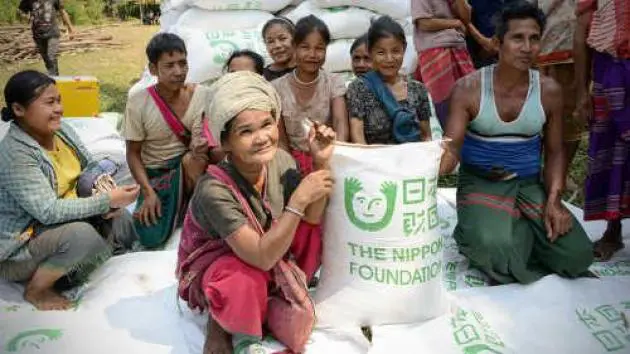
The foundation said on its website that starting in December 2012, it began to provide aid to these conflict-affected people in Myanmar through the provision of rice and medicine. The humanitarian aid initiative was to assist people who have been affected by the conflict between the government of Myanmar and Non-state Armed Groups (NSAGs).
In the current phase of assistance, it is projected that a total value of $3.3 million in assistance will be supplied. Already, approximately 47 per cent of the rice and 21 per cent of the medicine have been distributed to the conflict-affected people.
During the rainy season, which begins in late May, the supply of aid was interrupted temporarily as roads leading to areas inhabited by ethnic people were blocked. However, with the arrival of the dry season in November, full-scale provision of supplies resumed. Thus, over the past year, the aid effort has made steady progress, in line with plans.
Takehiro Umemura, manager of the Nippon Foundation’s Myanmar Liaison Office, who handles the frontline humanitarian aid, points out that obtaining the approval of both the government and the specific NSAGs was an absolute precondition for the relief effort to begin.
“If we had rushed into the relief effort in tense areas without receiving the approval of both sides, it could have led to new conflicts. This was something that we wanted absolutely to avoid. The decisions as to who would receive aid, what areas would be targeted, and how much would be distributed were ironed out through discussions between the Myanmar Peace Center, which coordinates issues related to the conflict affected people in Myanmar, the representatives of each of the non-state armed groups, and the Nippon Foundation. In terms of the timing for provision of aid, we began with those areas where a final consensus had been reached between stakeholders, having confirmed that the situation in the given area was stable and the preparations had been made to receive the aid.”
