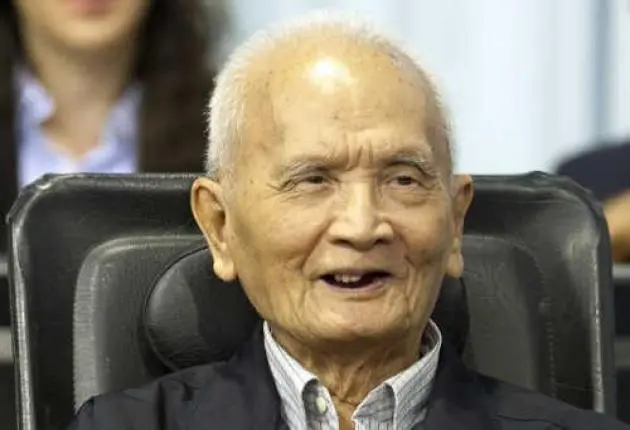
Arrogant, intimidating and above all unrepentant, Nuon Chea is considered the chief ideologue of the Khmer Rouge and a key architect of its killing machine, according to AFP.
Once regime leader Pol Pot's most trusted deputy, he was arrested in September 2007 on charges of war crimes, genocide and crimes against humanity.
During his trial, the former law student denied a role in one of the worst atrocities of the 20th century, telling judges that he was mainly in charge of educating fellow cadres.
Wearing his trademark sunglasses even in the dock, he frequently walked out of the courtroom in protest at proceedings, angering victims of the Khmer Rouge's reign of terror in the late 1970s.
Addressing the country's UN-backed tribunal in October 2013 in his final statement, Nuon Chea blamed everything on "treacherous" subordinates.
He said he had educated Khmer Rouge cadres "to love, respect and serve the people and the country".
"I never educated or instructed them to mistreat or kill people, to deprive them of food or commit genocide," he added.
Nuon Chea was accused of playing a critical role in a regime which left up to two million people dead of starvation, disease, overwork and executions between 1975 and 1979.
He and his fellow defendant Khieu Samphan were "dictators who controlled Cambodians by brutal force and fear", according to prosecutor William Smith.
"They brutalised and dehumanised their own people and kept spilling blood for power," he said.
Secretive cadre
Born Long Bunruot in 1926 to a wealthy Chinese-Khmer family in Cambodia's northwest Battambang province, Nuon Chea studied law in Bangkok, where he joined the Communist Party of Thailand in 1950.
A year later he transferred membership to the Vietnamese-dominated Indochinese Communist Party, and rose quickly through the ranks of Cambodia's Maoist insurrection.
In April 1975, the communists defeated Cambodia's US-backed government and marched into Phnom Penh.
Nuon Chea, a secretive cadre even by the standards of one of the world's most enigmatic movements, was by then positioned as the second-in-command of the Khmer Rouge, also known as the Communist Party of Kampuchea (CPK).
It is unknown how many of the Khmer Rouge's victims were killed outright, but researchers believe the regime was systematically eliminating its "enemies", most likely on Nuon Chea's orders.
"There is substantial and compelling evidence that Nuon Chea, commonly known as 'Brother Number Two' played a leading role in devising the CPK's execution policies," wrote genocide scholars Stephen Heder and Brian Tittemore in their book "Seven Candidates for Prosecution".
"There is also substantial evidence that he played a central role in implementing those policies."
Nuon Chea became the first former regime leader living freely in Cambodia to be detained by the UN-backed tribunal in 2007.
Under detention in a purpose-built facility near the court, Nuon Chea has suffered a number of ailments including high blood pressure, acute bronchitis and heart disease.
Even so, judges rejected his lawyers' argument that he was unfit to stand trial.
In 1998, after the fall of the last stronghold of the Khmer Rouge, Nuon Chea defected to the government side led by current premier Hun Sen. He subsequently lived freely in the Thai border area until his arrest in 2007.
Since then, he has acknowledged deaths that took place under the regime he helped control, while denying he was in a position to stop the disaster that unfolded.
In the award-winning 2009 documentary "Enemies of the People", Cambodian film-maker Thet Sambath -- who lost his parents and a brother under the regime -- extracted startling revelations from him.
In the film, Nuon Chea can be seen sitting at a table in his modest wooden home, calmly telling Thet Sambath that the Khmer Rouge killed perceived traitors if they could not be "re-educated" or "corrected".
"These people were categorised as criminals... They were killed and destroyed. If we had let them live, the party line would have been hijacked. They were enemies of the people," he said.