
Grand military parade resumes after over 50 years


Play
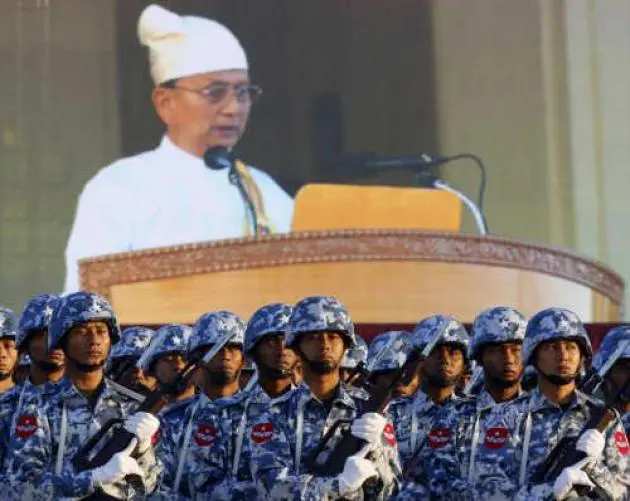
Myanmar held a grand military parade in Nay Pyi Taw to celebrate its 67th Independence Day anniversary on January 4 for the first time since 1962.
The celebration in Nay Pyi Taw was attended by top government and military leaders, amid protests in London by activists and students. No parades have been held since the military coup in 1962.
The event in Nay Pyi Taw was attended by President Thein Sein, senior government officials and invited guests.
As the country is in the third wave of reform process, the people are already enjoying the fruits of those reforms, the President said during a speech on the occasion.
“For democracy to succeed, we have been taking all necessary steps towards reforming political, social and economic sectors. In this context, we have set the first, second and third waves to conduct reform based on the prevailing conditions. As we are now in the third wave, the people are already enjoying the fruits of those reforms. So, we will continue our relentless efforts so that the people can enjoy more fruits,” said Thein Sein.
“We have learned lessons that Myanmar lagged behind others in development due to prolonged internal conflicts throughout the history.”
He said the grand military review parade had taken place again in this parliamentary democracy era since it was last held in 1962. Since changing from an old system to a new parliamentary democracy on April 1, 2011, the government has been committed to fulfilling the people’s desires, the president added.
“Today, our more than 50 million people have two common desires - peace and socio-economic progress. This is why the main objective of our reforms is to make sure that our people enjoy peace and development in a democratic way,” Thein Sein said.
Over the year into the reform initiatives, Myanmar had been able to engage smoothly in the democratic transition under the cooperation of the government, parliament, the military and the people. And the international community has praised the country for its progress, he commented.
He also outlined the efforts to establish legislative, executive and judicial pillars under the constitution and engage in legislation such as passing new laws and by-laws and amending and annulling some relevant laws.
The grand military review parade on January 4 was the first of its type since 1962. Such parades were held from 1949 to 1962, after Myanmar gained independence in 1948.
The parades from 1949 to 1953 were held in front of Yangon City Hall and attended by presidents Sao Shwe Thaik and Dr Ba U. Presidents Ba U and Mahn Win Maung attended the parades from 1954 to 1962 on Pyay Road.
Suu Kyi’s warning
While observing centenary celebrations of her late father’s birthday on January 3, Aung San Suu Kyi, the chairperson of the opposition National League for Democracy (NLD), warned that Myanmar is not yet a sovereign state, if the people live under oppression after the independence.
“Myanmar already regained her independence, but the people are living under oppression, this is why, our country is not a sovereign state,” Aung San Suu Kyi said.
She added that Bogyoke Aung San and his comrades managed to regain the independence for the country. The duty of the generations is to sustain the independence to be more realistic. To do so is not enough for a single generation, but successive generations will be responsible for that.
“Some people said Myanmar people don’t deserve democracy yet. These people are the ones who do not want to pave the way for democracy,” she said, adding that the government must first realise the need and then people must hold the duty not to abuse the democratice rights. “The rights and responsibility are always together. I believe the people can perform these duties. Moreover, I believe our country deserves democracy.”
Protests
On the day, in Yangon, around 150 activists from 22 organisations demonstrated to demand constitutional amendment, the release of all political prisoners, freedom of expression and internal peace.
The 22 organisations released an announcement in honour of Independence Day, recounting the failures of previous Myanmar governments to negotiate nationwide peace. The announcement also pointed out that despite Myanmar’s 67 years of independence, citizens have been bereft of basic rights since the military took power in 1962.
They furthered that although Myanmar is said to be undergoing a democratic transition under a quasi-civilian government, the government continues to confiscate land from citizens, labour rights are frequently violated, the national education law is not the student-centred, citizens are frequently bullied and even murdered by government authorities and political activists are often arrested.
“There are 164 political prisoners remaining in Myanmar prisons. Another 203 are going through trials. Please amend the constitution, which is the main source of all political crises. Only then can Myanmar achieve genuine independence,” declared political activist Moe Thway.
Five former students of Yangon School of Political Science also distributed 10,000 sheets of Burma’s Declaration of Independence in different townships in Yangon.
“The declaration includes how our ancestors fought for the independence. The fourth paragraph states that ‘Our country is not for one religion.’ And the fifth paragraph states that ‘Our country is not the inheritance of a person or an organisation.’ We want to share this information with the public. Many people do not know about the Independence Declaration. That’s why we distributed the declaration,” said Htet Lin Aung.
He continued: “the government should have said about the Independence Declaration on the Independence Day. The government should say that the Independence was gained through the efforts of all races and religions.”
