
Singapore seeks slice of growth


Singapore expects to further play a key role in helping Myanmar tackle its business bottlenecks, with a number of companies ready to engage in various activities.
To Lee Yi Shyan, senior minister for Trade & Industry and National Development, Myanmar still needs to upgrade physical infrastructure to match the needs of large urban populations, as well as connectivity and reforms in other economic areas.
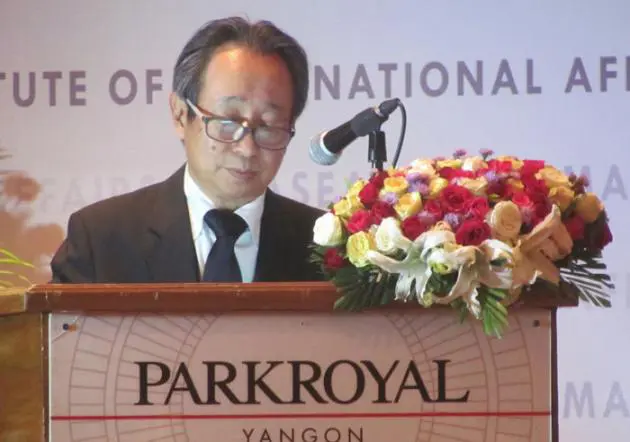
Lee was expected to attend the Asean-Myanmar Forum in Yangon last week but the visit was cancelled due to the passing away of Singapore’s founder Lee Kuan Yew. His speech was read out by Robert Chua, Singapore’s ambassador to Myanmar. In his speech, he outlined tangible relationships of the two countries.
“At the G-to-G (government-to-government) level, we have partnered Myanmar to identify its needs in capacity building through the Singapore-Myanmar Technical Cooperation Programme since 2012,” he said.
“At the business level, Singapore companies have also contributed to Myanmar’s development. Some key areas where Singapore companies have made good inroads include urban development, connectivity and finance.”
Singaporean firms have been engaged in several projects in the country.
On urbanisation, he noted that Surbana International Consultants, a masterplanner firm in Singapore, is providing master planning and architectural consultancy services for the affordable housing in Dagon Seikkan township. Other Singapore developers such as Keppel Land, Soilbuild, and Pan Pacific are also active in the real estate sector. The firms have expertise providing end-to end solutions from master-planning to property development, facility management and industrial development.
Lee also said Singaporean firms are ready to help improve connectivity in the country.
“Better overall connectivity and supply chain management are essential to support the flow of goods, services and people both within and across borders. Both hardware and software are important in connectivity and our companies are able to provide both,” he said.
In this part, late last year, a consortium comprising Singapore’s Changi Airport Planners and Engineers (CAPE), Yongnam Holdings and Japan’s JGC Corp won the deal to construct the Hanthawaddy International Airport. The consortium will also operate the airport, transferring valuable management expertise to Myanmar.
Last year, two Singapore banks -- Overseas-Chinese Banking Corp and United Overseas Bank -- were among the nine foreign banks awarded the licences to operate in Myanmar.
Meanwhile, Fullerton Financial Holdings has also started providing micro-financing and individual loans to home enterprises and small businesses in Myanmar.
The minister noted that sound, reliable and predictable financial systems are critical to attracting foreign investments.
“As Myanmar develops its banking systems, it will benefit from tapping on the expertise of foreign banks and their experience in other markets. I am pleased to see that the confidence the Myanmar government has demonstrated in Singapore through the award of banking licences,” he said.
The minister added that Singapore is bullish on the growth prospects of Myanmar’s economy due to the latter’s strategic location at the intersection of China and India and its abundant natural resources.
In 2014, the two countries signed a memorandum of understanding to establish the Singapore-Myanmar Vocational Training Institute that would help Myanmar build up its pool of skilled workers in areas such as hospitality and tourism, electrical skills and electronics. Last month, both countries announced to reconvene the bilateral Joint Ministerial Working Committee later this year. The committee will focus initially on three areas of trade and investment, finance and legal sectors.
Myanmar and Singapore enjoy strong and growing economic links, with bilateral trade steadily increasing in recent years. With a cumulative investment of S$8.3 billion, Singapore was Myanmar’s third largest foreign investor last year. Trade rose by 6.6 per cent year-on-year to reach S$3.23 billion in the same year. Singapore was Myanmar’s third largest trading partner in 2013 and Myanmar moved up eight places to become Singapore’s 29th largest trading partner last year.
Lee noted that reforms must continue for sustainable growth, and Asean integration will help Myanmar realise its economic potential.
“I am confident that Asean can fulfill our vision of an integrated economic community and that Myanmar will continue to thrive in the coming decades. We look forward to be partnering Myanmar in its development journey,” he said.
