
1990 election revisited


Play
Lessons from 25 years ago recalled, ahead of 2015 elections in November
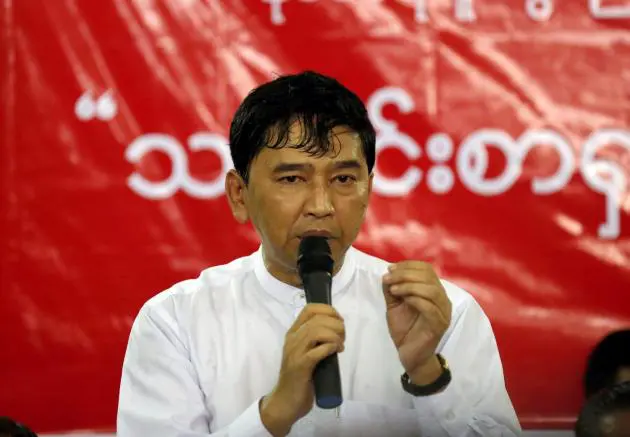
The former government's refusal to recognise the 1990 election results caused hardships to the country, said Pa-O National Liberation Organisation (PNLO) chairman Khun Myint Tun.
“The 1990 election was a milestone in Myanmar history. But the results were cancelled, so we are facing difficulties. We should take this as a lesson. Our people’s dreams should not fade away. Once, our dreams and hopes disappeared in 1990. This was a major cause of the destruction our country experiences today because the former government did not see the election a sign of progress,” said Khun Myint Tun.
He was one of the elected candidates of the National League for Democracy (NLD) member in the 1990 election.
The election was held in 485 constituencies out of a total of 492. A total of 2,209 candidates competed, including 87 independent candidates. An impressive 15,112,524 voters out of 20,818,313 total eligible voters, or 72 per cent, turned out to vote. About 12 per cent of the votes were invalid or blank.
Over 400 candidates from 93 political parties were elected, including 392 candidates from the National League for Democracy (NLD), in races with at least 2 candidates per constituency.
The NLD won the election with over 80 per cent of the vote. However, the military junta did not transfer power to the NLD as it had previously promised.
Twenty five years have passed and on May 27, representatives of political parties gathered to celebrate the silver jubilee of the first multi-party democratic elections since 1960.
To mark the occasion, NLD and the 88 Generation Peace and Open Society issued a joint statement, citing that they would resort to every possible approach, including standing for election, to amend the 2008 Constitution. Both wanted to see a federal union, in which all national groups lived in peace.
NLD also promised to ensure a free and fair election in 2015 and make continued efforts for charter change in and out of Parliament.
“No peace was possible without charter change to solve basic problems and build the union wanted by all ethnic groups. But no significant work that may lead to charter change had been seen even though the Parliament had clearly announced a referendum would be held this month,” it said in the statement.
Tin Aye, chairman of Myanmar's Union Election Commission (UEC), told reporters on Tuesday that the 2015 election will be in November. The actual polling date will be announced in August.
Myanmar is inviting foreign observers to the election. While the European Union Delegation is mulling the invitation, on May 26 the UEC signed a memorandum of understanding with Carter Centre for short- and long-term observation.
Tin Aye said that the observers assigned for long-term observation, to last three or four months, will monitor how to make the list of representatives, how the representatives stage election campaign and how the media report about the election.
“They will analyse the UEC and check how the UEC is doing, how the UEC is preparing for the voting system and voting list, and what kind of training to be given to the electoral staff. They will scrutinise the complaint letters after the election. They will monitor the election process. They will leave after the elected representatives start work,” he said.
UEC is in discussion to invite election commissions from Asean to the country three or four days before the election.
It will be the first time international observers are allowed to observe the election. In 2010 general election and 2012 by-election, only diplomats were allowed to observe the elections.
Although the observers can ask questions if they are not cleared about the facts, they cannot interfere or hinder the election process directly or indirectly. Each observer cannot make personal remarks to the media and only a responsible person will be allowed to make comments about the election process. The organisations observing the election can submit advice, techniques and analysis to the UEC.
The country is gearing up for the election amid challenges. The voter lists are not yet ready while the nationwide ceasefire agreement is not yet signed with ethnic armed groups.
