
Laos launches its first satellite


Play
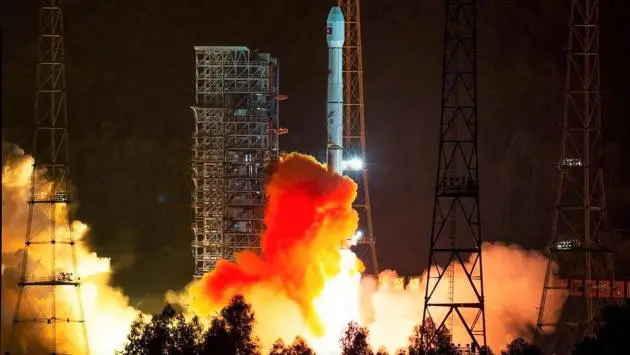
Laos' first telecommunications satellite (Lao Sat-1) was launched into orbit from the Xichang Satellite Launch Centre in Sichuan province at 00:07 local time on Saturday.
Lao Sat-1 successfully separated from the rocket upper stage and deployed its solar panels after it had blasted off.
The satellite was designed, developed and delivered on-orbit by China with the total project amounting to US$259 million.
The scientists also noted that out of 193 United Nations member countries in the world, less than half still did not have their own satellites.
The launching ceremony was attended by Vice President of the Lao PDR Mr Bounnhang Vorachit, ministers and other senior government officials from Laos and China.
Bounnhang said Laos was proud to have its own satellite which was considered a landmark in Lao history.
He said the launch of the satellite would contribute to further enhancing relations and the comprehensive strategic partnership between Laos and China.
The satellite is designed to provide communication links for government work, television transmissions and a range of telecommunication applications in Laos.
The satellite will also be used for other purposes, including education, health, defence, security and so on.
Xichang is one of the only three satellite launch centres in China with many satellites having blasted off onboard rockets here. China's rocket to explore the moon was also launched at this centre.
Lao Sat-1 was developed through a venture between the Lao government and three Chinese developers.
A shareholders' agreement for the Lao Sat-1 Joint Venture Company was signed in Vientiane on October 30 between all sides.
The Lao government holds a 45 percent stake in the Lao Sat-1 Joint Venture Company, while APMT has a 35 percent shareholding, SSTC has 15 percent, and APST has a 5 percent stake.
Minister of Posts and Telecommunications Mr Hiem Phommachanh said “The launch of the satellite by China is a special gift to Laos to mark the 40th anniversary of the Lao People's Democratic Republic on December 2.”
Work on the satellite project began in 2006 when Laos expressed interest in seeking an orbital slot.
When Laos found the 128.5 degrees East orbital slot available in 2009, the Lao government applied for use of the slot.
But one of the most important issues for this project was funding as it required large sums of capital investment.
It was also in 2009 when the government decided to seek out a loan in order to move the project forwards, but it was delayed while funding was procured.
Then in 2012, the Lao government signed a US$259 million loan agreement with the Export-Import Bank of China.
