
To Phuket on the route less travelled


Play
In a unique trip to Phuket, one of Thailand’s most popular tourist destinations, we approach the city from an unusual angle when we drive overland from Kota Baru, through troubled South Thailand, and then up to the country’s west coast.
To reach Phuket, we pass Pattani, Narathiwat, Yala, Songkhla, Pattalung, Krabi, Trang and Phang Nga.
We’re rather impressed at the start of the journey by the road we’re on; though it can’t accurately be called a highway as it winds through major towns where we have to stop for traffic lights, it is well-maintained and – get this – toll free!
In this initial part of the journey organised by the Royal Thailand Consulate-General’s office in Kota Baru, we see more paddy fields than houses or villages, suggesting there isn’t much development of physical infrastructure in the provinces of Narathiwat, Pattani and Yala, where three million Muslims live.
It was this area that bore the brunt of the centuries-long civil war between the Pattani Sultanate and Siamese kings, who eventually forced the region into submission. Thousands of Pattani Malays died, from as early as the 16th century until the region was officially annexed between 1902 and 1909 under the 1909 Anglo Siamese Treaty signed between the Kingdom of Thailand and Britain.
Then, about a decade or so ago, more than 8,000 lives were lost in what was said to be insurgent attacks by armed Pattani guerillas who wanted the south to secede from Thailand.
There were bombings, deaths from IEDs (improvised explosive devices) planted everywhere and rampant shootings in Sungai Golok, Hatyai, Pattani and Yala. While it was never proven, drug cartels were said to have been behind the attacks, which took more than 50,000 troops sent from Bangkok to quell.
Today, Pattani, Yala and Narathiwat are considered the most underdeveloped provinces in Thailand.
“These provinces have had a Muslim population as long as I can remember,” says Consul Azman Taepoh, adding, “Pattani was ruled by Muslim Sultans and, naturally, the people are Muslim and live by the Islamic code today.”
The common perception nowadays is that Muslims in these districts reject development. Or that the laid-back atmosphere means that the people here are backward, says Azman, a native of Pattani. But that’s not true.
It’s just that the majority of the population does not want any “vice-related” development, they are only interested in conducting legitimate, halal, business. They prefer farming, running small businesses like grocery shops, livestock breeding and aquamarine ventures, he says.
“That is why the Thailand government is pushing for a halal hub, to get the population to participate. This has been the government’s main thrust since the violence erupted in 2002,” explains Azman over lunch after a meeting with provincial district leaders in downtown Pattani.
Azman adds that there are many natural areas that can be developed into tourist attractions but, for security reasons, the Thai government is not encouraging that right now.
Instead, Pattani’s annual revenue of 20 million Thai baht (RM2.3mil) will be boosted by developing a halal industry that could become an important hub linking Kunming in South China and Malaysia.
As we continue our journey north, Phuket’s busyness is foreshadowed by the increasing number of houses, buildings and commercial activities as we approach Hatyai.
Trang
After six hours on the road, we reach Trang province, a heaven for sun and sea worshippers. The former seaport, now a bustling town of 680,000 people, draws tourists and their money with the 44 islands that lie off its coast.
We don’t stop, though, and continue on to Pattalung in our 12th hour, with night falling.
As we approach Phuket, the night sky brightens, lit up by the city’s many nightspots. At midnight we reach our hotel, the Royal Paradise, smack in the middle of Phuket’s red light district of Patong Beach.
As we tour the area the next day, our guide and van driver Deli points out that the hotels and resorts lining Patong Beach stand in the same area that appeared in many videos – including National Geographic’s special report – showing the devastating waves that claimed more than 8,000 lives during the Asian tsunami in 2004.
Deli also claims that rooms in some of these new places erected where people had been killed are closed because … they’re haunted!
“Some of the residents and also hotel patrons claim to have seen floors covered in water and the pale, dead bodies of drowned victims lying on the floor,” says Deli, adding while we zip past an empty resort that the areas in which these haunted hotels stand have been left poorly lit because not many people go there.
Although I am sceptical about the stories, I’m game when one of our group suggests sleeping in the area to find out if the ghosts are real. But our packed itinerary puts paid to the intriguing idea, unfortunately.
Though I am an excited first-time visitor to this famous 535sq km island, there is really nothing that I can say about Phuket that has not already been written about by countless writers and travellers in magazines and on blogs. Though perhaps the number of tourists is new – they have been steadily increasing over the past few years. Slightly more than 12 million tourists visited Phuket last year, with China arrivals topping the number of visitors followed by people from Europe; Malaysians were in 10th spot. (See “Major boost to tourism” below.)
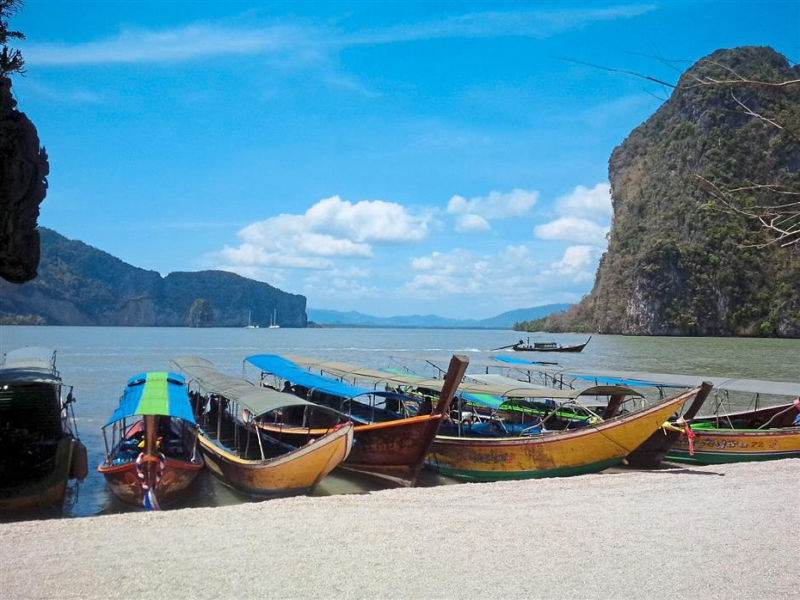
We are to cap the day off with a sunset experience at Promthep Cape, about 40km south of our hotel. Watching the sun disappearing over the horizon with the spectacular play of bright orange and red colours reflected in the sea is not an experience to be missed. In fact, the beautiful Promthep Cape is a place that’s photographed even more than the famous James Bond Island, which is 45 minutes off the coast here. The island with beautiful, sheer limestone cliffs became world-renowned after being used as a location in the 1974 Bond movie, The Man With The Golden Gun.
Phuket
Phuket at night is party central at Patong Beach, of course, especially along Bangla Road. While I never do find out why the road is named as such, I do find it a sight to behold: a 400m stretch lined with tattoo parlours, live bands, pole dancing clubs and peddlers of the so-called tiger shows, all selling their experiences into the wee hours. This is not a place for the depressed!
We leave after four days in Phuket, and while I carry away many impressions about the Land of Smiles, the strongest one is how it’s wonderful to see areas that had been so tragically affected by those waves are as vibrant as ever – and how life goes on despite tragedies, sorrow or political turmoil.
Phuket will see major changes to cope with the climbing numbers of visitors in the next three years, with the injection of one trillion Thai baht (RM117.4bil) to upgrade its infrastructure.
Arguably Thailand’s most popular area, Phuket was visited by 12.5 million tourists from 10 nations last year. In comparison, 25 million tourists visited Malaysia in the same period – which means Phuket had a concentration of visitors nearly half of the number in Malaysia within its tiny 535sqkm.
Phuket Tourism Authority of Thailand director Anom Vongyai says the allocation is needed to improve road infrastructure (including the construction of two road tunnels) and an expansion of Phuket International Airport, which needs another terminal to cope with the passenger load.
“Phuket has reached a saturation level in terms of tourist capacity, and we have to prepare proper infrastructure to cope with the influx of visitors,” says Anom.
“As it is, we expect to face a shortfall in the water supply, which comes from a dam catching water from three small waterfalls on the island.
“We need to find other water resources to meet the demand,” she tells reporters during a weekend visit to the area organised by the Royal Thailand Consulate-General office in Kota Baru, with its consul, Azman Taepoh, also on hand.
When Anom is asked whether Phuket is losing its charms to commercialisation chasing tourist dollars, she is quick to point out that Phuket – and Thailand, generally – is still known as the Land of Smiles.
“Of course, things here are getting more expensive by the year but we have not lost our identity as a people of warmth that is central to our culture.
“Change is inevitable but we have not lost our sense of hospitality, and this is proven by the increasing number of tourists,” she says.
