
Indian universities keen to lure Myanmar students


Play
YANGON - India expects to attract a greater number of students from Myanmar in coming years, confident the country is a good destination for higher education students.
Gautam Mukhopadhaya, Indian ambassador to Myanmar, said he anticipates many more students to go to India for their studies, as they can get very good quality education at much more affordable prices than offered in other English-speaking countries such as Australia and Singapore.
“India is a developing country like Myanmar and we have many cultural affinities,” he said.
“Most parts of India, especially in the east, are culturally very close to Myanmar. So, Myanmar students can feel at home. As food is also similar, they will feel comfortable. Generally, a three-year programme at an Indian university costs only about 400,000 rupees [Bt200,000] including accommodation, food and tuition fees. After finishing their degrees, they can also find a job with multinational companies,” he said.
“Education is an important pillar of India-Myanmar relations. And it is one area where India has a very good record in providing English language-based quality education. For several reasons, education is one area of |cooperation that we are interested in |promoting,” he said.
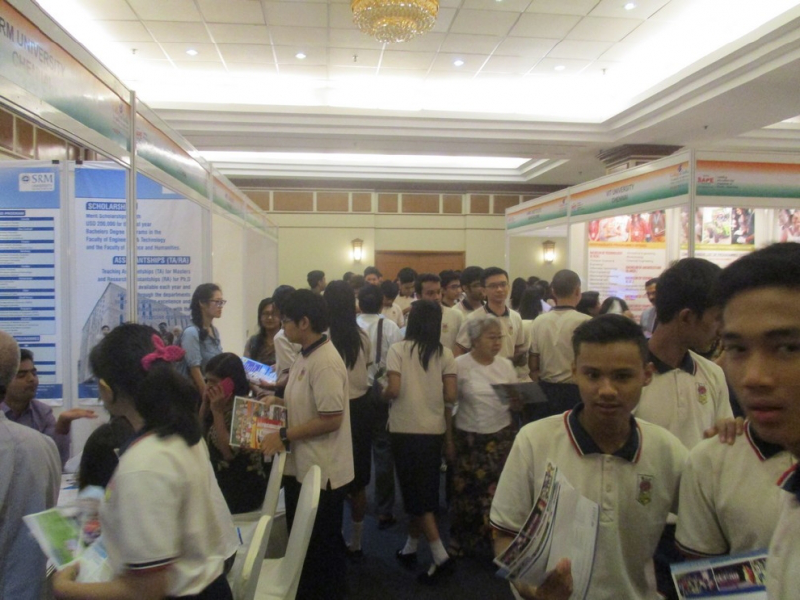
About 15 universities from India joined the third India Education Fair held in Yangon early this month. They included AIMS Institute, Mody University, Parul University, SRM University, VIT University, Assam University, ITM University, KIIT University, Amity University, Ajeenkya DY Patil University, PCTE Group of Institutions and Krupanidhi Group of Institutions.
Presiding over the event, the ambassador said the fair was a private initiative.
“I encouraged them to invest and start schools, colleges, and universities in Myanmar, when Myanmar’s rules and regulations |permit it. We would love it to be here.”
He noted that raising awareness was really important as Indian universities were not yet popular among Myanmar students.
According to Mukhopadhaya, the prospect was bright, as Myanmar people become more aware of India and its quality services.
“A lot of Myanmar medical patients are now going to India for medical treatment. As they go there, they will discover there are good schools. Then they will think of their children going to schools like that,” he said.
The envoy talked about the government-to-government scholarship programme of India’s Council of Cultural Relations under which close to 10,000 students from all over the world study in Indian universities. Nearly 25 Myanmar students have been awarded scholarships so far.
Additionally, India offers two scholarship schemes for Myanmar students through Myanmar’s Education Ministry. About 40 Myanmar nationals have joined these schemes for studies in various subjects such as art, dance, music, finance, Buddhism, Pali, Sanskrit and religious studies.
“Once we see there is more demand, the government of India will be very ready to increase the number of scholarships,” he said.
“In the long term, we will need to work on accreditation so that degrees in Myanmar are also recognised at Indian universities … Calcutta University has signed a memorandum of understanding with Dagon University. We would like to see many more such things.”
Expectations from the fair
Bangalore-based AIMS Institute participated in all three India education fairs in Myanmar. Last year, the institute welcomed two Myanmar students, boosting the total number to eight. AIMS’ regional admission director Sarabindu Pal wants to welcome more.
“This year, we expect six to eight Myanmar students as a result of our participation in this fair. We offer Myanmar students very good discounts for business studies and IT courses. They can get up to US$3,000 [Bt105,000] partial scholarships. They can visit our website and apply for the scholarships online. We expect more than 30 new students from Myanmar over the next three years,” he said.
He said that the BBA (Bachelor of Business Administration) course was the most popular at the AIMS Institute today. During the education fair, Myanmar students showed an interest in business studies as well as tourism and hospitality programmes.
Suresh Anand Mani, business development manager of SRM University, said the university’s debut participation in the fair not only aimed at finding new students but also at collaboration with Myanmar universities about students’ exchange programmes, curriculum exchange, faculty exchange and research work.
“The reason we came here is to share knowledge between SRM and Myanmar universities. We want Myanmar students to know more about SRM and what we are offering. Basically in the past, we had students from Myanmar who applied on their own. Every year, we |usually get two or three Myanmar students who apply online,” he said.
According to Mani, SRM has more than 2,500 international students in the campus, including eight from Myanmar. Four more have submitted applications. It aims to |concentrate on receiving more Southeast Asian students.
Mani said Myanmar nationals were more interested in technical education such as |engineering and technology, and courses in the medical and health sector. The university has partnered with Yangon Technological University for an exchange of knowledge and expertise.
Normally, an engineering course for undergraduate students costs about $9,000 per year, covering tuition fees and others. A partial scholarship would reduce the tuition fee by 25 to 35 per cent.
Harpreet Kang, dean of international affairs at PCTE Group of Institutes, saw demand for studies in fashion designing, hotel management, airlines and tourism, besides some enquiries about biotechnology.
Tuition fees cost about $5,000 a year, but special full scholarships are on offer for Myanmar students. The scholarship winners can also earn a 50 per cent discount on in-campus accommodation, food, Internet and other facilities, which cost about $1,000 a year.
