
Five things to know about South Korea's presidential election
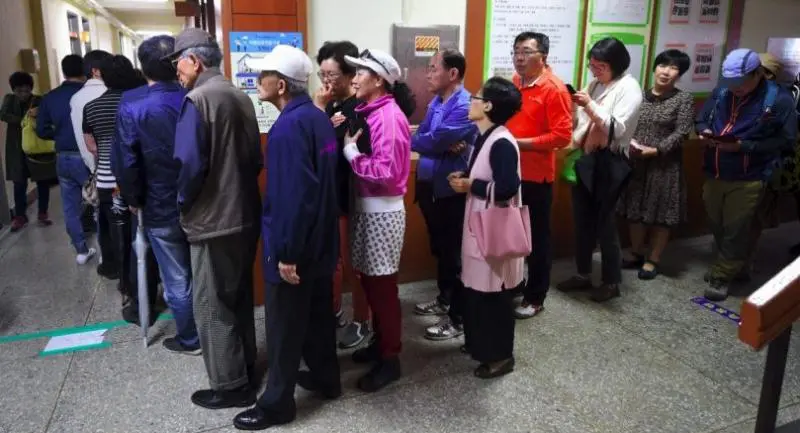


The Korea Herald breaks down today's historic presidential election in South Korea that may see Conservatives lose power for the first time in a decade.
South Koreans go to the polls Tuesday after eight months of political turmoil saw President Park Geun-hye removed by a massive, but peaceful, grassroots rebellion.
Park’s historic impeachment on March 10, immediately ousting her from her elected post, set the timer for a turbulent 60 days leading up to the election of a succeeding state chief. With May 9 chosen for the election, the official electioneering period kicked off April 17, allowing parties and candidates some three weeks to promote themselves to the largely undecided political audience.
Whoever wins the election will have to live up to a stronger public mandate for democracy while healing wounds and bridging political and socioeconomic divides. He or she also faces some tough external challenges, with a belligerent North Korea racing toward nuclear armament and an unpredictable leader in its key ally the United States.
1. Background basics
Conservatives have been in power for the past decade in South Korea, through Presidents Lee Myung-bak and Park Geun-hye. But after months of political turmoil, set off by Park’s corruption scandal and culminating in her impeachment, the pendulum appears to have shifted to the left: Moon Jae-in of the liberal Democratic Party of Korea has been the favourite to win throughout this election’s tight run of 60 days.
Some 26 per cent of voters already cast their ballots in the two-day early voting period Thursday and Friday. The election commission expects the total turnout to be one of the highest in recent decades, exceeding 80 per cent. Voting closes at 8 pm with exit polls expected shortly afterward and confirmed results projected to come in the early hours of Wednesday morning. Although it is a by-election in nature, the new president will get a full five-year term, starting immediately upon the reception of the certificate of election from the National Election Commission. This will most likely take place Wednesday morning.
2. Who’s likely to win?
Opinion polls, released right before a ban on releasing polls, all put Moon far ahead of his rivals. Moon is a lawyer who entered politics as an aide to the late President Roh Moo-hyun in the early 2000s. Since then, he has grown to be a heavyweight himself, once heading the main opposition party and previously running for the presidency in 2012. His main agenda is, in effect, a complete overhaul of the country, which he and his supporters see as being bogged down in “accumulated evils.”
His plans include increasing transparency and addressing issues that have occurred during the two consecutive conservative administrations, such as the “undemocratic” decision-making process for the deployment of the US’ Terminal High Altitude Area Defence anti-missile system. 3. Who are the other candidates? In all, 15 candidates entered the race, with some bowing out early on. Apart from Moon, there are four major players.
Hong Joon-pyo of the Liberty Korea Party is the conservative front-runner, while Ahn Cheol-soo of the People’s Party claims to be the champion of the centrists. In the last batch of polls, Hong made notable rises in popularity and is now claiming he has surpassed Moon in support, and would come out victorious in the end on the back of quickly consolidating conservative votes. Yoo Seong-min of the minor conservative Bareun Party and Sim Sang-jeung of the Justice Party also remain, having seen their campaigns through to the end despite expectations that they would pull out.
4. How did candidates fare during the campaign period?
Having relatively little time to reach out to the public, major candidates placed focus on the six consecutive televised debates that ran from April 13 to May 2 so as to underline their strengths and reveal rivals’ weaknesses.
“Usually, the television debates do little more than reinforce the already-existing conviction of each voter, but the situation was different this year,” said Shin Yul, a professor of political studies at Myongji University. “As the race started off in a rush, amid the aftermath of the presidential impeachment, the public didn’t have time to figure out the candidates and consequently turned to the debates to make up their mind.”
But largely due to the pressing schedule, it was mostly superficial features such as the candidates’ attitude, voice and general image that determined their rankings.
For instance, Ahn Cheol-soo of the centrist People’s Party started off the race as a neck-and-neck rival to front-runner Moon Jae-in of the Democratic Party of Korea, but he saw a fall in polls after each debate. The reason was to some extent attributed to his lack of debating skills as well as his attempt to change the sound of his voice, which many saw as abrupt and awkward.
5. What are the election promises?
Having witnessed a sitting president ousted over a corruption scandal, the candidates of this year’s snap presidential election each vowed to prioritise integrity and provide the public with detailed policies and a vision for the nation’s future.
But in light of the tight timeline and a highly crowded race, most of them ended up engaging in typical mudslinging campaigns. During televised debates, which acted as a key public communication platform for candidates during the short campaigning period, key state agendas such as economic democratisation and political reform failed to attract attention, overshadowed by doubts raised and quarrels.
Such slandering campaigns differentiated this year’s early election from past presidential races. In 2002, when the late former President Roh Moo-hyun was elected, it was the idea of relocating the nation’s capital to Sejong Admnistrative City which heated up debates. In the 2012 race, the issue of economic democratisation and social welfare projects stood at the heart of the policy talks.
Constitutional revision, which was for some time seen as a watershed issue, also fell out of the public’s interest during the three-week electioneering frenzy.
