
Asean to focus on code of conduct with China
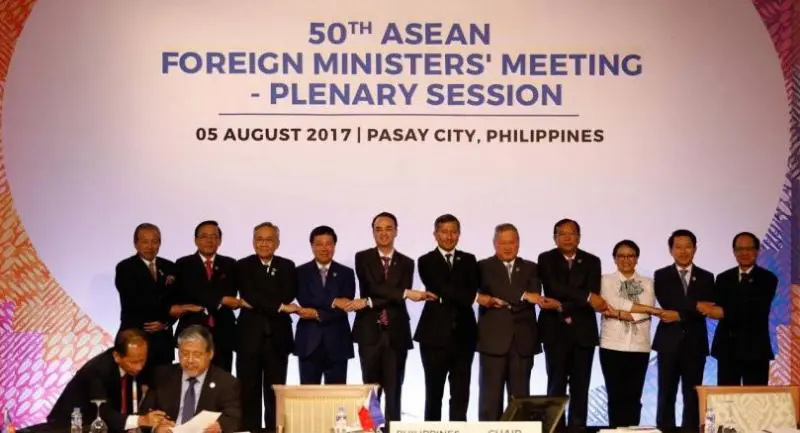


Philippines foreign minister says policy of engagement with beijing working well
The Philippines, as the current chair of Asean, wants to see the Code of Conduct (COC) for the contentious South China Sea to be more specific, substantial and legally binding.
Foreign ministers of the group and China will adopt a framework of the code during a meeting here today.
Four members of Asean – the Philippines, Vietnam, Malaysia and Brunei – have been at loggerheads with China for decades over the territorial disputes in the South China Sea.
The group together with China signed in 2002 a non-binding Declaration on the Conduct of Parties in the South China Sea (DOC) but the document failed to prevent conflicts as most of claimants, notably China, built facilities on islands and features in the sea, which facilitated militarisation.
While analysts doubted whether the new document would help to regulate behaviour of countries in the sea, Philippines Foreign Minister Alan Peter Cayetano said “when compared with domestic law, I look at the DOC as the constitution and the COC is a law implementing the constitution”.
A draft of the framework leaked to media indicated a reference to “promote mutual trust, cooperation and confidence, prevent incidents, manage incidents should they occur and create a favourable environment for the peaceful resolution of disputes”.
They also decided to maintain “respect for each other’s independence, sovereignty and territorial integrity in accordance with international law, and the principle of non-interference in the internal affairs of other states”.
The draft framework also highlights the need for “full and effective implementation of the DOC”.
It is expected that Asean and China would take time to use the framework as a guideline to draft the text of the so-called code of conduct.
“Looking back at the past [nearly] 20 years after the DOC, it went from bad to worse, and now from worse it’s getting better. As the framework has been agreed upon, we hope there would be less debate on the substantive part of the COC. If we get to pass it, it would benefit the whole of Asean,” Cayetano told a group of editors and senior journalists from Asean countries during a conversation on the sidelines of the Asean ministerial meeting.
The Philippines has softened its stand on its disputes with China since President Rodrigo Duterte took office last year although the country won a favourable ruling from the Permanent Court of Arbitration shortly before his presidency.
The Duterte administration took a different stance but maintained the same goal – to have peace and stability at the sea, said Cayetano.
The Philippines would keep the arbitration award and in the meantime the two countries would have a bilateral deal, he said. With that approach, a tentative fishery agreement has been put up, “so Filipino fishermen are allowed to fish in the area which we believe is our traditional fishing area”, he said.
In an area where they have to protect the environment, both the Chinese and the Philippine coastguards are jointly overseeing the area, making sure there is no overfishing or illegal activities, he added.
“Our coastguards have been talking so there would be less navy ships and more coastguard ships in the area. China has given a verbal assurance that they will not build any more facilities in Scarborough shoal. So we believe the current strategy – without judging the past strategy – is now working,” he said.
Asked if the framework of COC addressed the ongoing militarisation in the contentious sea, Cayetano said it might not directly mention the problem but noted parties, not only China, are now militarising the area.
“When we look at the militarisation, the media focus is on militarisation of some features of China. But the militarisation of other features by other countries are mostly ignored and the security blanket all around China is not discussed,” he said. “I’m not pro-China, I’m pro-Asean and pro-Philippines, but we have to look at the big picture,” he added.
With Duterte’s independent foreign policy, Manila now believes that bilateral engagement would generate mutual benefit for both sides. By putting territorial disputes aside, there remain several areas of cooperation such as protection of maritime resources and environment, he said.
The Philippines and China recently agreed to have joint exploration of petroleum resources in the South China Sea.
