
‘Departure tax’ eyed to fund tourism development in Japan
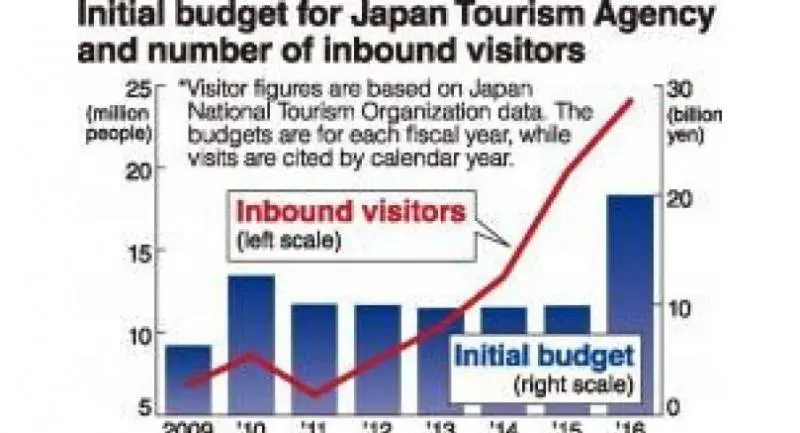


TOKYO - Whether to establish a 'departure tax' requiring payment from tourists and other individuals when they leave Japan is the focus of ongoing discussions by an expert panel of the Japan Tourism Agency on securing funds to develop tourism resources.
The talks will not be easy. New financial resources would help develop environments capable of handling the rapidly increasing number of foreign tourists, but new financial burdens could bring protests from tourists and the tourism industry.
At the start of the panel’s first meeting on Friday, Japan Tourism Agency Commissioner Akihiko Tamura emphasised the need to secure financial resources. “We need to implement high-level policy measures aimed at 2020 and 2030,” Tamura said. “We need to discuss how to raise financial resources.”
The agendas of the panel’s discussions are expected to include:
■ Should taxation be used to secure financial resources, or other methods, such as fee-based measures?
■ How should the raised funds be spent?
■ What is the appropriate amount, one likely not to affect the number of inbound tourists?
The agency believes it would be difficult to collect funds only from foreign nationals, so Japanese people are expected to be included in the new system. One possible method that has been suggested is taxing the use of hotels or other accommodations. However, most hotel guests are Japanese, so this could give rise to a sense of unfairness.
As a result, another strong candidate has become a system in which both Japanese and foreign nationals are charged when they depart Japan for other countries.
This is different from a so-called exit tax in which wealthy individuals who hold more than ¥100 million in stocks and other financial assets are taxed on the latent profits as income tax when they immigrate overseas.
The panel will hear from people in such fields as tourism and the airline industry while studying similar cases in other countries. The agency hopes to come up with its basic position in early November.
If the agency wants to establish a departure tax, it will coordinate with other government offices so that the new tax will be included in the next tax reform outlines to be compiled by year-end.
Wireless LAN, signs lacking
The number of inbound visitors to Japan tripled to 24.04 million in 2016 from 7.33 million in 2006.
The Japan Tourism Agency is exploring new financial resources because the country is lagging behind in developing environments to receive rapidly increasing inbound visitors.
For example, many tourist spots are not furnished with free wireless LAN, and there are not enough information signs in various foreign languages. The agency wants to secure financial resources to introduce such items to receive inbound visitors.
The raised funds are also to be used in promotional projects overseas, as part of efforts to realise the government’s goal to increase the number of inbound visitors to 40 million in 2020 and 60 million in 2030.
“Several tens of billions of yen will be needed” to pay for such matters, a senior agency official said. Therefore, a levy of ¥1,000 to ¥2,000 per person is expected.
Currently the number of Japanese leaving Japan and inbound foreigners totals 40 million per year. If ¥1,000 is collected from each individual as they depart, that translates to ¥40 billion — about double the agency’s fiscal 2016 initial budget.
However, some parties concerned have expressed caution and the panel’s discussions may see rough going. “Travelers would see it as higher travel fares, which could put a brake on people’s eagerness to visit Japan,” an airline industry official said. “That would be a serious issue for low-cost carriers.”
“It would be the tail wagging the dog if taxing visitors leads to a decrease in foreign tourists,” the agency official said.
