
Ukraine crisis is an internal war of Europe not the largest after World War II
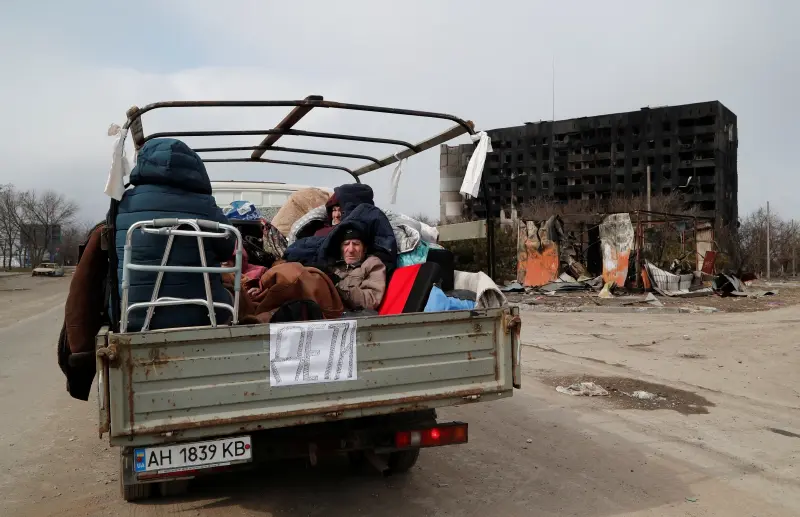


The West led by the United States has described the Ukraine crisis as the largest war in Europe after World War II. Even though the causes of the conflict are complicated, they are the inevitable product of the Western-dominated international order as well as the US’ anti-Russia manoeuvres.
BEIJING - To begin with, from the perspective of the geographic regions, this is an internal war of Europe.
No matter how one interprets European civilization, one thing is indisputable: Europe is a region within which wars broke out very frequently in the course of human history. Even after paying an immense price, the continent is yet to resolve the issue of war and peace and remain the powder keg of the world.
From the view of civilization, it is an internal war of the white Christian world, instead of a war between different civilizations and races. From this point, the paradigm of “clash of civilizations” that was raised by American political scientist Samuel Huntington is wrong.
What truly threatens world peace is not the conflict between and among different civilizations, but an internal war of the white Christian world. The history of Christianity shows that it lacks tolerance, which is demonstrated not only through its atrocities against so-called heretics but also through the infighting between and among the different sects within a religion.
The most serious religious war in Europe was between Protestantism and Catholicism. Lying behind today's Russo-Ukrainian conflict is Orthodoxy and Catholicism.
Third, no matter how Western civilization evolves, the contemporary world is still a jungle society that lacks justice. Even in the case of a powerful country like Russia, it has been repeatedly humiliated and suppressed by the West during its decline. In its nature, the action launched by Russia counts as the reckoning of all the acts of the West after the Cold War. It has just chosen a target formerly under its wing but is now endorsed by the West.
The West attacks Russia by claiming that it had violated the UN Charter. Nonetheless, not long ago the West just did everything that Russia has done: they rushed to recognize the independence of breakaway republics which led to the dismemberment of Yugoslavia; NATO’s launch of the Kosovo War and the United States' initiating wars in Afghanistan and Iraq all serve as precedents.
It is just that the West has the means to speak louder. For example, in 2019, Ukraine introduced a law “on ensuring the functioning of Ukrainian as the state language”, which stipulates that all local self-governing bodies must use Ukrainian rather than Russian. If this kind of thing had happened in China, the label of "cultural extinction" would have been posted long ago. But the West has said nothing to Ukraine.
Fourth, under the current international system, a country’s security serves as its highest national interest and strategy, but the pursuit of security by Western countries often is a zero-sum game.
The eastward expansion of NATO maximizes its own interest, which results in Russia, for the sake of its own security, choosing to send troops to Ukraine.
This also indicates that, if there is no major reform to existent mechanisms of the international order, it is hard for each member to gain a long-lasting sense of security.
Looking back at history, a world dominated by the West can neither eliminate wars nor bring long-lasting peace. Instead, the East Asian order led by China can achieve sustainable peace.
The Chinese civilization lays stress on stability and harmony with diversity, which requires peace and order.
No doubt the lessons of Ukraine are thought-provoking.
First, it did not focus on the economy and people’s livelihood. When the Soviet Union collapsed, Ukraine, then the second-largest state in Europe, was filled with hopes for the future. What none could have imagined, however, was that after its democratization, Ukraine's economy had a disastrous performance, with its people’s living standards plummeting. A region that was once very prosperous has a per capita GDP of just over three thousand US dollars, belonging to the Third World.
Second, the Ukrainian political elite has not been able to clearly comprehend the West’s stand, and thought that it can really join the European Union or NATO, failing to understand that Ukraine will hardly ever be able to meet the conditions — it is required to complete draconian reforms pertaining to elections, justice and its Constitution, to adapt to more than 200 EU directives and nearly 150 rules.
In 2013, the Ukrainian parliament overruled some bills that were aimed at helping meet the EU’s demands, due to their high economic costs.
This triggered massive protests and the then government of former president Viktor Yanukovych was toppled, directly leading to the Crimea incident.
An outsider can see that the West, led by the US, only uses Ukraine as a tool to deal with Russia, and it is in the interest of the West to let Russia consume its energy on Ukraine, destroy its own image, and even have chaos in the neighbouring state.
Third, there is the bitter price of "democratization". Ukraine's political system was established overnight by transplanting the so-called democratic system of the West. Historically speaking, whether gradual or radical, the transition to democratization has had to go through upheavals and pay a heavy price.
Ukraine is no exception. Due to historical factors, Ukraine has pro-Russian and pro-Western factions. When Yanukovych decided to turn to Russia, the pro-Western faction immediately protested, and some western regions simply declared independence. And when pro-Western forces forcibly seized power, the pro-Russian regions, too, declared independence.
Clearly, in establishing a Western democratic system in a place where there is no consensus on the future of the country, such an ending was bound to happen. To put it another way, democracy simply cannot resolve the major divisions within the country.
From the point of view of geopolitics, Ukraine is sandwiched between Russia and the West. Each side fully penetrates through Ukraine’s system, supporting its own political forces that align with their wish. This is why after democratization Ukraine began to see continuous "colour revolutions".
Ukraine’s internal contradictions today appear indissoluble, and its external gaming is also a zero-sum game. Sadly, Western democracy has magnified these two factors to the maximum.
Song Luzheng
Contributor, China Daily
The author is a Chinese political scientist based in France and a researcher at the China Institute, Fudan University in Shanghai.
