
Lessons from Ukraine crisis . And what does it all mean for Asia?
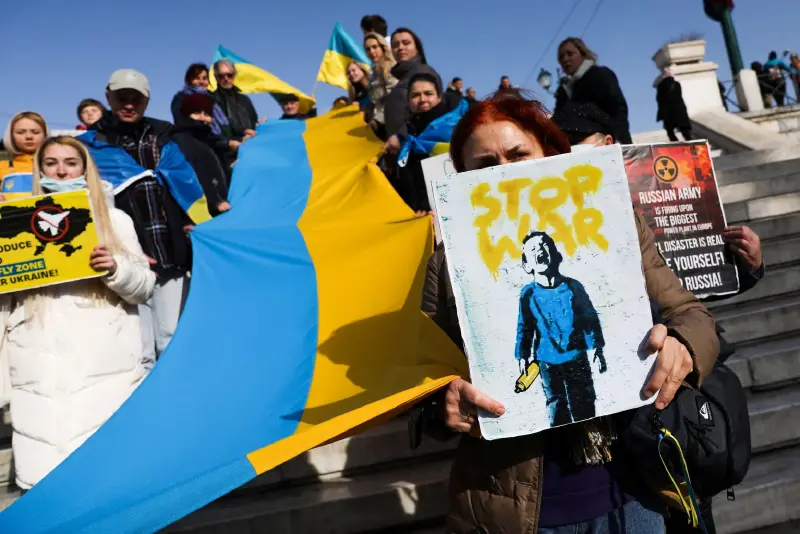


Beyond the alarm, indignation, and outrage over Russia's aggression against Ukraine comes the sobering thought: Has, not the international community failed to prevent the much-anticipated attack? Could something similar take place here?
At a purely superficial level, the events unfolding in Europe and the situation in Asia are not exactly similar.
Europe is witnessing the struggle of a declining power attempting to claw back some of its erstwhile influence and glory while being nagged by massive insecurities about encirclement.
In Asia, the issue is all about contending with a rising power that willy-nilly seems to brush against every door frame it seeks to enter and not always deliberately.
Europe has settled boundaries. Twenty-seven nations - including its biggest economies - are grouped as the European Union. Separately, 30 countries, including the United States, make up the North Atlantic Treaty Organisation that underwrites the security of most of these states.
Asia, in comparison, is wracked by territorial issues on land and water. It has modest structures in comparison and the most important of them all, ASEAN, is a toothless body, an intergovernmental organisation that often has difficulty agreeing on a joint statement.
Now, as the joint statement that followed last month's summit meeting in Beijing between Russian President Vladimir Putin and Chinese President Xi Jinping underscored, the world views of the declining and ascending powers are converging.
Both are joined by their insecurities of being encircled and demand their strategic spaces. And each is faced with adversaries they perceive as going all out to deny them what is their legitimate due.
To meet this common challenge, they have announced they are ready to cooperate in heretofore unimaginable areas.
Those who believe the entente is an empty one should take note that China has unequivocally backed Russian demands for an end to Nato's eastward expansion and that Mr. Putin, in turn, waited until the Beijing Olympic Winter Games ended before attacking Ukraine.
So what happens in Europe is not something that will leave Asia unaffected. Indeed, more and more, the security challenges may well converge.
What then are the options for key Asian states that are on the front line of aggression, real or imagined?
First, it is becoming clear with startling clarity that there is little alternative to being individually able to protect one's interests.
That means maintaining a credible armed force, possibly even seeking a deterrent. Germany's decision over the weekend to drop its long-held reluctance to militarise, and announce the raising of defence spending by at least a third, is a lesson that will not be lost on Asia. It will be particularly noted in Japan, which, after all, was the other side of the same coin during World War II.
Second, it is clear that even those with substantial militaries - India, Indonesia, Japan and South Korea included - will not be able to go it alone and will need strong alliances to buttress them.
Just as Ukraine's plight is forcing nations like Finland and Sweden to consider taking cover in Nato, it is a fair bet that fence sitters in Asia will now be forced to reconsider their positions.
Indeed, this has already happened on the periphery; Australia's initiative in stitching together Aukus - the alliance that groups it with the US and Britain - is a clear example of that.
At the same time, the West's proclivity to swing back to Europe and its suspicions of Russia almost by default must surely give pause to Asian strategists and military planners who bank on that support to stiffen their own backs.
Many Europeans, who were alarmed by what seemed like a US turn to Asia at Europe's cost, are gratified that Mr Putin has pulled the US back into Europe.
Whether the distraction is temporary, or more lasting, will only be known in the months to come.
For now, Washington has tried to stay on message about its commitment to the Indo-Pacific by inviting Asean leaders to a summit in Washington to be held on March 28-29.
There is an even bigger lesson for sia from the Ukraine crisis that has not been talked about enough.
It is that while defending their sovereign right to make their individual choices, it is critically important for all countries to stretch diplomatic levers to the utmost to assuage the insecurities and nervousness of key neighbours, especially if they are significantly bigger than you.
Sri Lanka, once mentioned as a possible rival to Singapore thanks to its strategic location along key sea lanes and the quality of its talent, continues to pay an enormous price for not paying enough attention to Indian strategic concerns when it opened its economy in the early 1980s, took a decidedly pro-West line and even permitted a Voice of America transmitter to be installed on its northern tip that could beam into India.
Under the late Indira Gandhi, India was significantly closer to the Soviet Union at the time and suspicious of the West, particularly the US. With an unsettled border with China to the east and a forever-tense boundary with Pakistan to the west, New Delhi was loath to open a third front on its southern flank.
This led to its fuelling of a Tamil-led insurgency in Sri Lanka that lasted a quarter century and cost all sides greatly.
Then Sri Lankan President J.R. Jayewardene was fully within his rights to do what he wished with his economy. It is an open question if the fate of the two nations and even Mrs Gandhi's family - her son and successor Rajiv would subsequently be assassinated by the Tamil Tigers - would have been different had he cared to take Mrs Gandhi into confidence, and assure her that he had no ill intentions.
Mr Putin's actions in Ukraine therefore mirror what Mrs Gandhi did four decades ago, only that they are unimaginably more crude.
There is a final lesson from the Russia-Ukraine crisis and it is the importance of securing solid, written guarantees in negotiations.
Mr Putin is not entirely wrong in saying that the West went back on its promise to then Soviet leader Mikhail Gorbachev that Nato would not expand eastward towards Russia.
Declassified US national security doc ments suggest that then Secretary of State James Baker offered guarantees that Nato's eastward movement would not take place - "not an inch". Similar assurances were also possibly offered by then West German Foreign Minister Hans-Dietrich Genscher.
Still, it could be argued that even the most solemn signed commitments can run aground against a volatile leader who decides on his own course of action regardless of consequences.
After all, in the Budapest Memorandum of 1994, Russia agreed to respect the independence, sovereignty and the existing borders of Ukraine, and to refrain from the threat or use of force against the country.
This is why it is important for Asians - whether it is Asean negotiating a Code of Conduct for the South China Sea or India attempting to settle border disputes - to demand binding commitments.
Memories fade and mere promises are easily broken.
Ravi Velloor
Associate Editor, The Straits Times
