
Royally golden
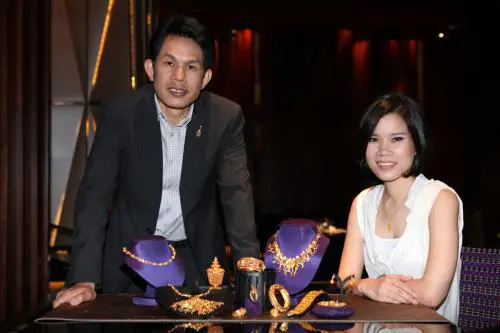


Two goldsmiths make the case for keeping an ancient Thai art alive
To ensure the exquisite craftsmanship of ancient gold jewellery, the career of royal goldsmith must be preserved, says Professor Niphon Yodkhampun, a royal goldsmith with the Bureau of the Royal Household and professor at the Faculty of Jewellery Design, Golden Jubilee Royal Goldsmith College.
Speaking during a group discussion on the topic “Legend of Crafting Gold Jewellery: Exquisite Craftsmanship of the National Heritage” held in conjunction with House of Goldsmiths Group at the Siam Kempinski Hotel, Niphon pointed out that goldsmiths were a dying breed. “There are about 20 royal goldsmiths in the country and some 150 graduates from the college, who are completing the seven-year course,” he says.
“Master craftsmen of ancient art styles cannot survive unless people recognise the value of the genre and the artistic creation. In the past, working with gold had much to do family lineage; today, it is more closely related to the economy and modern manufacture.”
In the ancient tradition, crafting gold jewellery was subject to exquisite craftsmanship and very much part of Thai tradition. Gold represented prosperity, wealth, art, and culture. Starting in the Sukhothai period and continuing through the Ayutthaya and Rattanakosin eras, gold jewellery was used to develop the relations between countries with five of the most distinguished goldsmith families being based in Sukhothai, Phetchaburi, Nakhon Sri Thammarat, Chiang Mai and Surin provinces.
“Gold jewellery in the past represented the status of the wearer. The Three Seals Law prohibited peasants from wearing gold because gold jewellery belonged to the King, who is the living god according to Brahman beliefs. Precious gold is believed to deliver mysterious powers. Those who were able to wear gold jewellery in the past were certainly not ordinary people,” Niphon adds.
Goldsmiths too were far from ordinary. Not only did fashioning jewellery from the most precious metal require a high level of concentration but also high moral standards – they could feel no attachment to their creations nor any greed. A royal goldsmith worked to serve the royal family. Royal gold jewellery was grand, refined and very delicate.
“Even today, while creating gold jewellery, the goldsmith has to be pure at heart. Love, attachment and care can be put into the artwork in order to create an incredible piece of art but the feeling at the outcome of jewellery is different. That’s why sometimes you can tell if the goldsmith is in a good mood or not,” says Niphon with a smile.
“Also, we might think it’s unnecessary to have a pattern inside or on the back of the jewellery but some goldsmiths insist on it. They do it to show their honesty and attention to detail.”
Sornsida Chanonprapa, a third generation member of the House of Goldsmiths Group, is carrying on the family’s tradition with her two-year-old Goldlery brand. Her experience in the trade has shown her there’s a lot of truth in the old saying that gold jewellery chooses its owner.
“Think about going to a gold boutique. Have you wondered why you unhesitatingly pick one piece over another? If we have a piece we cannot sell, we still say that it’s waiting for the right owner,” she says.
Part of the 70-year-old Baan Chang Thong goldsmith family, Sornsida is working on modernising the group’s management and marketing as well as developing product and design. She’s integrating new technology to create masterpieces and is responding to the demands of today’s market by designing elegant, fashionable, and wearable pieces for the modern working women.
Goldlery’s Ga-Ran-Dha collection uses Sukhothai’s sroi see sao (four-stones pillars) design to create a modern rectangular shape for earrings, ring and necklace.
The Panchan collection’s design is inspired by Phetchaburi’s provincial speciality, the nutmeg fruit.
“With a new approach to design, gold jewellery becomes friendlier,” says Sornsida. “Embellishing and making beautiful things is very Thai.”
And so the craftsmanship of the goldsmiths must be passed on down the line. “Precious gold is the symbol of wealth, and it will always be more valuable in the future,” says Niphon. “I believe all kind of master crafts, especially ancient ones, need conserving. The royal goldsmith is one of them.”
